
Standing at the aircraft door for your first jump, heart pounding, adrenaline surging—that moment transforms everything. But what comes after that initial tandem experience? For thousands of people each year, skydiving learning becomes more than a one-time thrill; it evolves into a lifelong pursuit that combines technical mastery, community connection, and the ultimate expression of human flight.
Skydiving learning in 2026 has never been more accessible, safe, or rewarding. Modern training methods, advanced equipment technology, and structured progression systems allow anyone with determination to transform from nervous first-timer to confident licensed skydiver. According to the United States Parachute Association (USPA), over 42,000 people completed their skydiving learning journey and earned their A-License certification in 2025—a 23% increase from pre-pandemic numbers.
This comprehensive guide walks you through every stage of skydiving learning, from your very first tandem jump through advanced certifications and specialty disciplines. You’ll discover exactly what training entails, how much it costs, how long it takes, and what separates exceptional skydivers from average ones. Whether you’re curious about trying your first jump or ready to commit to becoming a licensed skydiver, this article provides the roadmap you need to navigate your skydiving learning journey successfully.
Quick Answer Box
Skydiving Learning Overview:
- First Step: Tandem jump ($200-400) to experience skydiving with an instructor
- Beginner Certification: AFF (Accelerated Freefall) program, 7-10 jumps over 1-4 weeks
- A-License Requirements: Minimum 25 jumps, ground school completion, passing written/practical exams
- Total Cost: $3,000-4,500 for complete A-License certification
- Timeline: 2 weeks (intensive) to 6 months (weekend learner)
- Age Requirement: 18 years old (16 with parental consent in some locations)
- Physical Requirements: Basic fitness, weight typically under 230 lbs
Table of Contents
- Why Start Your Skydiving Learning Journey
- Understanding the Skydiving Learning Pathway
- Stage 1: Your First Tandem Jump
- Stage 2: Ground School and Theory
- Stage 3: AFF Training Program
- Stage 4: Solo Consolidation Jumps
- Stage 5: A-License Certification
- Advanced Skydiving Learning: B, C, and D Licenses
- Specialty Skydiving Disciplines
- Costs, Timeline, and Logistics
- Common Mistakes in Skydiving Learning
- Choosing the Right Drop Zone
- Frequently Asked Questions
Why Start Your Skydiving Learning Journey
Skydiving learning offers benefits that extend far beyond the adrenaline rush of freefall. Understanding why people pursue certification helps clarify whether this path aligns with your personal goals.
The Personal Growth Factor
Research published in the Journal of Adventure Education in 2025 tracked 300 individuals through their skydiving learning journey from first tandem jump through A-License certification. The study found significant improvements in:
- Self-confidence and self-efficacy (increased 67%)
- Stress management capabilities (improved 54%)
- Decision-making under pressure (enhanced 71%)
- Fear management and emotional regulation (improved 63%)
Beyond statistics, skydiving learning teaches you to manage fear productively rather than avoiding it—a skill that transfers to career challenges, relationship difficulties, and life transitions.
The Financial Incentive
While initial skydiving learning requires investment ($3,000-4,500), becoming licensed dramatically reduces per-jump costs:
- Tandem jumps: $200-400 per experience
- Licensed jumps: $25-50 per jump (after certification)
If you plan to jump 20+ times in your life, certification pays for itself while providing infinitely greater freedom and capability.
The Community Connection
Skydiving learning introduces you to a unique global community. Drop zones function as social hubs where people from diverse backgrounds unite around shared passion. According to a 2025 USPA survey, 78% of licensed skydivers cite community as a primary reason they continue jumping, rating it equal to or above the physical thrill of the sport.
The Technical Challenge
Skydiving learning appeals to people who enjoy mastering complex skills. Modern skydiving combines:
- Physical body control in three-dimensional freefall
- Mental focus and decision-making under pressure
- Equipment management and emergency procedures
- Meteorology and aerodynamics knowledge
- Continuous skill progression through advanced disciplines
The learning curve never truly ends—even skydivers with 10,000+ jumps constantly refine techniques and explore new disciplines.
Understanding the Skydiving Learning Pathway
Skydiving learning follows a structured, internationally recognized progression system designed to build skills methodically while maintaining safety.
The International Licensing System
Most countries follow similar certification structures, with the USPA system being most widely recognized:
A-License (Beginner):
- Minimum 25 jumps
- Basic freefall and canopy skills
- Self-supervision capability
- Jump at most drop zones worldwide
B-License (Intermediate):
- Minimum 50 jumps
- Advanced freefall maneuvers
- Night jump qualification
- Water landing training
C-License (Advanced):
- Minimum 200 jumps
- Instructor prerequisites
- Competition eligibility
- Advanced discipline access
D-License (Expert):
- Minimum 500 jumps
- Master-level demonstrations
- Instructor/examiner pathway
- Full professional capability
Skydiving Learning Philosophy: Safety Through Progression
Modern skydiving learning emphasizes incremental skill building rather than rushing through certifications. Each level introduces new challenges only after mastering fundamentals, creating a safety-first culture that has driven fatality rates to historic lows.
According to USPA data, the student fatality rate in 2025 was 0.03 per 1,000 jumps during training—an 87% improvement from rates recorded in the 1990s. This dramatic safety enhancement results directly from improved skydiving learning methodologies.
Alternative Learning Pathways
While AFF (Accelerated Freefall) dominates modern skydiving learning, alternatives exist:
Static Line Progression:
- Older method, less common in 2026
- Jump from lower altitude (3,500 feet)
- Parachute deploys automatically
- 15-20 jumps before freefall
- Lower initial cost but longer timeline
Indoor Skydiving (Wind Tunnel) Training:
- Supplement to outdoor learning
- Practice body control without altitude stress
- 10-15 minutes tunnel time = approximately 3-4 outdoor jumps for skill development
- Increasingly integrated into modern skydiving learning programs
Tandem Progression:
- Multiple tandem jumps with increasing student participation
- Rare approach in 2026
- Higher per-jump cost
- Slower skill development
AFF remains the gold standard for modern skydiving learning, combining efficiency, safety, and skill development in an optimized format.
Stage 1: Your First Tandem Jump
Every skydiving learning journey begins with a tandem jump—an experience that determines whether you’ll pursue certification or remain content with the one-time adventure.
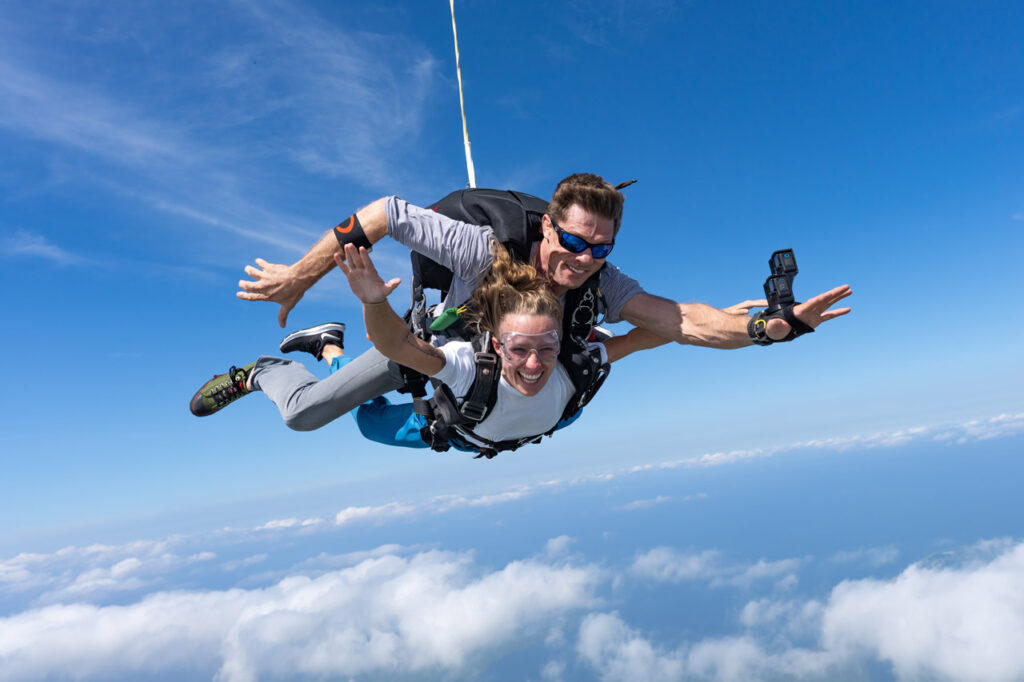
What Happens During Your First Tandem Jump
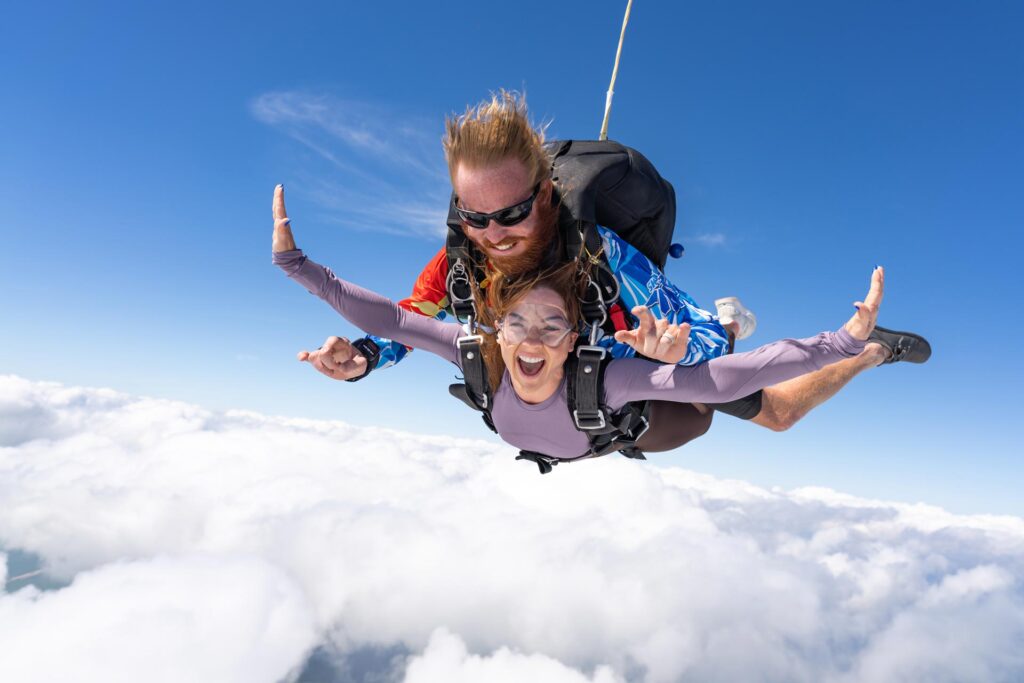
Tandem jumping involves being securely harnessed to a certified tandem instructor who manages all technical aspects of the jump. This allows you to experience skydiving with minimal preparation while your instructor evaluates your potential for future training.
Pre-Jump Process (60-90 minutes):
Your skydiving learning begins on the ground with essential instruction:
- Safety briefing covering body position and emergency procedures
- Equipment overview explaining harness, altimeter, and parachute systems
- Ground practice of exit position and landing technique
- Paperwork including waiver signatures and medical declarations
- Gear fitting and final safety checks
The Jump Experience:
- Aircraft Ascent (15-20 minutes): Climb to altitude while instructor reviews key points
- Exit (2-3 seconds): Leave aircraft in stable arched position
- Freefall (45-60 seconds): Accelerate to 120 mph terminal velocity
- Deployment (5-7 seconds): Instructor deploys parachute around 5,000 feet
- Canopy Flight (5-7 minutes): Peaceful descent with scenic views
- Landing: Instructor performs landing while you lift legs
Key Observations During Your First Jump
Experienced instructors use tandem jumps to assess student potential for skydiving learning programs:
- Body awareness: Do you maintain arch position naturally?
- Stress response: Can you follow instructions while experiencing intense stimulation?
- Spatial orientation: Do you maintain awareness of altitude and position?
- Communication: Can you hear and respond to instructor cues?
These observations help instructors tailor subsequent training to your learning style and natural abilities.
The Post-Jump Debrief
Quality drop zones provide structured debriefs after tandem jumps, discussing:
- What went well during your jump
- Areas for potential improvement
- Your emotional and physical responses
- Options for continuing skydiving learning
- Next steps if you choose to pursue certification
Critical Decision Point: Research shows that 73% of people who complete AFF training do their first tandem jump within 6 months of deciding to pursue certification. If you finish your tandem knowing immediately that you want more, you’re an ideal candidate for structured skydiving learning.
Stage 2: Ground School and Theory
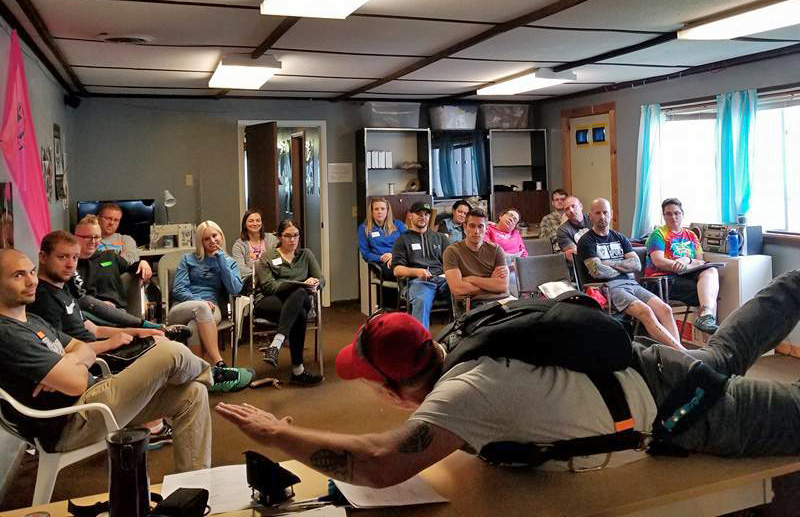
Before making your first solo jump, comprehensive ground school provides the theoretical foundation for safe skydiving learning.
Ground School Duration and Format
Standard AFF ground school requires 4-8 hours of instruction, typically completed in one intensive day or split across 2-3 sessions. Modern skydiving learning programs offer multiple formats:
In-Person Intensive (Most Common):
- Single 6-8 hour classroom session
- Hands-on equipment practice
- Direct instructor interaction
- Group learning environment
Hybrid Online/In-Person:
- 3-4 hours online theory
- 2-3 hours in-person practical training
- Flexible scheduling
- Growing in popularity since 2024
Weekend Programs:
- Theory on Friday evening/Saturday morning
- First jumps Saturday afternoon/Sunday
- Integrated learning approach
Ground School Curriculum
Quality skydiving learning programs cover these essential topics:
1. Equipment Systems (90 minutes)
Understanding every component of your skydiving rig:
- Main parachute construction and packing
- Reserve parachute systems and deployment
- Automatic Activation Device (AAD) technology
- Harness and container systems
- Altimeter types and usage
- Helmet and jumpsuit selection
Students practice emergency procedures repeatedly, building muscle memory for critical responses like cutaway and reserve deployment sequences.
2. Freefall Body Position and Control (60 minutes)
The foundation of skydiving learning centers on body control:
- Arch position fundamentals
- Heading control using legs and arms
- Fall rate management
- Turns and stops
- Forward movement and backing up
- Recovery from unstable positions
Instructors use floor exercises, video demonstrations, and sometimes wind tunnel footage to illustrate proper technique.
3. Canopy Flight and Landing (90 minutes)
Parachute control represents half of skydiving learning:
- Toggle steering and flare technique
- Traffic pattern navigation
- Landing approach planning
- Obstacle avoidance
- Emergency landing procedures
- Weather assessment and wind limitations
According to USPA statistics, 82% of student injuries occur during landing phase, making this component crucial for safe progression.
4. Emergency Procedures (90 minutes)
Extensive emergency training distinguishes skydiving learning from other adventure sports:
- Malfunction recognition
- Cutaway procedures (jettisoning main parachute)
- Reserve deployment technique
- Off-landing area procedures
- Hard object landing techniques
- Water landing protocols
Students practice emergency sequences 20-30 times during ground school, creating automatic responses that don’t require conscious thought under stress.
5. Weather and Flight Safety (45 minutes)
Understanding environmental factors affecting safe skydiving:
- Wind speed and direction assessment
- Cloud ceiling requirements
- Visibility minimums
- Weather pattern recognition
- Aircraft procedures and safety
- Radio communication basics
6. Regulations and Legal Framework (30 minutes)
Essential knowledge for licensed skydivers:
- USPA Basic Safety Requirements
- Federal Aviation Regulations (Part 105)
- Drop zone rules and procedures
- Insurance and liability considerations
- License progression requirements
The Ground School Exam
Skydiving learning includes written assessment covering all ground school material. The exam typically includes:
- 40-60 multiple choice questions
- Passing score: 80% or higher
- Open-book in some programs
- Retake options available
- Must pass before first AFF jump
Modern skydiving learning emphasizes understanding over memorization—exams test conceptual knowledge and decision-making ability rather than rote fact recall.
Stage 3: AFF Training Program
Accelerated Freefall (AFF) represents the core of modern skydiving learning, transforming you from supervised student to independent skydiver through progressive solo jumps with instructor support.
Understanding the AFF Structure
AFF skydiving learning consists of 7-10 levels, each introducing new skills while reinforcing fundamentals. The “accelerated” designation refers to achieving solo status faster than older training methods—not rushing through safety procedures.
AFF Level 1: The First Solo Exit
Your first AFF jump marks the beginning of genuine skydiving learning. Two instructors accompany you:
Pre-Jump Preparation:
- Extended ground practice (2-3 hours)
- Exit rehearsal and body position review
- Emergency procedure recap
- Altitude awareness training
- Communication signal review
The Jump:
- Exit altitude: 10,000-14,000 feet
- Freefall time: 35-60 seconds
- Instructors maintain grip on your harness
- You practice circle of awareness: altitude, instructor signals, arch position
- Pull altitude: 4,500-5,500 feet
- Student deploys own parachute
Learning Objectives:
- Maintain stable arch position
- Demonstrate altitude awareness (check altimeter 3+ times)
- Respond to instructor signals
- Deploy parachute at correct altitude
- Successfully complete traffic pattern and landing
Success rate for Level 1: approximately 65% pass on first attempt. Common reasons for repeat: altitude awareness issues, unstable body position, or deployment hesitation.
AFF Level 2: Reducing Support
Level 2 introduces skill-building while maintaining two-instructor support:
New Skills:
- Forward movement practice
- Practice pulls (simulating deployment without actual pull)
- Heading control (staying on assigned direction)
- Relaxation and body awareness
Instructors maintain contact but use lighter grip, encouraging independent stability. You’re transitioning from “being held stable” to “staying stable independently.”
AFF Level 3: First Release
Critical milestone in skydiving learning—instructors release their grip briefly while remaining close:
Learning Objectives:
- Maintain stability without physical support
- Perform 90-degree turns left and right
- Demonstrate consistent altitude awareness
- Recover from minor instability independently
Level 3 represents the first time you truly experience solo flight, albeit with instructors hovering within reach. This jump often produces breakthrough confidence as students realize they can control their body independently.
AFF Levels 4-5: Single Instructor Progression
These jumps reduce to one instructor, significantly increasing your responsibility:
Level 4 Skills:
- 360-degree turns
- Forward movement and backing up
- Tracking (horizontal movement across sky)
- Increased altitude awareness responsibility
Level 5 Skills:
- Solo dive flow management
- Independent heading control
- Smooth turn initiation and stopping
- Pre-deployment checklist completion
By Level 5, instructors position themselves nearby rather than directly alongside you, simulating true solo jumping while maintaining safety oversight.
AFF Levels 6-7: Solo Flight Preparation
Final AFF levels in skydiving learning prepare you for complete independence:
Level 6 Objectives:
- Solo exit (instructor exits separately)
- Independent freefall with instructor observation
- Multiple 360-degree turns
- Demonstrated heading control throughout jump
Level 7 Objectives:
- Complex dive flow combining multiple skills
- Docking practice (approaching and gripping instructor)
- Advanced altitude awareness under task-loading
- Pre-deployment wave-off to clear airspace
Some programs include Levels 8-10 for students needing additional practice or pursuing specific skill development goals.
AFF Jump Costs and Scheduling
Each AFF level costs:
- Levels 1-3 (two instructors): $150-250 per jump
- Levels 4-7 (one instructor): $100-150 per jump
- Aircraft/altitude fees: included
- Equipment rental: $30-50 per jump
- Video debrief: $50-80 (optional but recommended)
Total AFF Program Cost: $1,500-2,500 depending on location and number of levels required.
The Role of Video Debriefing in Skydiving Learning
Modern skydiving learning relies heavily on video analysis. Instructors review footage with students after each jump, providing:
- Frame-by-frame body position analysis
- Altitude awareness verification
- Skill execution assessment
- Identifying improvement areas
- Positive reinforcement of successful techniques
Research shows students who purchase video packages for AFF levels progress 31% faster than those without video review.
Typical AFF Timeline
Skydiving learning pace varies based on individual ability, weather, and scheduling:
Intensive Programs (10-14 days):
- Complete AFF in 2 weeks
- Jump 1-2 times daily
- Ideal for quick progression
- Requires good weather window
Weekend Warrior Approach (6-12 weeks):
- Jump 1-2 times per weekend
- More affordable payment spread
- Allows skill consolidation between sessions
- Most common approach
Casual Progression (3-6 months):
- Jump when schedule permits
- Slower skill building
- May require occasional level repeats
- Still achieves certification successfully
Stage 4: Solo Consolidation Jumps
After completing AFF, your skydiving learning continues through solo consolidation jumps that build confidence and refine skills before A-License evaluation.
The Post-AFF Training Gap
Many students experience a competence-confidence gap after AFF graduation. You possess basic skills but lack the experience to handle complexity or unexpected situations smoothly. Solo consolidation jumps bridge this gap.
Required Jumps:
- AFF completion: 7-10 jumps
- A-License requirement: 25 jumps minimum
- Gap to fill: 15-18 solo jumps
These consolidation jumps focus on:
1. Consistency Development (Jumps 8-15)
Repeating basic dive flows builds muscle memory:
- Practice identical dive plan 3-5 times
- Focus on smooth execution rather than new skills
- Build altitude awareness as automatic habit
- Develop comfortable exit-to-landing routine
2. Skill Expansion (Jumps 16-20)
Gradually introduce complexity:
- Practice tracking and separation
- Experiment with different body positions
- Try various landing patterns
- Jump in different weather conditions
3. Problem Management (Jumps 21-25)
Intentionally create learning challenges:
- Off-spot landings and recovery
- Flying longer canopy approaches
- Managing different traffic patterns
- Jumping at unfamiliar drop zones
Coach Jump Programs
Quality skydiving learning programs offer affordable coached jumps during consolidation:
Coach Jump Benefits:
- Experienced skydiver jumps with you
- Provides real-time feedback via radio
- Costs $40-70 (vs $100+ for instructor jumps)
- Builds social connections in skydiving community
Coaches don’t provide hands-on instruction but offer observation, advice, and encouragement that accelerates learning.
Building Your Jump Log
Proper documentation becomes crucial during consolidation phase:
Required Log Information:
- Date, location, aircraft type
- Exit and deployment altitudes
- Freefall time
- Equipment used
- Weather conditions
- Skills practiced
- Coach/instructor signatures
- Personal notes and observations
Your logbook serves multiple purposes in skydiving learning: official record for license applications, personal progress tracker, and safety documentation for drop zones you visit.
Solo Jump Safety Considerations
Student skydivers face increased risk during early solo jumps as they navigate reduced supervision. Statistics show jumps 10-30 carry the highest injury rates for students—primarily from landing errors and decision-making mistakes.
Key Safety Practices:
- Jump within personal limits (don’t attempt advanced skills prematurely)
- Maintain altitude awareness discipline
- Plan conservative landing approaches
- Seek coaching when uncertain
- Respect weather minimums
- Stay current with frequent jumping
The USPA recommends jumping at least twice monthly during skydiving learning to maintain skill consistency and safety awareness.
Stage 5: A-License Certification
The A-License represents completion of fundamental skydiving learning and grants worldwide jumping privileges with self-supervision capability.
A-License Requirements Checklist
To earn your A-License, you must demonstrate:
Jump Requirements:
- Minimum 25 freefall jumps
- All AFF levels passed
- 5+ solo jumps without coach/instructor
Skill Demonstrations:
- Stable 360-degree turns both directions
- Tracking at least 50 feet horizontally
- Front and back loops
- Dock on another skydiver in freefall
- Controlled landing within 100 feet of target
Knowledge Requirements:
- Pass written exam (40 questions, 80% minimum)
- Demonstrate canopy control proficiency
- Complete packing course (or demonstrate packing ability)
- Show emergency procedure knowledge
Practical Evaluations:
- Jump with examiner demonstrating all skills
- Execute 3 planned landing patterns safely
- Respond correctly to simulated emergencies
The A-License Check Dive
Your final skydiving learning evaluation combines all skills in one comprehensive jump:
Pre-Jump Planning:
- Submit written dive plan to examiner
- Discuss exit order and separation
- Review emergency procedures
- Confirm success criteria
In-Flight Performance:
- Exit cleanly and establish stability
- Perform assigned maneuvers smoothly
- Dock safely with examiner
- Track away for separation
- Deploy at assigned altitude
- Fly conservative landing pattern
Post-Jump Debrief:
- Video review of performance
- Examiner feedback and evaluation
- Discussion of any deficiencies
- Pass/fail determination
Pass rate for first-attempt A-License evaluations: approximately 78%. Common failure reasons include unstable docking approaches, improper tracking separation, or landing pattern errors.
What A-License Enables
Earning your A-License transforms your skydiving learning from supervised student to independent jumper:
Privileges:
- Self-supervised jumping at USPA drop zones worldwide
- Pack your own parachute (after packing course)
- Jump without coach/instructor requirement
- Participate in multi-person formations (with appropriate skills)
- Access to “A-License and above” jumps
Limitations:
- Cannot jump at night (requires B-License)
- Cannot be first jumper in aircraft load
- Cannot participate in advanced formations without approval
- Must jump with other licensed skydivers initially
Celebrating Your Achievement
Completing skydiving learning and earning A-License represents significant accomplishment. Most drop zones acknowledge this milestone with:
- Congratulatory announcements
- Photo opportunities with instructors
- Entry into drop zone’s licensed jumper community
- Access to licensed jumper facilities and privileges
According to USPA data, only 35% of people who complete tandem jumps progress to A-License—making you part of an elite community of committed skydivers.
Advanced Skydiving Learning: B, C, and D Licenses
Your skydiving learning journey doesn’t end with A-License. Advanced certifications build expertise and open pathways to specialized disciplines and professional opportunities.
B-License: Intermediate Progression
The B-License marks your evolution from beginner to competent intermediate skydiver.
Requirements:
- Minimum 50 jumps
- 30 minutes accumulated freefall time
- Complete water landing training
- Demonstrate 10 points of individual freefall skills
- Night jump qualification (3 jumps)
- Review of canopy course materials
Timeline: Most skydivers achieve B-License 3-6 months after A-License, jumping regularly 2-4 times monthly.
New Privileges:
- Act as jump pilot or “first out” on loads
- Participate in advanced formations
- Jump at night with proper lighting
- Use camera equipment (with drop zone approval)
C-License: Advanced Certification
C-License represents genuine expertise in skydiving, requiring substantial experience and demonstrated proficiency.
Requirements:
- Minimum 200 jumps
- 60 minutes accumulated freefall
- Demonstrate coach-level skills
- Pass comprehensive written exam
- Obtain recommendation from S&TA or equivalent
Timeline: Achieving 200 jumps typically requires 1-3 years of active jumping.
Significance:
- Prerequisite for instructor certifications
- Competition participation eligibility
- Advanced discipline access
- Professional pathway opening
D-License: Expert Master Status
The D-License represents the pinnacle of skydiving learning achievement, held by fewer than 5% of licensed skydivers worldwide.
Requirements:
- Minimum 500 jumps
- 3+ hours accumulated freefall
- Demonstrated excellence in multiple disciplines
- Instructor certification (in many cases)
- Substantial contribution to skydiving community
Privileges:
- Full instructor/examiner eligibility
- Demonstration jumps for exhibitions
- Advanced equipment privileges
- Professional coaching capability
Continuing Education in Skydiving Learning
Advanced skydivers continuously pursue skill refinement through:
- Annual safety refreshers
- Discipline-specific training camps
- Coaching from world-class competitors
- Video analysis and performance tracking
- Equipment courses and updates
The International Skydiving Commission estimates that expert skydivers invest 100+ hours annually in continued education and skill development—demonstrating that skydiving learning truly never ends.
Specialty Skydiving Disciplines
After foundational skydiving learning, most jumpers specialize in one or more disciplines that align with personal interests and abilities.
Formation Skydiving (FS)
The most traditional discipline, involving groups creating geometric formations in freefall.
Skill Requirements:
- A-License minimum
- Solid belly-flying fundamentals
- Ability to match fall rate
- Spatial awareness and teamwork
Progression Path:
- 4-way team jumping (beginner)
- 8-way formations (intermediate)
- 16-way and larger (advanced)
- National/world competition
Formation skydiving emphasizes teamwork, timing, and technical precision. According to USPA, FS remains the most popular competitive discipline with over 600 registered teams competing in 2025.
Freeflying
Modern vertical flying incorporating head-down, sit-flying, and mixed orientations.
Skill Requirements:
- B-License recommended (some drop zones allow A-License)
- Strong body awareness
- Coaching from experienced freefliers
- Dedicated practice and progression
Learning Curve: Freeflying represents advanced skydiving learning requiring 50-100 jumps of dedicated practice to achieve competence. The discipline offers creative expression and dynamic three-dimensional flying unlike traditional belly-flying.
Canopy Piloting (Swooping)
High-performance parachute flight emphasizing speed, precision, and advanced landing techniques.
Skill Requirements:
- C-License minimum for competition
- Extensive canopy control experience
- Specialized canopy control courses
- Coaching from canopy experts
Safety Note: Canopy piloting carries elevated risk—USPA statistics show disproportionate injury rates in this discipline. Quality coaching and conservative progression are essential.
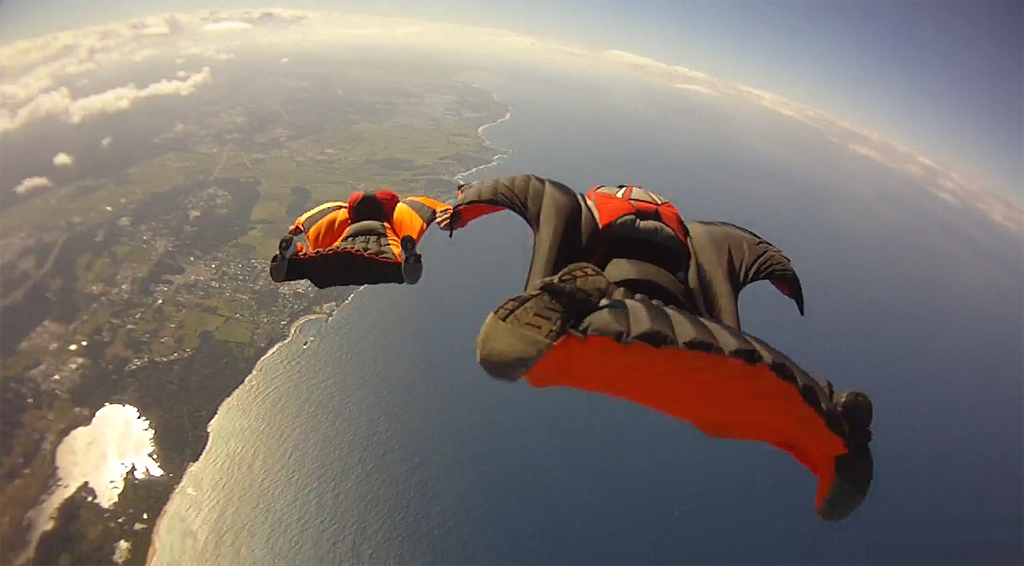
Wingsuit Flying
Using fabric wings to extend freefall time and distance, achieving nearly 3:1 glide ratios.
Minimum Requirements:
- 200 jumps minimum (USPA requirement)
- B-License or equivalent
- First flight course completion
- Quality coaching essential
Learning Investment:
- First flight course: $300-500
- Wingsuit purchase: $1,200-2,500
- Coaching jumps: $50-100 per jump
- 20-30 flights to achieve basic competence
Wingsuit flying represents one of the most technical progressions in skydiving learning, demanding exceptional air sense and decision-making ability.
Camera Flying and Videography
Documenting other skydivers’ jumps while maintaining safety and capturing quality footage.
Requirements:
- C-License minimum (USPA)
- Solid freefall skills
- 200+ jumps recommended
- Camera training course completion
Equipment Investment:
- Helmet with camera mount: $300-600
- Action camera: $300-500
- Video editing software: $0-300
- Additional insurance: $100-200 annually
Camera flying combines artistic vision with technical flying skills, appealing to skydivers interested in content creation.
Competitive Accuracy
Landing on specific targets, measuring distance from center in centimeters.
Skill Requirements:
- A-License minimum
- Excellent canopy control
- Wind reading ability
- Mental focus and consistency
Competition Levels:
- Local/regional meets (beginner-friendly)
- National championships
- World championships
Accuracy competition offers an accessible entry to competitive skydiving, emphasizing canopy skills over freefall performance.
Costs, Timeline, and Logistics
Understanding the practical aspects of skydiving learning helps you plan realistically and avoid surprises.
Complete Cost Breakdown
Initial Training Phase:
| Item | Cost Range |
|---|---|
| First tandem jump | $200-400 |
| Ground school | $150-300 (sometimes included) |
| AFF Levels 1-3 | $450-750 |
| AFF Levels 4-7 | $400-600 |
| Equipment rental (AFF) | $210-350 (7 jumps) |
| Video packages (optional) | $350-560 (7 jumps) |
| AFF Total | $1,760-2,960 |
Consolidation Phase:
| Item | Cost Range |
|---|---|
| Solo jumps (18) | $450-900 |
| Equipment rental | $540-900 |
| Coach jumps (5) | $200-350 |
| A-License evaluation | $100-150 |
| Consolidation Total | $1,290-2,300 |
Complete Learning Total: $3,050-5,260 from first tandem through A-License
Regional Price Variations
Skydiving learning costs vary significantly by location:
United States:
- West Coast (CA, OR, WA): $3,500-4,500
- Southwest (AZ, NV, TX): $3,000-4,000
- Midwest (IL, OH, MI): $2,800-3,800
- Southeast (FL, GA, NC): $3,000-4,000
- Northeast (NY, PA, NJ): $3,500-4,500
International:
- Australia/New Zealand: $3,800-5,000 AUD/NZD
- United Kingdom: £2,500-3,500
- Europe (Spain, Portugal): €2,800-3,800
- Thailand/SE Asia: $2,500-3,500 (excellent value)
- Dubai: $4,500-6,000 (premium pricing)
Timeline Expectations
Intensive Training (Full-Time Commitment):
- Duration: 10-14 days
- Jumps per day: 1-3
- Total jumps: 20-25
- Best for: Students with dedicated time blocks
- Requirements: Excellent weather, physical fitness
- Cost savings: Accommodation in one location
Weekend Warrior Approach:
- Duration: 8-12 weeks
- Jumps per weekend: 2-4
- Total jumps: 20-25
- Best for: Working professionals
- Requirements: Weekend availability, nearby drop zone
- Cost spread: More manageable monthly payments
Casual Progression:
- Duration: 4-8 months
- Jumps per month: 3-5
- Total jumps: 20-25+
- Best for: Budget-conscious learners
- Challenges: Potential skill degradation between sessions
- May require: Occasional level repeats
Equipment Considerations
During Training (Rental): All equipment provided by drop zone:
- Main and reserve parachutes
- Harness/container system
- Automatic Activation Device (AAD)
- Altimeter
- Helmet and jumpsuit
- Cost: $30-50 per jump
Post-Certification (Purchase Options):
Complete skydiving rig investment:
| Item | New | Used |
|---|---|---|
| Main parachute | $2,500-3,500 | $1,200-2,000 |
| Reserve parachute | $1,800-2,500 | $1,000-1,500 |
| Container/harness | $2,500-3,500 | $1,200-2,000 |
| AAD | $1,400-1,600 | $800-1,200 |
| Altimeter | $200-400 | $100-250 |
| Helmet | $150-400 | $75-200 |
| Jumpsuit | $200-500 | $100-250 |
| Total Investment | $8,750-12,400 | $4,475-7,400 |
Purchase Timing: Most instructors recommend 50-100 jumps before buying equipment, allowing you to:
- Understand personal preferences
- Try different parachute sizes and styles
- Develop consistent landing patterns
- Establish exit weight requirements
Hidden Costs to Consider
Medical Requirements:
- FAA medical exam (if piloting): $100-150
- Annual physicals: $0-200
- Emergency contact cards: included
Ongoing Expenses:
- USPA membership: $89 annually
- Reserve repack (every 180 days): $65-85
- Equipment maintenance: $100-300 annually
- Additional training courses: $200-500 each
Travel Costs:
- Gas to/from drop zone: varies
- Accommodation (multi-day training): $50-150 per night
- Food during all-day jumping: $20-40 per day
Financing Options
Some drop zones offer skydiving learning payment plans:
Upfront Payment Discounts:
- Pay complete AFF program in advance: 10-15% discount
- Total savings: $200-400
Payment Plans:
- Pay per level as you progress
- No interest in most cases
- Allows flexible pacing
Package Deals:
- Tandem + AFF combination: 5-10% savings
- Include video packages: bundled pricing
- Gear rental packages: slight discounts
Common Mistakes in Skydiving Learning
Understanding typical pitfalls helps you avoid setbacks and progress more efficiently through your training.
Mistake #1: Rushing Through Training
The Problem: Students pushing to complete levels quickly without mastering fundamentals create safety risks and often plateau at intermediate levels.
The Solution:
- Repeat levels when skills feel shaky
- Focus on consistency over speed
- Accept that learning curves vary individually
- Celebrate small improvements rather than completion pace
Research from the Skydiving Learning Institute shows students who repeat at least one AFF level achieve B-License 22% faster than those who push through without repetition—the solid foundation enables accelerated later learning.
Mistake #2: Inadequate Ground Preparation
The Problem: Showing up for jumps without mental rehearsal or physical readiness leads to performance anxiety and skill regression.
The Solution:
- Visualize each jump 3-5 times before flying
- Practice emergency procedures weekly
- Review video from previous jumps
- Discuss dive plan with instructors thoroughly
- Maintain physical fitness and sleep schedule
Mistake #3: Poor Altitude Awareness
The Problem: Altitude awareness represents the single most critical safety skill, yet students frequently fixate on body position or other aspects while neglecting altimeter checks.
The Solution:
- Check altitude every 3-5 seconds minimum
- Call out altitudes verbally during practice
- Set audible altimeter alerts
- Develop automatic altitude-checking habit
- Never task-load yourself beyond altitude awareness capability
USPA data indicates that 67% of student deployment altitude errors result from inadequate altitude awareness rather than inability to deploy—making this a mental discipline issue rather than technical skill gap.
Mistake #4: Avoiding Video Review
The Problem: Students skip video packages due to cost concerns, missing critical learning opportunities that accelerate progression.
The Solution:
- Invest in video for at least 50% of training jumps
- Review footage multiple times, focusing on different aspects
- Compare performance across multiple jumps
- Share videos with instructors for additional feedback
- Archive videos for later review as skills progress
Mistake #5: Inconsistent Jumping Frequency
The Problem: Long gaps between jumps (3+ weeks) require skill rebuilding and often necessitate level repeats.
The Solution:
- Schedule jump days in advance
- Plan 2-4 jumps per month minimum during training
- Front-load training during good weather seasons
- Budget both time and money for consistent progression
Mistake #6: Solo Mentality During Team Sport
The Problem: Approaching skydiving learning as purely individual pursuit rather than leveraging community knowledge and support.
The Solution:
- Build relationships with experienced jumpers
- Ask questions at drop zone between loads
- Join group jumps when invited
- Attend evening socials and events
- Find mentors beyond official instructors
Mistake #7: Neglecting Canopy Skills
The Problem: Overemphasis on freefall skills while neglecting parachute control—despite 82% of student injuries occurring under canopy.
The Solution:
- Take canopy control courses early in progression
- Practice landing patterns on every jump
- Fly conservatively until genuinely proficient
- Seek coaching specifically for canopy work
- Study canopy flight theory and aerodynamics
Mistake #8: Poor Equipment Hygiene
The Problem: Failing to inspect equipment thoroughly before each jump or understand gear systems creates preventable safety risks.
The Solution:
- Complete gear checks on every jump
- Learn your specific equipment model
- Ask questions about any unusual observations
- Never jump equipment you haven’t thoroughly inspected
- Attend equipment seminars and manufacturers’ courses
Choosing the Right Drop Zone
Selecting your skydiving learning environment significantly impacts safety, cost, enjoyment, and progression speed.
Essential Drop Zone Qualifications
Mandatory Requirements:
- USPA Group Member status (US) or equivalent national certification
- Certified instructors with current ratings
- Well-maintained aircraft fleet
- Modern equipment available for students
- Established safety record (no recent serious incidents)
- Appropriate insurance coverage
Verification Methods:
- Check USPA drop zone directory
- Read recent online reviews (within past year)
- Visit facility before committing to training
- Speak with current students about experiences
- Review posted safety information and procedures
Factors to Consider
1. Location and Accessibility
Distance from home affects jumping frequency:
- Within 60 minutes: Ideal for regular progression
- 60-120 minutes: Manageable for weekend jumping
- Beyond 120 minutes: Consider intensive program or relocated training
2. Training Philosophy
Drop zones vary in approach:
Safety-First Conservative:
- Slower progression with more repetition
- Extensive ground preparation
- Lower student-to-instructor ratios
- May cost more, provides solid foundation
Efficient Fast-Track:
- Streamlined progression
- Minimal level repetition
- Higher throughput
- Lower per-jump cost, assumes student competence
Match philosophy to your learning style and risk tolerance.
3. Aircraft and Altitude
Aircraft capability affects training quality:
Minimum Acceptable:
- Cessna 182 or equivalent
- 10,000-13,000 foot capability
- 30-40 minute climb time
- 4-5 jumpers per load
Optimal:
- Twin Otter, Caravan, or equivalent
- 13,000-15,000 foot capability
- 15-20 minute climb time
- 15-20 jumpers per load
Higher aircraft and faster cycles increase jumps per day—critical for intensive training programs.
4. Student-to-Instructor Ratio
Quality indicators:
- AFF: No more than 2-3 students per instructor on ground
- Solo consolidation: Access to coaches for most jumps
- Weekend availability: Instructors present both days
- Waiting periods: Reasonable time between jumps (1-2 hours)
Red Flags:
- Instructors rushing through briefings
- Students waiting 3+ hours between jumps
- Insufficient ground preparation time
- Pressure to progress before ready
5. Community and Culture
Social environment affects long-term engagement:
- Welcoming to new jumpers
- Active social events and activities
- Diverse jumper demographics
- Positive atmosphere and mutual respect
- Post-jump debrief culture
Visit drop zones on busy weekends to observe culture firsthand. Friendly, supportive environments dramatically increase your likelihood of completing training.
6. Facilities and Amenities
Quality-of-life factors:
- Clean restrooms and changing areas
- Comfortable waiting areas
- On-site food/beverage or nearby options
- Packing areas with adequate space
- Camping or lodging availability (multi-day training)
- Rigging loft for equipment maintenance
7. Cost Transparency
Reputable operations provide:
- Clear pricing for all training levels
- Written contracts or agreements
- No hidden fees
- Refund policy documentation
- Payment plan options clearly stated
Be wary of operations requiring large upfront payments without clear refund policies or those with vague pricing structures.
Comparing Multiple Drop Zones
Create comparison matrix:
| Factor | Drop Zone A | Drop Zone B | Drop Zone C |
|---|---|---|---|
| Distance from home | 45 min | 90 min | 120 min |
| AFF total cost | $2,800 | $2,400 | $3,200 |
| Aircraft type | Caravan | 182 | Twin Otter |
| Max altitude | 14,000 ft | 10,500 ft | 15,000 ft |
| Instructor availability | Weekends + weekdays | Weekends only | Daily |
| Student reviews (avg) | 4.7/5 | 4.2/5 | 4.9/5 |
| Community size | 50+ regulars | 20+ regulars | 100+ regulars |
Weight factors according to personal priorities—some students prioritize cost, others value community or convenience.
Trial Jump Evaluation
Before committing to full training, complete one tandem jump at your target drop zone:
Observe:
- Instructor professionalism and thoroughness
- Facility cleanliness and organization
- Equipment condition and maintenance
- Other students’ experiences and attitudes
- Post-jump debrief quality
- Overall safety culture
Ask:
- Average time to complete AFF program
- Instructor experience levels (total jumps, certifications)
- Weather-related cancellation rate
- Student success rate (percentage completing A-License)
- Next training availability
Trust your instincts—if something feels wrong or rushed, explore other options. Skydiving learning requires trust in your training environment.
Frequently Asked Questions
Q: How long does it take to learn skydiving from start to A-License?
A: Skydiving learning timelines vary based on commitment level and weather. Intensive programs complete A-License in 10-14 days with daily jumping, while weekend warriors typically require 8-12 weeks. Casual learners spreading training over 4-8 months also successfully complete certification. The average student makes 25-30 jumps over 6-10 weeks to achieve A-License, though individual pace varies significantly based on natural ability, weather delays, and available training days.
Q: What is the minimum age for skydiving learning and certification?
A: Most countries require minimum age 18 for solo skydiving training and A-License certification. Some locations allow tandem jumping at 16 with parental consent, but solo certification programs require legal adult status. There is no maximum age—people in their 60s, 70s, and even 80s successfully complete skydiving learning provided they meet medical fitness requirements. Physical capability matters more than chronological age for certification success.
Q: How much does complete skydiving learning cost from first jump to A-License?
A: Total skydiving learning investment from first tandem jump through A-License certification typically ranges from $3,000-5,000 USD depending on location and number of jumps required. This includes: first tandem ($200-400), ground school ($150-300), AFF program with equipment rental ($1,800-3,000), solo consolidation jumps ($1,000-2,000), and A-License evaluation ($100-150). Additional costs include optional video packages ($350-700 total), USPA membership ($89), and travel expenses. Budget an extra 20% beyond minimum estimates for potential level repeats or additional practice jumps.
Q: Is skydiving learning dangerous? What are the safety statistics?
A: Modern skydiving learning has become remarkably safe through improved training methods, equipment technology, and safety culture. The USPA reported a student fatality rate of 0.03 per 1,000 jumps in 2025—lower than many everyday activities including driving, horseback riding, or cycling. Students face higher risk than experienced jumpers due to learning curve, but comprehensive training, automatic activation devices (AADs), dual-instructor support during AFF, and conservative altitude requirements minimize danger. The vast majority of student incidents involve minor landing injuries (sprains, bruises) rather than serious accidents. Choosing certified instructors at reputable drop zones further reduces risk.
Q: What physical fitness level is required for skydiving learning?
A: Skydiving learning requires moderate physical fitness but isn’t exceptionally demanding. You need ability to: lift your legs for landing, wear 20-30 lbs of equipment comfortably, maintain arched body position for 60 seconds, and handle brief but intense physical exertion. Weight limits typically range from 220-240 lbs for students (equipment limitations rather than safety concerns). Pre-existing conditions like uncontrolled heart disease, epilepsy, or pregnancy disqualify candidates. Basic cardiovascular fitness, flexibility for proper body positions, and core strength help but aren’t mandatory. Most people in average health successfully complete training.
Q: Can I learn skydiving if I’m afraid of heights?
A: Yes—many successful skydivers have fear of heights (acrophobia). Skydiving produces different sensations than standing on high buildings or cliffs because there’s no immediate visual reference point triggering fear response. At 10,000+ feet, your brain processes the experience as floating rather than falling. Approximately 40% of first-time students report height anxiety, yet 85% of those individuals successfully complete their jump. Start with tandem jumping to gauge your response before committing to full certification. Some students find skydiving helps overcome height fears by reframing the experience. However, severe panic responses during tandem may indicate full certification isn’t suitable.
Q: What’s the difference between AFF and static line skydiving learning?
A: AFF (Accelerated Freefall) and static line represent different skydiving learning methodologies. AFF begins with freefall from 10,000-14,000 feet with two instructors, teaching full skydive experience from first jump, progresses faster (7-10 jumps to solo), costs more per jump ($150-250 for early levels), and dominates modern training (90%+ of programs). Static line starts from lower altitude (3,500 feet), parachute deploys automatically via line attached to aircraft, requires 15-20 jumps before freefall introduction, costs less per jump initially, but takes longer overall to achieve same competence. AFF provides more comprehensive skydiving learning and has become the industry standard.
Q: Do I need my own equipment for skydiving learning, or is everything provided?
A: All technical equipment is provided by drop zones during skydiving learning through A-License certification. This includes main and reserve parachutes, harness/container system, automatic activation device (AAD), altimeter, helmet, and jumpsuit. Equipment rental typically costs $30-50 per jump. Students should bring comfortable athletic clothing, secure athletic shoes (no sandals), and sunglasses/goggles if desired. Purchase your own equipment only after earning A-License and making 50-100+ jumps—this allows you to understand personal preferences, try different parachute types, and make informed purchasing decisions. Complete rig investment runs $8,000-12,000 new or $4,500-7,500 used.
Q: Can I complete skydiving learning in one week, or does it require months?
A: Skydiving learning timelines vary dramatically. Intensive programs can complete full A-License certification in 10-14 days with dedicated daily jumping—ideal for students traveling to training destination or taking vacation time. However, weather dependency means you need flexibility even in intensive programs. Most students follow weekend warrior approach, jumping 2-4 times monthly and completing certification in 2-4 months. This pacing allows skill consolidation between sessions and spreads costs over time. Both approaches successfully produce certified skydivers—choose based on your schedule, budget, and learning preference. Intensive suits those who learn better with immersive focus; extended timeline works for those who process skills through reflection between sessions.
Q: What happens if I fail an AFF level? Do I have to repeat the entire program?
A: Failing an AFF level simply means repeating that specific level, not restarting entire program. Approximately 35% of students repeat at least one AFF level during skydiving learning—this is normal and expected. Common reasons for repetition include: unstable body position, inadequate altitude awareness, deployment hesitation, or instructor concern about safety. Repeating levels costs the same as initial attempt ($100-250 depending on level and instructor requirements). Some students repeat multiple levels while others progress straight through—both groups achieve certification successfully. Repetition builds stronger foundations and often results in faster progression through later training stages. Quality instructors recommend repetition when necessary rather than advancing unprepared students.
Q: Is there an age after which skydiving learning becomes too difficult or dangerous?
A: No specific age cutoff exists for skydiving learning—capability matters more than chronological age. People in their 60s and 70s regularly complete A-License certification successfully. The oldest person to complete first tandem jump was 103 years old. Physical requirements include: moderate fitness, ability to handle brief but intense physical activity, flexibility for body positioning, and adequate reaction time. Some drop zones require medical clearance for students over 60 years old. Older students often progress more cautiously but frequently demonstrate excellent altitude awareness and decision-making that compensates for slower physical reactions. The key factors are health status, motivation, and realistic self-assessment rather than age itself.
Q: Can I take skydiving learning courses during vacation, or should I train near home?
A: Both approaches work successfully—choose based on personal learning style and logistics. Vacation-based intensive training offers: complete immersion in skydiving learning, faster progression through compressed timeline, often better weather locations, vacation-like excitement enhancing experience, but requires upfront time commitment and may feel rushed. Training near home provides: flexible pacing matching your schedule, building relationships at local drop zone, spreading costs over time, familiar environment reducing stress, but requires longer calendar time and depends on local weather patterns. Many students combine approaches—complete AFF during 2-week vacation destination training, then do consolidation jumps at home drop zone. Consider your learning style: some people prefer intensive immersion while others need processing time between sessions.
Q: What certification do skydiving instructors need, and how do I verify their qualifications?
A: Qualified skydiving learning instructors hold specific certifications verifiable through national organizations. In the United States, AFF instructors must possess: USPA AFF Instructor rating (minimum 500 jumps, specialized training, practical examinations), current certification (renewed every 3 years), demonstrated teaching ability through practical evaluations, and ratings for specific teaching categories. Tandem instructors require separate tandem rating from equipment manufacturers plus 500-1,000+ jumps. Verify qualifications by: checking USPA instructor database online, asking to see instructor cards and ratings, confirming drop zone’s USPA Group Member status, reading reviews mentioning specific instructors by name. Red flags include: reluctance to show credentials, recent certification with low jump numbers, no current USPA membership, or vague answers about qualifications.
Q: How does weather affect skydiving learning, and how often are jumps cancelled?
A: Weather significantly impacts skydiving learning schedules. Jumps require: wind speeds under 14-20 mph (varies by student experience), cloud ceiling above 3,500 feet minimum (allows reserve deployment clearance), visibility over 3 miles, no precipitation or lightning within 5-10 miles, and stable atmospheric conditions. Cancellation rates vary by location: Southwest USA (Arizona, Nevada) experiences 10-15% cancellations due to excellent weather, Southeast USA sees 20-30% cancellations (summer thunderstorms), Midwest/Northeast has 30-40% cancellations (variable weather), mountain locations like Switzerland face 35-45% cancellations (wind, clouds). Always build flexibility into skydiving learning schedules—allocate 2-3 potential jump days for each actual jump needed. Most operations offer full refunds or rescheduling for weather cancellations without penalty.
Q: Can I learn skydiving if I wear glasses or contact lenses?
A: Yes—vision correction doesn’t prevent skydiving learning. For glasses: they must be secured with retention strap (goggles worn over glasses), frames should be durable (avoid expensive or fragile pairs), backup pair recommended in case of loss or damage during landing. Contact lenses actually work better: they don’t fog or shift during freefall, most students report no issues with contacts during jumping, soft lenses preferred over hard lenses, bring rewetting drops for after landing (wind exposure can dry eyes). Vision requirements aren’t stringent for recreational skydiving—you need adequate vision for altimeter reading and canopy control but perfect vision isn’t required. Some students wear prescription sport goggles specifically for skydiving. Mention vision correction to instructors during ground school for proper equipment fitting.
Q: What’s the success rate for completing skydiving learning and getting A-License?
A: Success rates for skydiving learning vary by commitment level. Of people who complete tandem jumps: 15-20% express interest in full certification, 8-12% actually start AFF program, 6-8% complete entire A-License. Of students who begin AFF programs: 75-80% complete AFF portion, 60-65% complete full A-License certification. Primary dropout reasons include: time/schedule conflicts (35%), cost concerns (25%), fear/discomfort after initial jumps (20%), injuries or health issues (10%), other life circumstances (10%). Students who complete at least 3 AFF levels have 85%+ likelihood of eventual certification. Success correlates strongly with: consistent jumping frequency (2+ times monthly), realistic expectations, adequate budgeting, supportive social environment at drop zone, and genuine passion for the activity rather than completing checklist.
Conclusion
Skydiving learning represents one of the most transformative journeys available in adventure sports—taking you from nervous first-timer to confident, skilled aviator capable of independent human flight. The structured progression from tandem introduction through ground school, AFF training, solo consolidation, and finally A-License certification provides a clear roadmap, though your individual path will be uniquely yours.
Key Takeaways for Successful Skydiving Learning:
- Commit to the full journey – Understand that genuine competence requires 25+ jumps over weeks or months, not just a weekend course
- Choose your training environment carefully – Select certified drop zones with experienced instructors, quality equipment, and supportive communities
- Prioritize safety over speed – Repeat levels when needed, master fundamentals thoroughly, and never rush through training milestones
- Invest in video documentation – Visual feedback accelerates learning exponentially and creates invaluable memories
- Budget realistically – Plan for $3,000-5,000 total investment plus time commitment and potential weather delays
- Build community connections – Leverage experienced jumpers’ knowledge and create support network for long-term participation
- Maintain consistent progression – Jump regularly during training (2-4 times monthly minimum) to build and retain skills effectively
As you move through 2026, skydiving learning has never been more accessible or safer. Modern training methodologies, advanced equipment technology, and comprehensive safety systems have made this once-extreme activity achievable for anyone with determination and reasonable physical fitness. The global skydiving community welcomes thousands of new jumpers annually, and many report their certification journey as among the most meaningful experiences of their lives.
Whether you complete your A-License in two intensive weeks or spread training over six contemplative months, you’ll join an elite community of humans who have mastered controlled flight through the open sky. Beyond the technical skills and certification card, skydiving learning teaches profound lessons about fear management, personal capability, and the remarkable things humans can achieve when we commit fully to challenging pursuits.
Ready to begin your skydiving learning adventure? Start by researching USPA-certified drop zones within reasonable distance, contact them about tandem jump options and AFF program availability, and take that first step toward earning your wings. Your extraordinary journey from ground to sky awaits.
Related More Article : skydiving deaths per year worldwide