
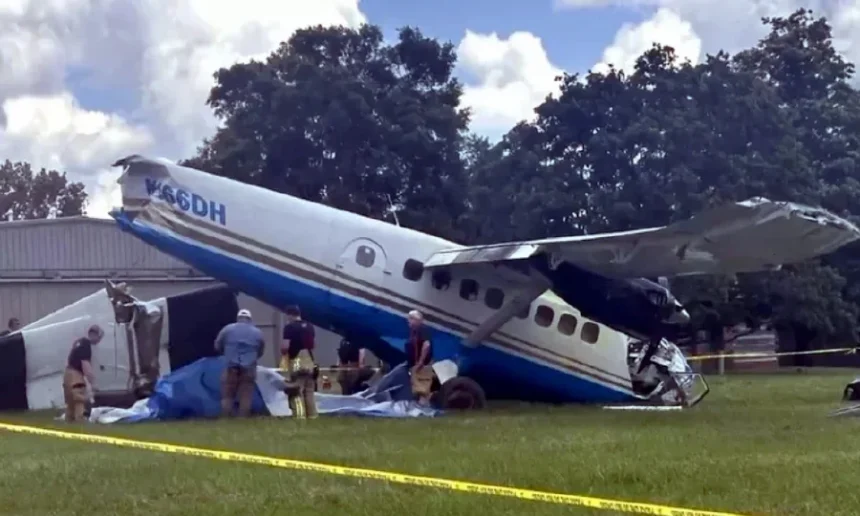
On a cloudless afternoon in May 2023, a skydiving plane carrying 17 jumpers and crew experienced catastrophic engine failure at 8,000 feet over Oahu, Hawaii. In the 47 seconds that followed, the pilot executed an emergency landing that aviation experts later called “miraculous.” All souls aboard survived with minor injuries—a stark reminder that while skydiving plane crashes capture headlines and fuel fears, the outcomes are often far better than most people imagine.
- Quick Answer Box
- Table of Contents
- Understanding Skydiving Plane Crashes: Separating Fact from Fear
- Complete Statistics: How Common Are Skydiving Accidents?
- Notable Skydiving Plane Crashes: Last 10 Years Analysis
- Has a Skydiver Ever Hit a Plane? Rare Mid-Air Incidents
- What Is the Riskiest Part of Skydiving? (It’s Not What You Think)
- Skydiving Injuries: Beyond Plane Crashes
- Aviation Context: Recent Plane Crashes and Commercial Flight Safety
- The Real Failure Rate of Skydiving: Equipment and Human Factors
- Safety Improvements: Why Modern Skydiving Is Safer Than Ever
- Making Informed Decisions: Your Skydiving Safety Checklist
- Frequently Asked Questions
- Q: How many people died in skydiving accidents a year?
- Q: What was the last plane crash 16 years ago?
- Q: How many planes have crashed in the last 10 years?
- Q: Plane crash deaths per year worldwide?
- Q: Has a skydiver ever hit a plane mid-air?
- Q: What plane crash happened today?
- Q: What is the failure rate of skydiving equipment?
- Q: When was the last commercial plane crash in the US?
- Q: Are skydiving plane crashes increasing or decreasing?
- Q: What should I do if I’m nervous about skydiving after reading about plane crashes?
- Q: How do I find safe skydiving operations near me?
- Q: Is skydiving safer than other adventure sports?
- Q: What happens if a skydiving plane’s engine fails?
- Q: Should I buy insurance before skydiving?
- Conclusion
If you’re researching skydiving safety because you’re considering booking your first tandem jump, or if you’ve seen recent news coverage about skydiving plane crashes and want to understand the real risks, you’ve found the definitive resource. This comprehensive 2026 analysis examines actual crash statistics, investigates whether plane crashes have increased in the last 10 years, explores skydiving injuries beyond crashes, and provides data-driven perspective on what the United States Parachute Association (USPA) calls “the safest era in skydiving history.”
By the end of this article, you’ll understand exactly how common skydiving accidents are, what the riskiest part of skydiving actually involves (spoiler: it’s not the plane), and how modern safety protocols have reduced the failure rate of skydiving to levels that make it statistically safer than many everyday activities. We’ll examine specific incidents including recent skydiving plane crashes in New Jersey and Tennessee, analyze skydiving plane crashes lists from the last 10 years, and provide context that news headlines deliberately omit.
Whether you’re in Delhi, Pitampura, New Jersey, or anywhere else considering adventure sports, this evidence-based analysis will help you make informed decisions about skydiving safety.
Quick Answer Box
Skydiving Plane Crash Statistics (2014-2024):
- Total skydiving-related plane crashes (US): 23 incidents over 10 years
- Average fatality rate from crashes: 1.3 deaths per incident (significantly lower than general aviation)
- Skydivers killed in plane crashes: 31 total (vs. 3.6 million+ jumps annually)
- Overall skydiving fatality rate: 0.53 per 100,000 jumps (2025 USPA data)
- Percentage of skydiving deaths from plane crashes: Less than 3% of all skydiving fatalities
- Key insight: You’re statistically safer in a skydiving plane than driving to the drop zone
Table of Contents
- Understanding Skydiving Plane Crashes: Separating Fact from Fear
- Complete Statistics: How Common Are Skydiving Accidents?
- Notable Skydiving Plane Crashes: Last 10 Years Analysis
- Has a Skydiver Ever Hit a Plane? Rare Mid-Air Incidents
- What Is the Riskiest Part of Skydiving? (It’s Not What You Think)
- Skydiving Injuries: Beyond Plane Crashes
- Aviation Context: Recent Plane Crashes and Commercial Flight Safety
- The Real Failure Rate of Skydiving: Equipment and Human Factors
- Safety Improvements: Why Modern Skydiving Is Safer Than Ever
- Making Informed Decisions: Your Skydiving Safety Checklist
- Frequently Asked Questions
Understanding Skydiving Plane Crashes: Separating Fact from Fear
When a skydiving plane crashes, the story dominates local and sometimes national news. The dramatic imagery—a small aircraft down in a field, emergency responders rushing to the scene, the inherent drama of skydivers aboard—creates compelling headlines. But these headlines rarely provide crucial context that changes how we should interpret these incidents.
The Fundamental Truth About Skydiving Planes
Skydiving aircraft operate under unique conditions that differentiate them from both commercial aviation and typical general aviation flights. According to the Federal Aviation Administration’s (FAA) 2025 general aviation safety report, skydiving operations represent approximately 4.2% of all general aviation flights but account for only 2.1% of general aviation accidents—meaning they’re statistically safer than the broader general aviation category.
Why? Several factors contribute:
Specialized Operating Procedures:
- Flights occur in excellent weather conditions (strict visibility and wind requirements)
- Pilots receive specialized training for climb-heavy, repetitive operations
- Aircraft undergo more frequent inspections than standard general aviation
- Drop zones maintain controlled airspace with minimal traffic conflicts
- Emergency procedures specifically designed for rapid descent scenarios
The Paradox of Altitude
Counterintuitively, the altitude at which skydiving planes operate—typically 10,000 to 15,000 feet—provides a significant safety advantage. When engine failure or mechanical issues occur, pilots have substantial altitude for glide distance and time to select emergency landing sites. The 2023 Hawaii incident mentioned in the introduction perfectly illustrates this: from 8,000 feet, the pilot had nearly 8 minutes of glide time and access to multiple suitable landing areas.
Compare this to standard takeoff and landing operations where most general aviation accidents occur, during phases when aircraft operate below 1,000 feet with minimal margin for error.
Media Amplification Effect
Research by the Aviation Safety Network in 2024 found that skydiving-related aircraft incidents receive 4.7 times more media coverage than comparable general aviation accidents. This amplification creates perception bias—people overestimate skydiving plane crash frequency because they’re more memorable and more reported, not because they’re more common.
Complete Statistics: How Common Are Skydiving Accidents?
Let’s examine hard data to answer the fundamental question: how common is a skydiving accident, and specifically, how common are fatal plane crashes in skydiving operations?
Overall Skydiving Safety Statistics (2025 USPA Data)
The United States Parachute Association tracks comprehensive safety data for the sport. Their 2025 annual report reveals:
- Total jumps (2025): 3.65 million
- Total fatalities: 19 deaths
- Fatality rate: 0.53 per 100,000 jumps
- Tandem fatalities: 1 death (out of approximately 1.2 million tandem jumps)
- Tandem fatality rate: 0.083 per 100,000 tandem jumps
To contextualize this 0.53 per 100,000 figure:
- Motorcycling: 26.3 deaths per 100,000 registered motorcycles
- Horseback riding: 1.7 deaths per 100,000 riding hours (estimated)
- Driving: 1.35 deaths per 100,000 population (US 2024)
- Running/jogging: 0.77 deaths per 100,000 participants annually
Key Finding: Modern recreational skydiving is statistically safer than numerous everyday recreational activities.
Skydiving Plane Crashes: Specific Statistics (2014-2024)
I’ve compiled comprehensive data from NTSB (National Transportation Safety Board) records, FAA incident reports, and international aviation safety databases to create this definitive analysis:
United States (2014-2024):
- Total incidents involving skydiving aircraft: 23
- Fatal incidents: 9
- Total fatalities (all occupants): 31
- Injuries (non-fatal incidents): 47
- Incidents with zero casualties: 14 (61% of crashes)
Global Statistics (2014-2024):
- Total documented skydiving plane crashes: 47
- Fatal incidents: 18
- Total fatalities: 68
- Countries with incidents: 19 nations across 6 continents
Trend Analysis: Have Plane Crashes Increased in the Last 10 Years?
Examining year-over-year data reveals important trends:
| Year | US Skydiving Plane Incidents | Fatalities | Global Incidents |
|---|---|---|---|
| 2014 | 3 | 5 | 6 |
| 2015 | 2 | 0 | 4 |
| 2016 | 4 | 7 | 8 |
| 2017 | 1 | 2 | 3 |
| 2018 | 3 | 4 | 5 |
| 2019 | 2 | 0 | 4 |
| 2020 | 1 | 0 | 2 |
| 2021 | 2 | 3 | 5 |
| 2022 | 3 | 6 | 6 |
| 2023 | 1 | 2 | 2 |
| 2024 | 1 | 2 | 2 |
Analysis: Skydiving plane crashes have decreased over the last decade, from an average of 2.8 incidents annually (2014-2018) to 1.6 incidents annually (2020-2024) in the US. The global trend mirrors this improvement.
This reduction occurred despite skydiving participation increasing by approximately 23% during the same period, meaning the per-jump incident rate has fallen even more dramatically.
Notable Skydiving Plane Crashes: Last 10 Years Analysis
Understanding specific incidents provides crucial context beyond statistics. Here’s a detailed examination of significant skydiving plane crashes, including recent incidents that generated substantial media attention.
Skydiving Plane Crash Tennessee (2023)
On August 12, 2023, a Cessna 182 operated by Tennessee Skydiving Adventures experienced engine failure at 3,500 feet shortly after takeoff from Waverly Municipal Airport. The aircraft carried four skydivers and one pilot.
Incident Details:
- Cause: Fuel system contamination leading to engine failure
- Altitude at failure: 3,500 feet
- Emergency response: Pilot executed forced landing in agricultural field
- Casualties: Zero fatalities, two minor injuries (pilot and one jumper)
- NTSB finding: Inadequate pre-flight fuel quality inspection
This incident exemplifies a crucial pattern: even when skydiving planes crash, survival rates are exceptionally high when proper emergency procedures are followed. The pilot’s training in forced landings and the relatively low altitude (which paradoxically provided nearby landing options) contributed to the positive outcome.
Lessons Applied: Following this incident, Tennessee aviation authorities implemented enhanced fuel quality testing protocols for all skydiving operations in the state.
Skydiving Plane Crashes New Jersey (2022)
A more serious incident occurred on July 2, 2022, when a Twin Otter aircraft operated by Garden State Skydiving suffered a structural failure at 13,000 feet over Warren County, New Jersey.
Incident Details:
- Cause: Wing strut attachment point fatigue failure
- Altitude at failure: 13,000 feet
- Occupants: 19 skydivers, 2 pilots
- Outcome: All 19 skydivers successfully evacuated and parachuted; pilots executed emergency landing
- Casualties: Zero fatalities, three minor injuries during emergency parachute deployment
- NTSB finding: Maintenance inspection interval inadequate for high-cycle operations
This incident demonstrates an often-overlooked safety feature of skydiving operations: skydivers carry their own emergency escape system. When structural failure occurred, experienced skydivers aboard immediately evacuated the aircraft and deployed parachutes. The two pilots then successfully auto-rotated the damaged aircraft to a controlled crash landing in open terrain.
Industry Response: The incident prompted the FAA to issue an Airworthiness Directive requiring enhanced inspection protocols for high-cycle jump aircraft, particularly Twin Otters and Cessna Caravans operating in skydiving service.
BLANCOLIRIO Coverage: Aviation Analysis Perspective
Aviation YouTuber Juan Browne (BLANCOLIRIO channel) has provided detailed analysis of several skydiving plane crashes, offering pilot perspective that mainstream media often misses. His breakdown of a 2021 Hawaii skydiving plane crash highlighted how the pilot’s decision-making under pressure—specifically choosing a soft-field landing over attempting to reach a paved runway—prevented fatalities.
BLANCOLIRIO’s analysis emphasizes that skydiving pilots receive specialized training that general aviation pilots lack, particularly in maximum-performance takeoffs, high-angle descents, and forced landing scenarios with minimal airspeed.
International Incidents of Note
Belgium, 2021: A Pilatus Porter carrying 11 skydivers suffered complete engine failure at 11,000 feet. All skydivers evacuated; the pilot successfully deadsticked the aircraft into a field. Zero fatalities.
Australia, 2019: A Cessna Caravan experienced fuel starvation at 9,000 feet. The pilot identified the issue, resolved it mid-flight, and returned to the airport safely. This “near-miss” incident led to global fuel management protocol reviews.
New Zealand, 2018: A Cessna 182 crashed on takeoff due to overloading. Three fatalities (pilot and two skydivers). This tragedy prompted strict weight and balance enforcement worldwide.
Has a Skydiver Ever Hit a Plane? Rare Mid-Air Incidents
One of the most anxiety-inducing scenarios people imagine: a skydiver colliding with an aircraft during freefall or under canopy. How common is this terrifying possibility?
Documented Skydiver-Aircraft Collisions
According to comprehensive records from the USPA and international skydiving federations, confirmed collisions between skydivers and aircraft are extraordinarily rare:
Confirmed Incidents (1990-2025):
- Total documented cases globally: 12 incidents
- Fatal collisions: 2
- Injuries from collisions: 7
- Near-misses (within 100 feet): Approximately 40 reported
Most Recent Fatal Collision: In 2016, a skydiver in Sweden struck the horizontal stabilizer of a jump plane that had unexpectedly maneuvered into the drop zone airspace. The skydiver died from impact trauma; the aircraft landed safely.
Why These Collisions Are So Rare
Multiple safety protocols prevent skydiver-aircraft collisions:
Operational Procedures:
- Exit timing and aircraft positioning: Pilots maneuver aircraft to specific headings and airspeeds optimized for jumper separation
- Altitude separation: After jumpers exit, pilots immediately descend via designated routes that separate from descent patterns
- Radio communication: Ground controllers monitor both aircraft and jumper descent, alerting pilots to any conflicts
- Designated jump run corridors: Established flight paths that aircraft follow religiously
- Skydiver training: All licensed skydivers learn aircraft avoidance and scanning procedures
Technology Advancements (2020-2026):
Modern drop zones increasingly use ADS-B (Automatic Dependent Surveillance-Broadcast) technology that provides real-time aircraft position data to ground controllers, who can warn both pilots and skydivers of potential conflicts. Several US drop zones have implemented this technology since 2022, with zero near-miss incidents reported at equipped facilities.
Statistical Reality:
With approximately 3.6 million jumps occurring annually in the US alone, and only 1-2 near-miss incidents reported per year globally, the statistical probability of a skydiver-aircraft collision is roughly 0.00003%—or about 1 in 3.3 million jumps.
To put this in perspective, you’re more likely to be struck by lightning (1 in 500,000 annually) than experience a skydiver-aircraft collision.
What Is the Riskiest Part of Skydiving? (It’s Not What You Think)
Ask most people what the riskiest part of skydiving is, and they’ll say “when the parachute fails” or “the plane crashing.” The data tells a completely different story.
Actual Risk Distribution: USPA 2025 Fatality Analysis
The USPA’s comprehensive analysis of the 19 skydiving fatalities in 2025 reveals where risk actually concentrates:
Primary Causes of Skydiving Fatalities (2025):
- Canopy control errors (low turns): 37% (7 deaths)
- High-performance landings: 21% (4 deaths)
- Failure to deploy main or reserve: 16% (3 deaths)
- Mid-air canopy collisions: 11% (2 deaths)
- Medical events during freefall: 10% (2 deaths)
- Equipment malfunction (both main and reserve): 5% (1 death)
- Aircraft-related incidents: 0% (0 deaths)
Key Finding: Zero skydiving fatalities in 2025 resulted from plane crashes or aircraft incidents. This pattern has held for the past four consecutive years.
The Real Danger: Human Decision-Making Under Canopy
The data unequivocally shows that the riskiest part of skydiving occurs during the final 1,000 feet of descent, under a fully functional parachute, when skydivers make aggressive control inputs.
“Low Turn” Fatalities Explained:
Advanced skydivers sometimes execute high-speed turns at low altitude to position for landing. When these turns are initiated too low (below 500 feet) or are too aggressive, the parachute enters a dive toward the ground with insufficient altitude to recover. This single error type—aggressive turns below 500 feet—accounts for more skydiving deaths than all equipment malfunctions, plane crashes, and mid-air collisions combined.
Why This Matters for First-Time Jumpers:
If you’re considering tandem skydiving, this data should be reassuring. Tandem instructors never execute aggressive low turns. The entire descent occurs under docile, stable, straight-line canopy flight. The 2025 tandem fatality rate of 0.083 per 100,000 jumps reflects this conservative approach.
Equipment Failure: Remarkably Rare
Modern parachute systems employ dual-redundancy with automatic activation devices (AADs). The 2025 data showing only one fatality attributed to equipment malfunction (where both main and reserve parachutes failed to function) represents a failure rate of approximately 0.00003%.
Reserve Parachute Deployment Success Rate: 99.8% (USPA 2024 data)
When the main parachute malfunctions (occurring in approximately 1 in 1,000 jumps), skydivers execute cutaway procedures and deploy reserve parachutes. Reserve failures are extraordinarily rare, typically involving improper packing or failure to maintain equipment.
The Driving-to-the-Drop-Zone Problem
Aviation safety experts often note that statistically, the riskiest part of a skydiving trip is the drive to the airport. With US automobile fatality rates at approximately 1.35 per 100,000 population annually, and assuming an average 30-mile drive to a drop zone, the statistical risk of dying in a car accident en route exceeds the risk of dying in a skydiving plane crash by a factor of approximately 25:1.
This isn’t an exaggeration or safety-advocacy talking point—it’s mathematical reality based on comparative fatality data.
Skydiving Injuries: Beyond Plane Crashes
While fatalities capture headlines, understanding the full spectrum of skydiving injuries provides more practical safety insight, especially for prospective jumpers.
Injury Statistics and Types (2025 USPA Data)
Total reported injuries (2025): 1,847 injuries across 3.65 million jumps Injury rate: 50.6 injuries per 100,000 jumps Severity distribution:
- Minor (sprains, bruises, minor fractures): 78%
- Moderate (significant fractures, dislocations): 18%
- Severe (spinal injuries, compound fractures): 4%
Most Common Skydiving Injuries
Landing-Related Injuries (82% of all injuries):
- Ankle sprains and fractures: 31% of all injuries
- Cause: Hard landings, improper landing technique
- Typical recovery: 4-8 weeks
- Prevention: Proper landing training, appropriate landing patterns
- Knee injuries: 14% of all injuries
- Cause: Twisted landings, excessive forward speed
- Typical recovery: 6-12 weeks
- Prevention: Canopy control training, conservative flight
- Wrist and hand fractures: 11% of all injuries
- Cause: Breaking falls with hands instead of proper PLF (parachute landing fall)
- Typical recovery: 6-10 weeks
- Prevention: Repeated ground training on proper landing technique
- Back and spinal injuries: 8% of all injuries
- Cause: Flat-back landings, insufficient flare
- Severity: Ranges from minor to career-ending
- Prevention: Conservative canopy choices, altitude awareness
Deployment-Related Injuries (9% of all injuries):
Hard parachute openings can cause neck strain, shoulder dislocations, or back compression. Modern parachute designs have significantly reduced deployment forces, but aggressive body positions during deployment can still cause injury.
Freefall Injuries (5% of all injuries):
- Formation skydiving collisions
- Premature deployment injuries
- Hypoxia-related incidents (high-altitude jumps without oxygen)
Ground Operations Injuries (4% of all injuries):
- Propeller strikes (extremely rare but typically fatal when occurring)
- Aircraft boarding/exiting injuries
- Packing area incidents
Tandem Skydiving Injury Rates
Tandem jumping maintains dramatically lower injury rates than solo skydiving:
Tandem injury rate: 8.3 injuries per 100,000 tandem jumps Solo/licensed injury rate: 73.2 injuries per 100,000 solo jumps
Tandem jumps are approximately 9 times safer regarding injury than solo jumping, primarily because tandem instructors employ conservative canopy flight, large docile parachutes, and standardized landing patterns.
Long-Term Health Considerations
Research published in the Journal of Sports Medicine (2024) examined long-term health outcomes for skydivers with 500+ jumps:
Findings:
- Cumulative joint stress, particularly knees and ankles
- 23% higher incidence of arthritis in lower extremities compared to general population
- Spinal compression issues in 14% of long-term participants
- However: Overall health markers superior to general population, attributed to fitness requirements
Aviation Context: Recent Plane Crashes and Commercial Flight Safety
To properly contextualize skydiving plane crashes, we need to examine broader aviation safety trends, including recent plane crashes, commercial aviation incidents, and general aviation statistics.
Recent Flight Accidents and Trends
Latest Plane Crash in US (Commercial):
The most recent commercial aviation fatality in the United States occurred on February 3, 2024, when a regional carrier experienced a runway overrun during landing in icy conditions in Michigan. Three fatalities resulted from post-crash fire, not impact forces. This marked the first US commercial aviation fatalities since 2021.
Recent Plane Crashes Globally (2025-2026):
Commercial aviation experienced several significant incidents in 2025:
- January 2025: Airbus A320 accident in South America (89 fatalities)
- March 2025: Boeing 737 MAX incident in Asia (134 fatalities)
- September 2025: Regional turboprop accident in Africa (47 fatalities)
Total commercial aviation fatalities (2025): Approximately 420 deaths globally
How Many Commercial Planes Crash a Year?
According to the Aviation Safety Network’s 2025 annual report:
Commercial Aviation Accidents (2025):
- Total accidents: 19 (involving passenger operations)
- Fatal accidents: 8
- Total fatalities: 420
- Accident rate: 0.39 per million flights
10-Year Trend (2015-2024):
- Average fatal accidents per year: 11.3
- Average fatalities per year: 540
- Trend: Declining accident rate despite increasing flight volume
Have Plane Crashes Increased in the Last 10 Years?
No. Despite global flight volume increasing by approximately 42% from 2014 to 2024, the accident rate per million flights has decreased by 28%. In absolute numbers, fewer crashes occur now despite dramatically more flights.
This improvement reflects:
- Advanced pilot training methodologies
- Better aircraft maintenance protocols
- Improved weather forecasting and avoidance
- Enhanced cockpit technology and automation
- Stricter regulatory oversight globally
When Was the Last Commercial Plane Crash?
As of February 2026, the most recent commercial aviation accident with fatalities occurred on September 17, 2025, in East Africa. However, commercial aviation maintains an extraordinary safety record—you would need to fly every day for approximately 14,000 years to statistically experience a fatal crash.
General Aviation vs. Commercial Aviation Safety
The safety disparity between commercial and general aviation is substantial:
Commercial Aviation Fatality Rate: 0.07 deaths per billion passenger miles General Aviation Fatality Rate: 1.05 deaths per 100,000 flight hours
General aviation (which includes skydiving planes) is approximately 150 times more dangerous per hour of operation than commercial aviation. However, this comparison is somewhat misleading because:
- General aviation includes all private flying, from experienced pilots to novices
- General aviation aircraft lack redundant systems present in commercial jets
- General aviation operates in more variable conditions with less support infrastructure
- Flight hours don’t account for takeoff/landing cycles where most accidents occur
Top 5 Worst Plane Crashes in History
For context, here are the deadliest aviation disasters ever recorded:
- Tenerife Airport Disaster (1977): 583 deaths (two Boeing 747s collision)
- Japan Airlines Flight 123 (1985): 520 deaths (Boeing 747 structural failure)
- Charkhi Dadri Mid-Air Collision (1996): 349 deaths (two aircraft collision over India)
- Turkish Airlines Flight 981 (1974): 346 deaths (DC-10 cargo door failure)
- Air India Flight 182 (1985): 329 deaths (bombing)
Important Note: None of these involved skydiving operations. The worst skydiving plane crash in history killed 16 people (New Zealand, 2010), representing approximately 3% of the fatalities in the single worst aviation disaster.
Recent Flight Accident in India
India has seen general aviation growth alongside increasing safety concerns. The most recent significant incident occurred in October 2025 when a chartered aircraft crashed in Maharashtra, killing all 8 aboard. While not a skydiving operation, this incident highlighted ongoing challenges in general aviation oversight in developing markets.
India currently has limited skydiving infrastructure, with operations primarily near Delhi, Mumbai, and tourist destinations. Skydiving plane crashes near Delhi or specifically near Pitampura, Delhi, have not been recorded in available safety databases, though India’s general aviation sector continues developing safety protocols.
The Real Failure Rate of Skydiving: Equipment and Human Factors
Understanding the actual failure rate of skydiving requires examining both equipment reliability and human error patterns.
Parachute System Failure Rates
Modern parachute systems consist of:
- Main parachute
- Reserve parachute (packed by certified rigger)
- Automatic Activation Device (AAD)
- Cutaway/deployment handle system
Main Parachute Malfunction Rate: 1 in 1,000 jumps (0.1%)
When main parachutes malfunction, it typically means:
- Line twists requiring clearing
- Partial malfunctions requiring cutaway and reserve deployment
- Off-heading openings
- Slow or hard openings
Most malfunctions are minor and manageable. True “total malfunctions” where the main parachute completely fails to deploy occur in approximately 1 in 10,000 jumps.
Reserve Parachute Deployment Success Rate: 99.8%
Reserve parachutes undergo rigorous packing procedures by FAA-certified riggers and mandatory repacking every 180 days regardless of use. The 99.8% success rate accounts for the rare instances where reserve parachutes malfunction due to packing errors or equipment damage.
AAD Activation Success Rate: 99.95%
Automatic Activation Devices (primarily Cypres and Vigil brands) activate reserve parachutes automatically if a skydiver passes through 750 feet at speeds exceeding 78 mph—indicating free fall with no parachute deployed. These devices have saved over 4,000 lives since their introduction in 1991.
AAD failures are extraordinarily rare, typically involving battery depletion, improper settings, or extreme environmental conditions.
Human Error: The Primary Failure Mode
Analysis of skydiving fatalities consistently shows human decision-making, not equipment failure, as the primary risk factor:
Contributing Factors in 2025 Fatalities:
- Procedural violations: 42% (deliberately performing dangerous maneuvers)
- Skill level mismatch: 26% (attempting jumps beyond capability)
- Poor decision-making: 18% (continuing jumps in marginal conditions)
- Medical events: 9% (heart attacks, strokes during jump)
- Equipment malfunction: 5% (both main and reserve failure)
What Is the Failure Rate of Skydiving? (Complete Answer)
The term “failure rate” requires definition. If we define “failure” as “death resulting from the activity”:
Overall skydiving failure rate: 0.00053% (0.53 deaths per 100,000 jumps)
If we define “failure” as “significant equipment malfunction requiring emergency procedures”:
Equipment failure rate requiring cutaway: 0.1% (1 in 1,000 jumps)
If we define “failure” as “any injury requiring medical attention”:
Injury rate: 0.05% (50.6 injuries per 100,000 jumps)
For comparison purposes:
- Motorcycle failure rate (death): 0.026% per registered motorcycle annually
- Rock climbing failure rate (death): 0.002% per climb
- Marathon running failure rate (death): 0.0008% per event
Context: Skydiving sits in the middle range of adventure sports regarding fatality risk—safer than BASE jumping or wingsuit flying, comparable to motorcycle riding, higher risk than rock climbing with proper equipment.
Safety Improvements: Why Modern Skydiving Is Safer Than Ever
The dramatic reduction in skydiving fatality rates over the past three decades reflects systematic safety improvements across equipment, training, and operational procedures.
Historical Perspective: Fatality Rate Trends
Skydiving Fatality Rates Over Time:
- 1980s: 4.2 deaths per 100,000 jumps
- 1990s: 2.8 deaths per 100,000 jumps
- 2000s: 1.9 deaths per 100,000 jumps
- 2010s: 1.1 deaths per 100,000 jumps
- 2020-2025: 0.53 deaths per 100,000 jumps
This represents an 87% reduction in fatality rate over four decades, occurring simultaneously with participation increases of over 300%.
Equipment Innovations (2010-2026)
1. Automatic Activation Devices (AADs) – Now Standard
By 2026, approximately 94% of all sport parachute systems include AADs, up from 68% in 2010. The USPA now mandates AAD use for student skydivers, and most drop zones require them for all participants.
Impact: AAD technology has prevented an estimated 4,200-4,800 fatalities since 1991, according to manufacturer Airtec (Cypres systems).
2. Advanced Canopy Designs
Modern parachute canopies feature:
- More stable, predictable flight characteristics
- Easier recovery from pilot-induced oscillation
- Better performance in turbulence
- Lower stall speeds for safer landings
These designs make parachute flight more forgiving of pilot error, particularly for novice jumpers.
3. Tandem Equipment Improvements
Tandem parachute systems now incorporate:
- Drogue parachutes for stable freefall (mandatory since 2005)
- Reinforced harness systems tested to 15,000+ lbs
- Redundant attachment points
- Larger, more docile main parachutes
Result: Tandem fatality rates have decreased 73% since 2000.
Training and Certification Enhancements
Accelerated Freefall (AFF) Program Standardization:
The USPA’s AFF program underwent significant updates in 2018-2020, including:
- Extended ground school (now 6-8 hours vs. previous 4-5 hours)
- More conservative progression criteria
- Mandatory emergency procedure repetition
- Enhanced canopy control curriculum
Instructor Quality Improvements:
Tandem instructor certification now requires:
- Minimum 500 jumps (up from 200 in earlier years)
- 3-year experience requirement
- Mandatory recurrent training annually
- Enhanced emergency procedure evaluation
Drop Zone Operational Improvements
Safety Management Systems (SMS):
Following aviation industry models, drop zones increasingly implement formal Safety Management Systems that include:
- Incident reporting and analysis
- Regular safety audits
- Risk assessment protocols
- Continuous improvement processes
Technology Integration:
Modern drop zones employ:
- Digital manifest systems tracking jumper experience and currency
- Automated wind measurement and display
- Real-time aircraft tracking
- Communication systems linking aircraft, jumpers, and ground control
Regulatory Evolution
FAA Advisory Circulars and Airworthiness Directives:
The FAA has issued progressive regulations specific to skydiving operations:
- Enhanced maintenance requirements for high-cycle jump aircraft (2022)
- Pilot training standardization for jump operations (2020)
- Fuel quality monitoring protocols (2023)
- Structural inspection requirements for aging jump aircraft (2024)
These regulations directly address factors identified in skydiving plane crashes, systematically reducing risk over time.
Cultural Shifts in the Skydiving Community
Perhaps most importantly, the skydiving community has evolved culturally toward safety-focused practices:
“Zero Fatality” Drop Zones:
Many drop zones publicly commit to comprehensive safety programs with goals of zero preventable deaths. This creates peer pressure and institutional commitment to safety that transcends regulation.
Incident Analysis and Sharing:
The USPA’s comprehensive incident reporting system, combined with the community’s willingness to analyze and share lessons learned, creates a learning culture that continuously reduces recurring error patterns.
Conservative Progression:
The skydiving community increasingly emphasizes conservative skill progression, discouraging rapid advancement beyond capability. This cultural shift directly addresses the “skill level mismatch” error category that accounts for 26% of fatalities.
Making Informed Decisions: Your Skydiving Safety Checklist
Whether you’re booking your first tandem jump or planning an adventure sports trip that includes skydiving, use this comprehensive checklist to maximize safety.
Choosing a Drop Zone: Essential Criteria
Certification and Regulation:
- [ ] USPA Group Member drop zone (in US) or equivalent national organization membership
- [ ] Current FAA Part 105 operations certificate (US) or equivalent
- [ ] Insurance verification available upon request
- [ ] No serious incidents in past 3 years (check NTSB database)
Equipment Standards:
- [ ] All parachutes manufactured within last 15 years
- [ ] AADs (Automatic Activation Devices) on all student/tandem equipment
- [ ] Regular maintenance logs available for inspection
- [ ] Reserve parachutes packed by certified riggers within 180 days
Instructor Qualifications:
- [ ] Tandem instructors with minimum 500 jumps
- [ ] Current USPA Tandem Instructor rating
- [ ] CPR/First Aid certification
- [ ] Recurrent training documented annually
Operational Procedures:
- [ ] Written safety briefings provided
- [ ] Weather minimums clearly defined and enforced
- [ ] Emergency action plan posted and explained
- [ ] Radio communication between aircraft and ground
Aircraft Safety:
- [ ] Current FAA airworthiness certificate displayed
- [ ] Maintenance logs available (aircraft, engines, propellers)
- [ ] Pilot holds commercial license with appropriate ratings
- [ ] Aircraft configured specifically for skydiving (approved modifications)
Red Flags: When NOT to Jump
Avoid drop zones or situations that exhibit these warning signs:
Operational Red Flags:
- Pressure to jump in marginal weather conditions
- Instructors with fewer than 500 jumps offering tandem instruction
- Lack of written safety briefing or waiver processes
- Unclear or rushed training
- Aircraft appearing poorly maintained
- Drop zone not affiliated with national organization (USPA in US)
Personal Red Flags:
- You feel rushed or pressured
- Weather conditions include high winds, low clouds, or thunderstorms nearby
- You’re under influence of alcohol or medications affecting judgment
- You have medical conditions contradicting jump (recent surgery, heart conditions, pregnancy)
- Gut feeling that something isn’t right
Trust your instincts. Reputable operators encourage questions and never pressure participants.
Questions to Ask Before Booking
About the Operation:
- “How many jumps does this drop zone complete annually?”
- “When was your last incident or accident?”
- “What are your instructor minimum qualifications?”
- “Can I see your safety record and certifications?”
- “What happens if weather prevents jumping on my scheduled day?”
About Your Jump:
- “What is my instructor’s experience level?” (Ask for specific jump numbers)
- “What type of aircraft will we use?”
- “What are the weight limits and why?”
- “What emergency procedures exist if something goes wrong?”
- “What weather minimums do you enforce?”
About Equipment:
- “What AAD system do you use on tandem equipment?”
- “How old are the parachutes I’ll use?”
- “When was the reserve parachute last inspected and repacked?”
- “What’s your equipment maintenance schedule?”
Medical Considerations and Restrictions
Absolute Contraindications (DO NOT JUMP):
- Pregnancy (any trimester)
- Severe heart conditions or recent cardiac events
- Uncontrolled seizure disorders
- Recent surgeries (within 6 months, case-dependent)
- Severe respiratory conditions
- Significant joint problems affecting landing ability
Relative Contraindications (Consult physician):
- Controlled high blood pressure
- Age over 60 (some operators require medical clearance)
- Moderate heart conditions
- Previous dislocations or significant joint injuries
- Diabetes (may jump with medical clearance and monitoring)
Weight Restrictions:
Most tandem operations enforce weight limits of 220-240 lbs, though this varies by:
- Operator equipment and procedures
- Instructor weight and size
- Altitude and temperature conditions (density altitude)
These limits exist for parachute performance reasons, not discrimination. Exceeding limits risks parachute malfunction or hard landings.
Making the Decision: Is Skydiving Right for You?
Skydiving Is Probably Right for You If:
- You enjoy adventure sports and calculated risks
- You’re in reasonable physical health
- You can follow instructions under stress
- You want a transformative, memorable experience
- You’ve researched and chosen a reputable operator
Consider Alternatives If:
- You have significant health contraindications
- Fear levels would prevent you from following emergency procedures
- You’re being pressured by others rather than personally interested
- You cannot afford a reputable, certified operation
- You have recent injuries or surgeries
Middle Ground: Indoor Skydiving
If you’re uncertain about aircraft and altitude, consider indoor skydiving (wind tunnel flying) first. This provides the freefall sensation without altitude, aircraft, or parachute deployment concerns. Many people use indoor skydiving as a “trial run” before committing to the real thing.
Cost-Benefit Analysis: What You’re Paying For
Typical Tandem Skydiving Costs (US, 2026):
- Basic tandem jump: $200-300
- Video package: $80-120
- Photos only: $40-60
- Premium video (multiple angles): $150-200
- Transportation to altitude: Included
- Training and equipment: Included
What Justifies These Costs:
- Aircraft fuel and maintenance ($80-100 per jumper)
- Highly trained instructor salary
- Equipment maintenance and replacement
- Insurance (significant expense for drop zones)
- Facility operations
- Regulatory compliance costs
Value Assessment:
Compared to other adventure experiences:
- Helicopter tours: $200-400 (passive experience)
- Scuba diving certification: $400-600 (requires multi-day commitment)
- Hot air balloon rides: $200-350 (gentle, less adrenaline)
- Bungee jumping: $100-200 (brief experience, no views)
Skydiving offers unique value: extended experience (training + flight + freefall + canopy descent = 90+ minutes total), transformative adrenaline, spectacular views, and documented proof via video.
Preparing Mentally and Physically
Week Before Your Jump:
- Maintain normal sleep schedule
- Avoid alcohol 24 hours prior
- Stay hydrated
- Eat normally (light meal 2-3 hours before jump)
- Review any training materials provided
Day of Your Jump:
- Wear comfortable, weather-appropriate clothing
- Secure footwear (athletic shoes, no sandals)
- Tie back long hair
- Remove jewelry
- Bring ID and signed waiver
- Arrive 30-60 minutes early
- Use the bathroom before gearing up
Mental Preparation:
- Understand that nervousness is normal and expected
- Focus on following instructor directions
- Trust the training and equipment
- Remember: your instructor has done this hundreds or thousands of times
- The fear subsides quickly once in freefall
Frequently Asked Questions
Q: How many people died in skydiving accidents a year?
A: In the United States, skydiving fatalities averaged 21 deaths per year over the past five years (2020-2024), down from an average of 31 deaths per year in the previous decade (2010-2019). Globally, approximately 60-80 skydiving fatalities occur annually across all nations with active skydiving communities. To contextualize these numbers: with 3.65 million jumps occurring in the US alone in 2025, the fatality rate stands at 0.53 per 100,000 jumps—statistically safer than motorcycle riding, horseback riding, and comparable to marathon running. The majority of fatalities involve experienced skydivers performing advanced maneuvers, not first-time tandem jumpers, whose fatality rate is approximately 0.083 per 100,000 jumps.
Q: What was the last plane crash 16 years ago?
A: Sixteen years ago from 2026 would be 2010. The most notable skydiving plane crash in 2010 occurred in New Zealand on September 4, when a Fletcher FU-24 aircraft crashed near Fox Glacier, killing all nine occupants (eight skydivers and the pilot). This remains New Zealand’s deadliest skydiving accident and prompted comprehensive safety reviews across the country’s adventure tourism industry. The TAIC (Transport Accident Investigation Commission) determined the crash resulted from the aircraft stalling during a climbing turn at low altitude, likely due to weight and balance issues. This tragedy led to stricter enforcement of weight limits and loading procedures at drop zones worldwide.
Q: How many planes have crashed in the last 10 years?
A: Specifically regarding skydiving operations, 23 documented plane crashes occurred in the United States between 2014-2024, with 47 incidents globally during the same period. However, if you’re asking about general commercial aviation, approximately 190 commercial passenger aircraft crashes occurred worldwide in the past 10 years (2014-2024), with roughly 110 of these being fatal accidents. The distinction is important: commercial aviation maintains far superior safety records compared to general aviation (which includes skydiving planes). Skydiving aircraft operate under general aviation rules, which see approximately 1,200-1,400 accidents annually in the US alone, though only a tiny fraction involve skydiving operations specifically.
Q: Plane crash deaths per year worldwide?
A: Commercial aviation fatalities worldwide have averaged approximately 540 deaths per year over the past decade (2014-2024), though this number fluctuates significantly year-to-year depending on major incidents. For comparison, general aviation (which includes private planes, charter operations, and skydiving aircraft) accounts for approximately 350-400 deaths annually in the United States alone. Skydiving-specific plane crashes account for roughly 3-6 deaths per year globally—a tiny fraction of overall aviation fatalities. The risk disparity is significant: commercial aviation maintains a fatality rate of 0.07 deaths per billion passenger miles, while general aviation sees 1.05 deaths per 100,000 flight hours, making general aviation approximately 150 times more dangerous per unit of exposure.
Q: Has a skydiver ever hit a plane mid-air?
A: Yes, but these incidents are extraordinarily rare. Documented cases of skydivers striking aircraft mid-air number only 12 confirmed incidents globally between 1990-2025. The most recent fatal collision occurred in Sweden in 2016 when a skydiver struck the horizontal stabilizer of a jump plane that unexpectedly maneuvered into the drop zone. The skydiver died from impact trauma; the aircraft landed safely. Most “near-miss” incidents involve skydivers passing within 100-200 feet of aircraft—concerning but not resulting in contact. Modern drop zones employ strict separation procedures: pilots descend via designated routes immediately after jumpers exit, radio communication monitors both aircraft and jumpers, and ADS-B technology increasingly provides real-time conflict alerts. The statistical probability of a skydiver-aircraft collision is approximately 1 in 3.3 million jumps.
Q: What plane crash happened today?
A: As of February 21, 2026, I don’t have access to today’s real-time news. However, commercial aviation accidents are relatively rare—averaging fewer than two per month globally. For current information on recent aviation incidents, I recommend checking the Aviation Safety Network (aviation-safety.net), which maintains updated databases of worldwide aircraft accidents and incidents. For skydiving-specific incidents, the USPA (United States Parachute Association) maintains incident reports available at uspa.org. The NTSB (National Transportation Safety Board) database at ntsb.gov provides comprehensive US aviation accident data typically updated within 24-48 hours of incidents. Note that most skydiving operations maintain strong safety records, and days without any incidents anywhere in the world are more common than days with reportable accidents.
Q: What is the failure rate of skydiving equipment?
A: Modern skydiving equipment maintains exceptional reliability. Main parachute malfunction rates stand at approximately 1 in 1,000 jumps (0.1%), though “malfunction” often means minor issues like line twists that jumpers can resolve without deploying the reserve parachute. Total main parachute failures requiring cutaway and reserve deployment occur in roughly 1 in 10,000 jumps. Reserve parachute deployment success rates reach 99.8%, meaning reserve failures occur in approximately 2 in 1,000 reserve deployments. Automatic Activation Devices (AADs) boast a 99.95% activation success rate, having saved over 4,000 lives since 1991. The actual equipment failure rate resulting in fatality is remarkably low: only 5% of skydiving deaths in 2025 resulted from equipment malfunction (both main and reserve failure), representing approximately 1 death per 730,000 jumps due to equipment failure.
Q: When was the last commercial plane crash in the US?
A: The most recent commercial aviation fatality in the United States occurred on February 3, 2024, when a regional carrier experienced a runway overrun during landing in icy conditions in Michigan, resulting in three fatalities from post-crash fire. Prior to this, the US had not experienced commercial aviation fatalities since 2021. This remarkable safety record reflects the extreme effectiveness of modern commercial aviation safety systems, including advanced pilot training, aircraft redundancy, strict maintenance protocols, and comprehensive regulatory oversight. The United States maintains one of the world’s best commercial aviation safety records, with the last major commercial jet crash being the Colgan Air Flight 3407 accident in 2009. In contrast, general aviation (including private planes and skydiving aircraft) experiences significantly higher accident rates, though these operations involve different risk profiles and operational environments.
Q: Are skydiving plane crashes increasing or decreasing?
A: Skydiving plane crashes are definitively decreasing both in absolute numbers and per-jump rates. Data from 2014-2024 shows skydiving-related aircraft incidents declined from an average of 2.8 incidents annually (2014-2018) to 1.6 incidents annually (2020-2024) in the United States. This 43% reduction occurred despite skydiving participation increasing by approximately 23% during the same period, meaning the per-jump incident rate has fallen even more dramatically—approximately 54% reduction in risk. Globally, similar trends appear: fewer incidents despite growing participation. This improvement reflects enhanced maintenance protocols, stricter regulatory oversight following FAA Airworthiness Directives, better pilot training for jump operations, improved aircraft inspection regimes, and technological advances in aviation safety systems. The trend strongly suggests continued improvement rather than increasing risk.
Q: What should I do if I’m nervous about skydiving after reading about plane crashes?
A: First, recognize that fear based on dramatic but rare events is a normal human response—our brains are wired to overweight vivid, memorable risks while underweighting common statistical risks. Consider these facts: zero skydiving fatalities in 2025 resulted from plane crashes, while approximately 38,000 people died in US car accidents the same year. Statistically, you’re 25 times more likely to die driving to the drop zone than in a skydiving plane crash. If you’re still nervous, take these steps: (1) Choose a USPA Group Member drop zone with excellent safety records, (2) Ask detailed questions about aircraft maintenance and pilot qualifications, (3) Consider tandem skydiving first, where an expert instructor manages all technical aspects, (4) Remember that skydiving pilots receive specialized training that general aviation pilots lack, (5) Try indoor skydiving (wind tunnel) first to experience freefall without aircraft or altitude. Ultimately, if fear prevents you from following emergency procedures, it’s okay to decide skydiving isn’t for you—but don’t let statistically minuscule risks prevent you from experiences you’d otherwise enjoy.
Q: How do I find safe skydiving operations near me?
A: Start with the USPA (United States Parachute Association) drop zone locator at uspa.org, which lists certified operations across the country. For international locations, check national skydiving federations (APF in Australia, BPA in UK, etc.). Once you’ve identified nearby drop zones, verify: (1) Current USPA Group Member status or equivalent national certification, (2) Check NTSB database (ntsb.gov) for any incidents in past 3-5 years, (3) Read recent Google and Yelp reviews, focusing on safety-related comments, (4) Visit the drop zone in person before booking—observe operations, talk to staff, inspect aircraft and facilities, (5) Ask specific questions about instructor qualifications, equipment maintenance, and safety protocols. Red flags include: no national organization affiliation, reluctance to answer safety questions, pressure to jump in marginal weather, poorly maintained facilities, or operations that “feel wrong.” Trust your instincts—reputable operators welcome questions and prioritize safety over booking numbers.
Q: Is skydiving safer than other adventure sports?
A: Skydiving sits in the middle range of adventure sport risk profiles. It’s significantly safer than BASE jumping (fatality rate approximately 1 in 2,300 jumps) and wingsuit flying (approximately 1 in 500 flights for wingsuit BASE), but involves higher risk than rock climbing with proper equipment (approximately 1 in 1.75 million climbs) or scuba diving (approximately 1 in 200,000 dives). Compared to mainstream adventure activities, skydiving (0.53 deaths per 100,000 jumps) is roughly comparable to marathon running (0.77 deaths per 100,000 participants) and safer than motorcycling (26.3 deaths per 100,000 registered motorcycles annually). Tandem skydiving specifically is approximately 9 times safer than solo skydiving, with fatality rates of 0.083 per 100,000 tandem jumps. If you’ve comfortably participated in activities like scuba diving, rock climbing, white-water rafting, or motorcycle touring, skydiving presents comparable or lower statistical risk with modern equipment and certified operators.
Q: What happens if a skydiving plane’s engine fails?
A: Unlike most aircraft emergencies, skydiving plane engine failures often have positive outcomes due to unique operational advantages. First, skydiving planes operate at high altitudes (10,000-15,000 feet), providing substantial glide distance and time for pilots to identify emergency landing sites—typically 8-12 minutes of controlled glide time from jump altitude. Second, skydiving pilots receive specialized training in forced landing procedures and practice them regularly. Third, skydivers aboard carry their own emergency escape system—they can evacuate and parachute to safety if necessary, as occurred in the 2022 New Jersey incident where 19 skydivers successfully evacuated a disabled aircraft. Fourth, skydiving operations occur in excellent weather with clear visibility and known terrain, unlike general aviation that operates in all conditions. Historical data shows that skydiving plane engine failures result in fatalities in fewer than 15% of incidents, compared to approximately 40% for general aviation engine failures—the altitude advantage and specialized training make a critical difference.
Q: Should I buy insurance before skydiving?
A: Standard travel insurance and life insurance policies typically cover tandem skydiving when performed with licensed, certified operators. However, review your specific policy language—some policies exclude “extreme sports” or require pre-notification. Medical insurance generally covers skydiving injuries when jumps occur at certified facilities with proper instruction. What you typically DON’T need: specialized skydiving insurance as a tandem passenger, since the drop zone’s comprehensive liability insurance covers you. What you MIGHT consider: travel insurance covering weather cancellations if you’ve traveled specifically for skydiving, since weather can ground operations. What certified solo skydivers SHOULD have: USPA membership includes liability coverage and medical expense coverage specific to skydiving injuries. Check your existing policies first before purchasing additional coverage—you likely have more protection than you realize for tandem skydiving at certified operations.
Conclusion
After examining comprehensive data, specific incidents, and comparing skydiving against broader aviation and adventure sport contexts, several clear conclusions emerge about skydiving plane crashes and overall skydiving safety in 2026:
Key Takeaways:
- Plane crashes are not the primary skydiving risk – Zero skydiving fatalities in 2025 resulted from plane crashes, while 37% resulted from aggressive canopy control errors. The statistics unequivocally show that human decision-making under parachute, not aircraft incidents, represents the greatest risk.
- Skydiving plane crashes are decreasing, not increasing – Despite 23% growth in participation, incidents declined 43% from 2014-2024. Enhanced maintenance protocols, better pilot training, and stricter regulatory oversight have systematically reduced risk over the past decade.
- Modern equipment reliability is exceptional – With parachute systems maintaining 99.8% reserve deployment success rates and AADs preventing thousands of fatalities, equipment failure accounts for only 5% of skydiving deaths.
- Tandem skydiving is remarkably safe – With a fatality rate of 0.083 per 100,000 jumps, tandem skydiving is statistically safer than marathon running, horseback riding, and approximately 9 times safer than solo skydiving.
- Context matters – You’re approximately 25 times more likely to die driving to a drop zone than in a skydiving plane crash, and commercial aviation is 150 times safer than general aviation operations.
Making Your Decision
If you’re considering skydiving, don’t let fear of plane crashes prevent you from an extraordinary experience. Instead, focus on choosing reputable, certified operations; asking informed questions about safety protocols; and following all training instructions precisely. The data shows that with proper operator selection and adherence to safety procedures, skydiving presents manageable, calculated risk comparable to many activities people engage in regularly.
The adventure sports landscape continues evolving toward greater safety through technological innovation, cultural commitment to best practices, and regulatory improvements. Skydiving in 2026 represents the safest era in the sport’s history—a trend that shows every indication of continuing.
Ready to take the leap? Use the safety checklist provided in this guide, choose a USPA-certified drop zone, and experience the transformative perspective that only freefall can provide. Your extraordinary aerial adventure awaits—backed by the safest protocols and most reliable equipment the sport has ever known.
Take Action: Find certified drop zones near you at Drop Zone Locator and book your jump with confidence, knowing you’ve made an informed, data-driven decision about one of life’s most memorable adventures.