
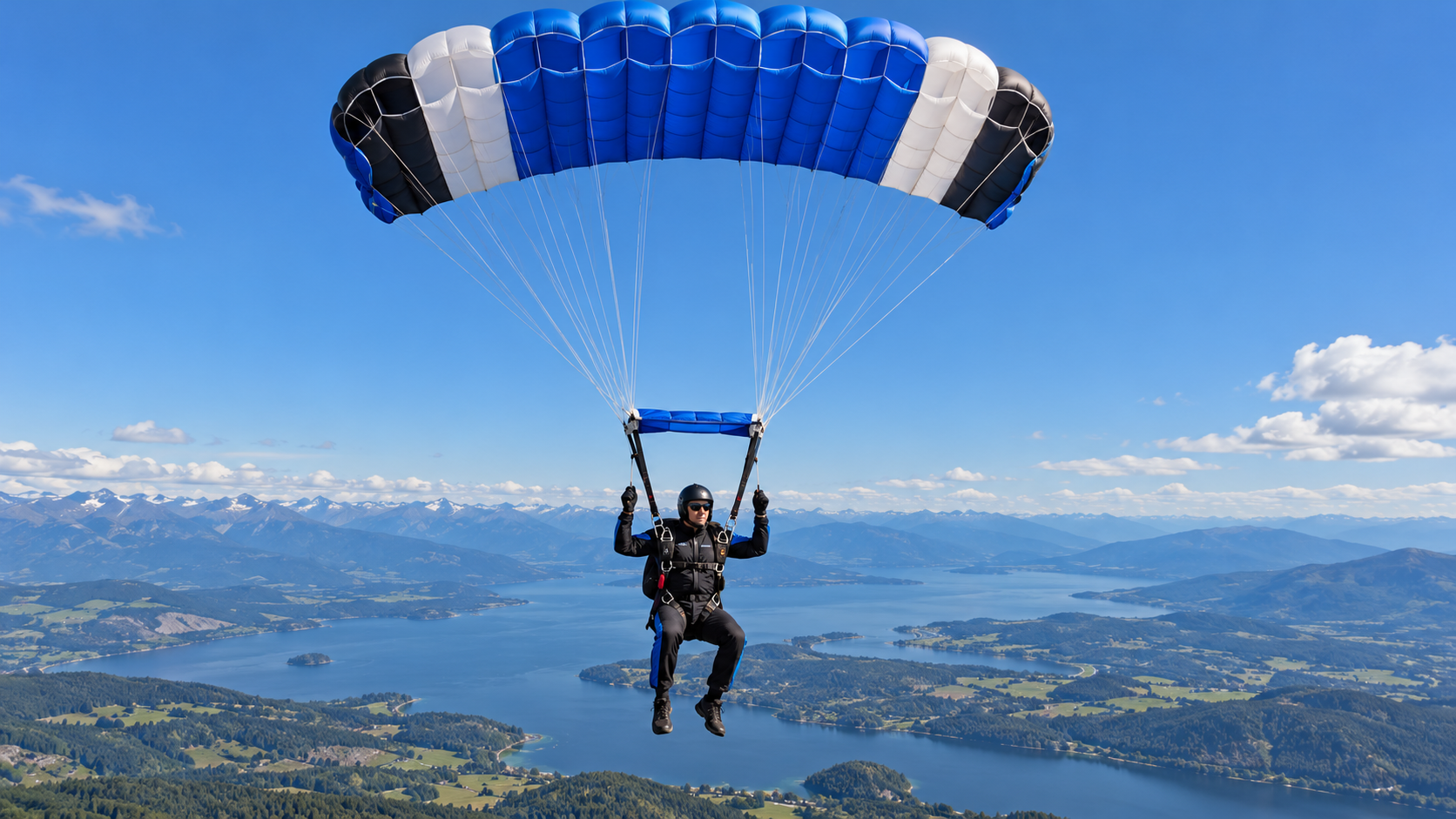
The parachute opening sequence from the ground may seem like one action, but a lot happens in the air before the chute is fully open. Several steps are involved in a skydiver opening the chute and slowing down as they descend. Each component of the system serves a purpose, from the tiny pilot chute to the large parachute that is filled with air above the body.
Well, how does a parachute open in a skydive? It begins when the pilot chute is caught by the airflow, which assists the main parachute in being released from the container. The canopy then opens, fills with air, and provides the drag needed to slow the skydiver’s descent.
This guide walks the reader through the sequence of events during parachute deployment, explains how the pilot chute operates, and what happens when the canopy opens. Let’s look more closely at the process that transforms a fast freefall descent into a controlled descent.
How Does a Parachute Open?
A modern skydiving parachute will normally open in three phases: activation, deployment, and inflation. First, the deployment system is turned on. Then the parachute, packed inside its case, is removed and opened. Lastly, air fills the parachute, causing lift and drag to slow the skydiver’s descent.
The United States Parachute Association (USPA) classifies these stages as the fundamental steps of today’s parachute system. How exactly it works is dependent on the equipment and deployment process.
While an umbrella opens with a push of a button, a skydiving parachute utilizes the flow of air, suspension lines, and specialized fabric to provide a controlled opening. The components are carefully packed so they deploy in an orderly manner, not all at once.
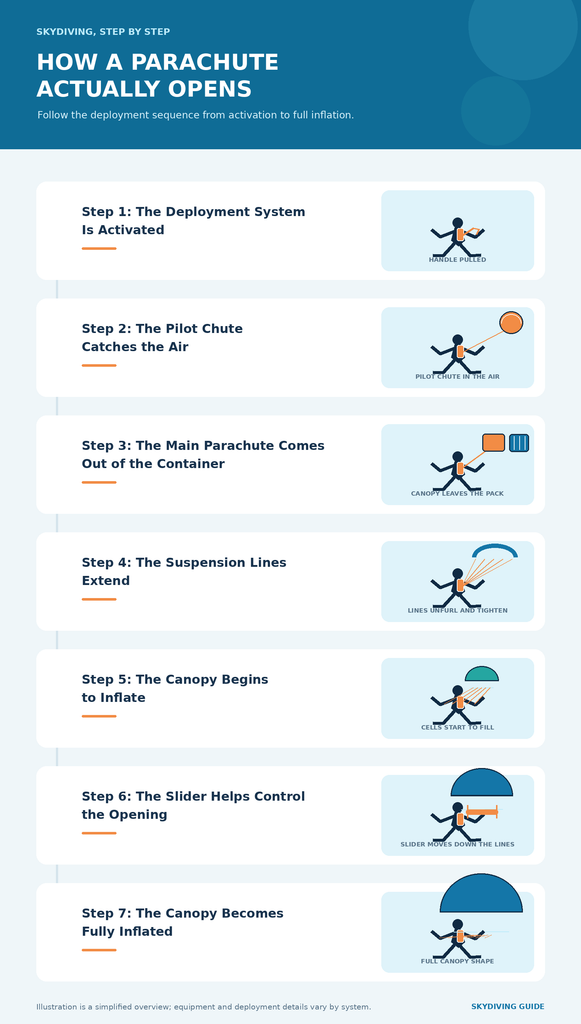
Step 1: The Deployment System Is Activated
It starts with activating the main parachute deployment system. In a normal solo jump, the trained jumper follows the procedure at the predetermined altitude. In a tandem jump, the instructor controls deployment.
Activation can be done in several ways, including hand-deploying a pilot chute, using a pull-out system, or any other approved method. Other training procedures include static-line deployment, where deployment is triggered after leaving the aircraft by a connection to the aircraft. Several components must move into position first to ensure a controlled sequence.
When the system is activated, the container opens, and the next stage starts. The parachute does not immediately become a fully inflated canopy. Several components must move in a controlled sequence to allow the opening.
Step 2: The Pilot Chute Catches the Air
A small parachute used to initiate or speed up the main parachute’s deployment. Although it is much smaller than the main canopy, it plays an important role in getting the packed system out of its container.
In a typical hand-driven system, the pilot chute enters the airflow, creating drag. This drag draws the deployment parts away from the skydiver. The pulling power is transmitted down the system through a line known as the bridle, which joins the pilot chute to the rest of the system.
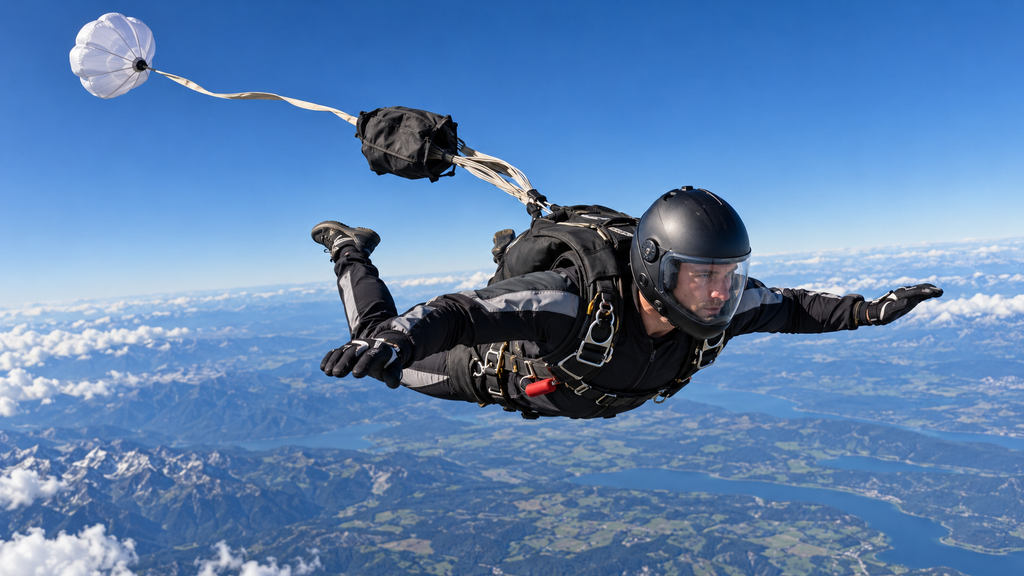
The pilot chute is the first component of a chain reaction. Although it’s a small piece of kit, it’s essential for deploying your main parachute. It helps deploy your packed canopy by catching the air.
Unlike the main canopy, the pilot chute does not support the skydiver’s weight or create drag. However, it helps deploy the larger parachute. Its size and design can also affect how your parachute deploys and may depend on the skydiving system you use.
Step 3: The Main Parachute Comes Out of the Container
When the system is activated and the pilot chute has enough drag, the main parachute starts to pop out of its container. This stage is known as deployment. It is not just a blanket of fabric that’s removed from the main canopy. It includes a deployment system that controls how the fabric and lines extend. A deployment bag or other staging device facilitates this process, depending on the equipment.
Each component has a function within the container: pilot chute, bridle, deployment device, suspension lines, and canopy. Together, they ensure the parachute opens in a controlled sequence and reduce the risk of an uncontrolled opening.
Packing and inspecting your kit are essential parts of skydiving. A trained person should pack your parachute according to the manufacturer’s instructions. Never alter your deployment system or pack it using a generic online guide.
Step 4: The Suspension Lines Extend
When the parachute is released from the container, the suspension lines stretch. These lines are used to attach the canopy to the harness system via risers, which give the inflated canopy the structural integrity it needs to lift the skydiver.
The lines must be extended as part of the planned deployment process before they can support the canopy as designed. Packing and staging the equipment support this process and help prevent the fabric and lines from being misarranged.
The suspension lines are not just cords to keep the parachute up. They distribute forces between the canopy and the harness and maintain the canopy’s shape while flying.
As the lines extend and the canopy inflates, the skydiver transitions from freefall to canopy flight. The speed and nature of this transition depend on several factors, including the parachute type, the load, body position, and how the parachute is deployed.
Step 5: The Canopy Begins to Inflate
This is the stage most people visualise when they think of a parachute deploying. Air flows into the canopy, and it begins to take on its intended shape.
Modern sport skydiving parachutes typically use a ram air canopy. This means they are much more similar to rectangular wings than the round parachutes seen in many old photographs. The fabric creates a series of pockets that trap air flowing into the canopy and help form an airfoil shape.
As the air fills these cells, the canopy starts to form its shape and its aerodynamic characteristics. This creates drag, which slows the falling skydiver; plus, the wing-shaped canopy generates lift, enabling forward gliding.
Inflation isn’t just inflating a balloon. The canopy should be formed by a carefully designed process, and the deployment system can help control the process. The objective is to get a satisfactory opening that puts the skydiver into canopy flight.
Step 6: The Slider Helps Control the Opening
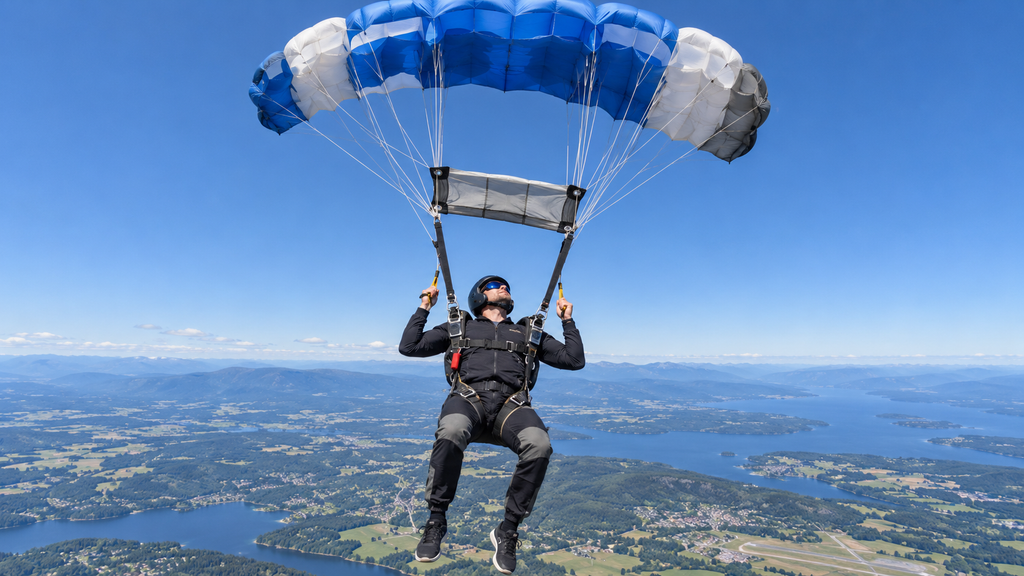
Many modern ram-air parachutes have a slider. This is a piece of material that is attached close to the suspension line and is usually held up to the canopy during deployment.
As the canopy deploys, the slider travels down the suspension line toward the risers. As it moves, it helps control how fast the lines and canopy open.
The ‘slider’ is an important component within many sports parachute systems. Depending on the canopy and equipment design, the slider’s size, shape, and function will vary accordingly. Skydivers should be trained by an experienced instructor following the manufacturer’s guidelines to understand how their equipment works.
A controlled deployment is important because, during deployment, the skydiver experiences a sudden increase in speed and force. As such, the deployment system has been designed to ensure the canopy opens in a controlled manner.
Step 7: The Canopy Becomes Fully Inflated
Once the canopy fully inflates and deploys, it takes on its desired wing shape. The skydiver can now check their parachute and begin flying towards their landing area.
The canopy acts as a large brake, slowing the skydiver while providing lift to keep them moving forward. Modern ram-air parachutes are much more advanced than traditional round parachutes that provide extra drag. They can glide and be steered.
Complete inflation of the canopy doesn’t mean that all aspects of the opening are normal. Skydivers are trained to identify their canopy and spot problems using their training and equipment-specific procedures. These checks are a crucial part of the canopy/parachute transition from deployment to flight.
For first-time tandem passengers, the instructor handles deployment and canopy flight. With support, students who jump solo and licensed skydivers learn canopy awareness and emergency procedures through formal training.
What Happens If a Parachute Does Not Open Properly?
Although parachute systems have safety features, problems can occur during deployment, extraction, line extension and canopy inflation. Some problems cause the parachute to deploy but not fly properly. Others prevent the main canopy from being usable.
Skydivers are trained to identify malfunctions and respond appropriately, based on their equipment and training. The USPA’s instructional materials discuss issues like pilot-chute hesitation, line twists, and other canopy-opening problems.
More modern gear might also incorporate a reserve parachute and an Auto Activation Device (AAD). Certain conditions are monitored by an AAD, and if it meets its programmed conditions, it can trigger the activation of reserves. It does not replace training, ascent awareness, or emergency procedure use.
How Long Does It Take for a Skydiving Parachute to Open?
The deployment happens quickly. However, the time depends on the parachute system, deployment conditions, and type of jump. It is better to think of opening as a sequence of stages rather than assume every parachute takes the same number of seconds. The pilot parachute deploys the packed parachute, which then inflates the canopy. Some steps are sequential, while others overlap during deployment.
A tandem jump feels different from a solo skydive. In a tandem jump, the instructor controls the system, and the passenger experiences the transition from freefall to canopy flight. Solo skydivers will learn to monitor altitude and will learn about deployment and emergency procedures during training. For accurate performance information, refer to the canopy manufacturer’s documentation and a qualified instructor familiar with the equipment.
Conclusion
Learning how the parachute deploys can help you understand the science behind it. Once the deployment system activates, the pilot chute catches the air, the main parachute deploys from the pack, and the suspension lines deploy, allowing the canopy to inflate and form a wing. This slows down the descent and creates controlled flight.
All components play a role, from the pilot chute, which begins the deployment process, to the slider, which helps control inflation on many modern sport parachutes. All of these help allow the canopy to be deployed.