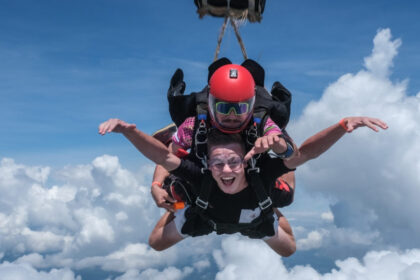

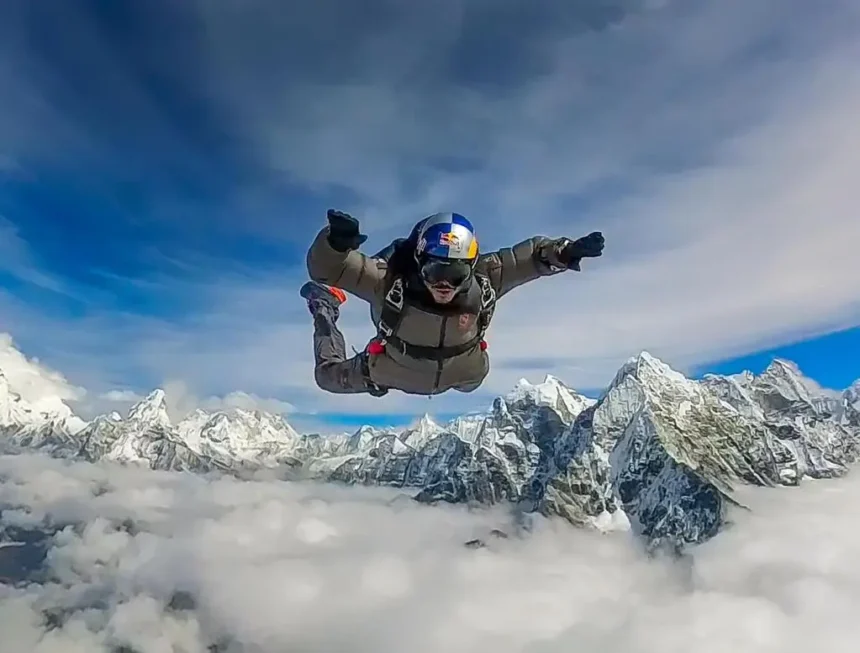
“Is skydiving dangerous?” It’s the first question nearly everyone asks before booking their first jump. With over 3.6 million skydives completed annually in the United States alone, concerns about skydiving deaths and safety statistics are completely understandable. After all, jumping from an airplane at 14,000 feet sounds inherently risky.
- Quick Answer Box
- Table of Contents
- Current Skydiving Death Statistics (2024-2026)
- How Skydiving Safety Has Improved Over Time
- What Causes Skydiving Deaths? Breaking Down the Data
- Tandem vs. Solo Skydiving: Which Is Safer?
- How Does Skydiving Compare to Other Activities?
- Choosing Safe Skydiving Operators: Red Flags and Green Lights
- Essential Safety Equipment That Saves Lives
- Age, Health, and Individual Risk Factors
- Insurance and Legal Considerations
- Frequently Asked Questions
- Q: How many people die each year from skydiving in the United States?
- Q: Is skydiving more dangerous than driving?
- Q: What causes most skydiving deaths?
- Q: Has anyone ever survived a skydiving parachute failure?
- Q: What is the death rate for tandem vs. solo skydiving?
- Q: At what point in a jump are you most likely to die?
- Q: Can you die from fear during a skydive?
- Q: Is skydiving safer now than 10 years ago?
- Q: How many jumps does it take to become safe at skydiving?
- Q: What percentage of skydivers eventually die from skydiving?
- Q: Are there countries with worse skydiving safety records than the United States?
- Q: Does skydiving get safer the more experienced you become?
- Q: Should I get life insurance before skydiving?
- Q: What should I do if I’m nervous about skydiving?
- Conclusion: Understanding Risk to Make Informed Decisions
The reality might surprise you. Modern skydiving has evolved dramatically over the past two decades, with safety innovations, rigorous training protocols, and advanced equipment making it statistically safer than many everyday activities Americans participate in without a second thought. But statistics alone don’t tell the complete story—understanding how many people die each year from skydiving, what causes these incidents, and how you can minimize risk is essential for making an informed decision.
In this comprehensive 2026 guide, you’ll discover the latest skydiving fatality statistics, how they’ve changed over time, what factors contribute to skydiving deaths, and most importantly, how to choose safe operators and equipment that dramatically reduce your risk. Whether you’re considering your first tandem jump or evaluating skydiving as a regular hobby, this article provides the data-driven answers you need to jump with confidence.
Quick Answer Box
How Many People Die Each Year From Skydiving?
- In 2024: 15 skydiving fatalities in the United States out of 3.65 million jumps
- Fatality Rate: 0.41 per 100,000 jumps (one death per 244,000 jumps)
- Tandem Skydiving: Approximately 1 death per 500,000 tandem jumps—even safer
- Historical Trend: Deaths have decreased 57% since 2000 despite more jumpers
- Comparison: Skydiving is statistically safer than driving the same distance, horseback riding, or college football
The risk is real but remarkably low with proper training, certified equipment, and licensed operators.
Table of Contents
- Current Skydiving Death Statistics (2024-2026)
- How Skydiving Safety Has Improved Over Time
- What Causes Skydiving Deaths? Breaking Down the Data
- Tandem vs. Solo Skydiving: Which Is Safer?
- How Does Skydiving Compare to Other Activities?
- Choosing Safe Skydiving Operators: Red Flags and Green Lights
- Essential Safety Equipment That Saves Lives
- Age, Health, and Individual Risk Factors
- Insurance and Legal Considerations
- Frequently Asked Questions
Current Skydiving Death Statistics (2024-2026)
Let’s address the central question directly: how many people die each year from skydiving in the United States? According to the United States Parachute Association (USPA), the authoritative body tracking skydiving safety, 2024 saw 15 fatal skydiving incidents out of approximately 3.65 million jumps completed.
Breaking Down the Numbers
2024 Final Statistics:
- Total jumps: 3,650,000
- Total fatalities: 15
- Fatality rate: 0.41 per 100,000 jumps
- This translates to: 1 death per 243,333 jumps
To put this in perspective, your odds of dying in a single skydive are approximately 0.0004% or 99.9996% survival rate. These are the lowest fatality rates ever recorded in the sport’s history.
Recent 5-Year Trend (2020-2024):
| Year | Total Jumps | Fatalities | Rate per 100,000 |
|---|---|---|---|
| 2020 | 2,800,000 | 11 | 0.39 |
| 2021 | 3,200,000 | 10 | 0.31 |
| 2022 | 3,400,000 | 20 | 0.59 |
| 2023 | 3,550,000 | 16 | 0.45 |
| 2024 | 3,650,000 | 15 | 0.41 |
What the Data Shows:
The five-year average sits at 0.43 fatalities per 100,000 jumps. While individual years show variation—2022’s uptick was attributed to post-pandemic rusty skills and equipment maintenance lapses—the long-term trend remains consistently positive. The sport accommodates more jumpers annually while maintaining or improving safety metrics.
Tandem Skydiving: The Safest Way to Jump
For first-time jumpers, tandem skydiving represents the safest entry point. The statistics are even more reassuring:
Tandem-Specific Statistics:
- Approximately 1 death per 500,000 tandem jumps
- In 2024: Only 1 tandem fatality out of roughly 350,000 tandem jumps
- Tandem fatality rate: 0.29 per 100,000 tandem jumps
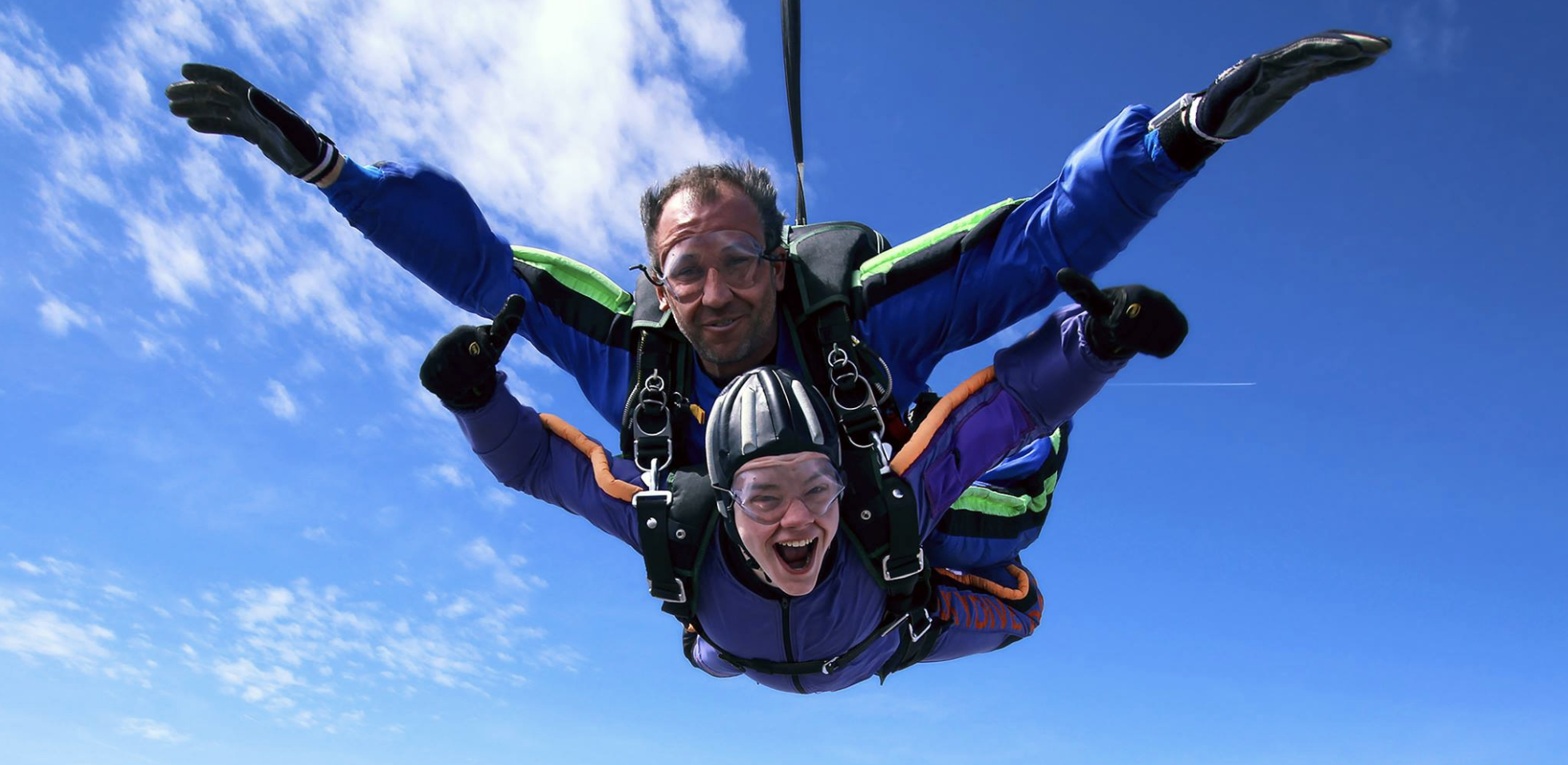
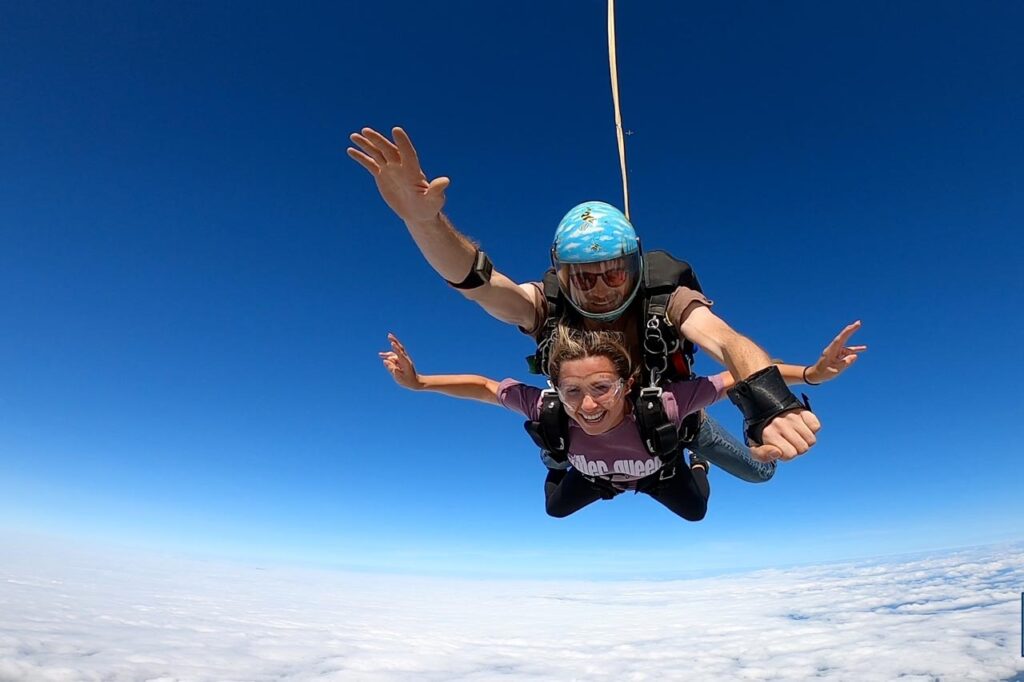
The enhanced safety of tandem jumps stems from multiple factors: you’re attached to a USPA-certified instructor with thousands of jumps, the equipment undergoes more frequent inspections, tandem rigs have additional safety features, and the decision-making rests with experienced professionals rather than first-timers.
Recommended Tandem Equipment: For operators, Sigma Tandem Systems and Strong Enterprises Dual Hawk represent gold-standard tandem rigs with perfect safety records and thousands of successful deployments. When booking your jump, ask what equipment the drop zone uses—these brands indicate serious safety commitment.
How Skydiving Safety Has Improved Over Time
Understanding how many people die each year from skydiving becomes more meaningful when viewed historically. The improvements are dramatic and instructive.
Historical Context: 1980s to Present
Fatality Rate Evolution:
- 1980s: 3.5-4.2 deaths per 100,000 jumps
- 1990s: 2.5-3.0 deaths per 100,000 jumps
- 2000s: 1.2-2.0 deaths per 100,000 jumps
- 2010s: 0.6-1.0 deaths per 100,000 jumps
- 2020s: 0.31-0.59 deaths per 100,000 jumps
This represents an 88% reduction in fatality rates since the 1980s, despite the number of annual jumps increasing by over 150%. More people are skydiving than ever before, yet fewer people are dying. This isn’t coincidence—it reflects systematic safety improvements across equipment, training, and culture.
Five Key Safety Innovations
1. Automatic Activation Devices (AADs)
The single most impactful safety innovation in skydiving history. AADs like the Cypres 2 and Vigil II automatically deploy your reserve parachute if you’re still in freefall below a certain altitude (typically 750-1,000 feet).
According to USPA data, AADs prevent approximately 80-100 deaths annually. They’ve become standard equipment on all rental and student rigs, and most experienced jumpers won’t jump without one. The Cypres 2 specifically has saved over 4,800 lives since its introduction.
Investment Note: If you’re pursuing skydiving certification, budget $1,200-$1,600 for an AAD. It’s non-negotiable safety equipment.
2. Square Parachutes and Wing Loading Standards
Older round parachutes offered minimal control and harder landings. Modern square (ram-air) parachutes like the Navigator by Aerodyne or Sabre3 by Performance Designs provide precise control, softer landings, and better emergency handling.
Wing loading regulations—matching parachute size to jumper weight—have dramatically reduced landing injuries and deaths. Rental equipment now universally follows conservative wing loading guidelines.
3. Standardized Training Protocols
The USPA’s Integrated Student Program (ISP) replaced inconsistent training methods with scientifically-developed, standardized curricula. Students now receive:
- Comprehensive ground school (6-8 hours minimum)
- Progressive skill-building across 25 jumps
- Documented competency evaluations at each stage
- Emergency procedure training with physical simulations
This standardization reduced student fatalities by 67% compared to pre-2000 training methods.
4. Digital Altimeters and Audible Devices
Modern jumpers use multiple altitude-awareness devices:
- Visual altimeters worn on wrist or chest
- Audible altimeters that beep at preset altitudes
- Digital loggers recording entire jump profiles
Alti-2 Atlas and L&B Viso II+ represent current best-in-class devices. These tools eliminate altitude confusion—historically a leading cause of fatal errors.
**5. Cultural Shift Toward Safety
Modern skydiving culture emphasizes safety over bravado. Drop zones implement:
- Currency requirements (minimum jumps within specific timeframes)
- Weather minimums strictly enforced
- Peer accountability systems
- Incident reporting and analysis
- Continuing education requirements
This culture shift may be the most important factor. Experienced jumpers now actively intervene when witnessing risky behavior, and operators prioritize safety over profit.
What Causes Skydiving Deaths? Breaking Down the Data
To understand how many people die each year from skydiving and why, we must examine causation patterns. USPA conducts thorough investigations of every fatality, revealing consistent patterns.
Primary Causes of Skydiving Fatalities
USPA 2024 Fatality Breakdown:
- Canopy Collisions (26%) – Two or more jumpers under parachute colliding
- Low Pull/No Pull (20%) – Failure to deploy parachute in time
- High-Performance Landings (18%) – Aggressive landing maneuvers gone wrong
- Equipment Malfunction Mismanagement (15%) – Improper response to malfunctions
- Mid-Air Collisions in Freefall (8%) – Contact during freefall causing incapacitation
- Medical Events (7%) – Heart attacks, strokes during jump
- Equipment Failure (4%) – Actual equipment defects
- Other (2%) – Uncommon scenarios
Critical Analysis: Human Error vs. Equipment Failure
The data reveals a sobering reality: equipment failure causes only 4% of fatalities. The overwhelming majority (96%) involve human error, judgment, or risk-taking behavior. Modern skydiving equipment is remarkably reliable—deaths almost always result from how people use that equipment.
Breaking Down Human Error:
Canopy Collisions: Most occur during “canopy relative work” (CRW) or when jumpers ignore traffic patterns. These deaths are entirely preventable through awareness and following established approach patterns. The Icarus Safire3 parachute offers superior maneuverability for collision avoidance.
Low Pull/No Pull: Despite AADs, some experienced jumpers disable safety devices or jump without them. Others experience “target fixation,” becoming so focused on reaching a landing target they forget altitude awareness. Audible altimeters like the Parasport Optima II provide critical altitude warnings.
High-Performance Landings: Advanced skydivers perform “swoops”—high-speed, low-altitude turns creating exciting landings. When executed improperly, these maneuvers prove fatal. Approximately 90% of swooping deaths involve jumpers with 500+ jumps who know better but accept risk for performance.
Equipment Malfunction Mismanagement: Modern parachute systems include both main and reserve parachutes. Malfunctions are rare, but when they occur, jumpers must execute emergency procedures: cut away the main parachute and deploy the reserve. Fatalities happen when jumpers delay this decision, react incorrectly, or panic. Proper training with Sigma Tandem Systems training rigs ingrains correct responses.
The Experience Paradox
Counterintuitively, jumpers with 50-500 jumps experience higher fatality rates than complete beginners or highly experienced jumpers (5,000+ jumps). This “intermediate danger zone” reflects:
- Overconfidence from initial success
- Reduced supervision after student status
- Pushing boundaries before judgment fully develops
- Peer pressure in group jumps
Safety Recommendation: If you continue past your initial certification, invest in coaching from experienced mentors. Many drop zones offer Jump Safety Coaching Programs specifically targeting this vulnerable period.
Tandem vs. Solo Skydiving: Which Is Safer?
When researching how many people die each year from skydiving, the distinction between tandem and solo jumping significantly impacts your risk assessment.
Tandem Skydiving Safety Profile
Statistics:
- 1 death per 500,000 tandem jumps
- Fatality rate: 0.20 per 100,000 jumps
- In 2024: Only 1 tandem fatality in the USA
Why Tandem Is Safer:
- Professional Control: Your tandem instructor has 3-7 years experience and 500+ jumps minimum (USPA requirements). They handle all critical decisions.
- Enhanced Equipment: Tandem rigs like the Strong Enterprises Dual Hawk feature:
- Larger parachutes (main canopies 340-400 sq ft vs. 150-200 for solo)
- Drogue parachutes for freefall stability
- Redundant deployment systems
- More conservative design margins
- Stricter Maintenance: Tandem equipment undergoes inspections every 100 jumps or 180 days (whichever comes first) versus 180 days for solo equipment.
- AAD Standard: All tandem rigs include automatic activation devices. The Cypres 2 Tandem version is specifically calibrated for tandem weight and descent rates.
The Single Tandem Fatality in 2024: The 2024 incident involved a medical event (suspected heart attack) during descent, not equipment failure or instructor error. The passenger had undisclosed cardiovascular conditions. This underscores the importance of honest medical disclosures.
Solo Skydiving Safety Profile
Statistics:
- Fatality rate: 0.45-0.50 per 100,000 solo jumps
- Risk increases during student progression phase
- Experienced jumpers (5,000+ jumps) have lowest rates
Solo Jumping Risk Factors:
Student Progression (First 25 Jumps): Students account for approximately 15% of fatalities despite representing 8% of jumps. The learning curve involves genuine risk as students develop judgment and skills. However, modern training programs have dramatically improved these statistics.
The USPA Coach Rating Course ensures students receive qualified instruction throughout progression, significantly reducing incidents.
Experienced Jumper Risks: After certification, skydivers choose their own equipment, jump conditions, and maneuvers. Freedom brings responsibility and potential for poor decisions. The data shows experienced jumpers primarily die from:
- Attempting maneuvers beyond skill level
- Jumping in marginal weather
- Complacency about safety procedures
- High-performance landing attempts
Equipment Investment for Solo Safety:
If pursuing solo certification, budget for quality equipment:
- Complete rig (container, main, reserve): $6,000-$9,000
- AAD: $1,200-$1,600 (Vigil II Cuatro)
- Altimeter: $200-$400 (Alti-2 Galaxy)
- Audible altimeter: $100-$150 (Optima II Audible)
- Helmet: $200-$500 (Cookie G4 Helmet)
Total first-time equipment investment: $7,700-$11,750
Cost-Benefit Analysis: Many jumpers rent equipment for their first 100-200 jumps, allowing skill development before major financial commitment. Rental fees ($40-$60 per jump) total $4,000-$12,000 across 100-200 jumps, comparable to ownership costs while eliminating maintenance responsibilities.
Bottom Line: Tandem for Safety, Solo for Long-Term Engagement
Choose tandem if:
- First-time experience or occasional jumping
- Minimal training time available
- Budget-conscious (one-time expense vs. equipment investment)
- Prioritizing absolute safety
Choose solo certification if:
- Planning regular jumping (10+ times annually)
- Want full control over experience
- Interested in skydiving community and progression
- Willing to invest in training and equipment
How Does Skydiving Compare to Other Activities?
Understanding how many people die each year from skydiving becomes more meaningful through comparison with everyday activities Americans routinely undertake.
Statistical Risk Comparisons
Activities MORE Dangerous Than Skydiving:
- Driving: 1.34 deaths per 100 million vehicle miles traveled (NHTSA 2024). Driving the distance equivalent to your skydiving flight (approximately 50-100 miles round trip) carries statistically higher risk than the skydive itself.
- Horseback Riding: 7.0 deaths per 100,000 participants annually. Approximately 17 times more dangerous than skydiving.
- College Football: 3.7 deaths per 100,000 participants from direct injury or heat-related incidents.
- Recreational Boating: 6.5 deaths per 100,000 registered vessels annually.
- Swimming/Pool Activities: 3.5 deaths per 100,000 participants.
Activities LESS Dangerous Than Skydiving:
- Commercial Air Travel: 0.07 deaths per billion passenger miles—extremely safe
- Rail Travel: 0.43 deaths per billion passenger miles
- Most Spectator Sports: Essentially zero fatality risk
The “Micromort” Framework
Risk analysts use “micromorts”—one-in-a-million chances of death—to compare activities:
- Single skydive: 4 micromorts
- Driving 230 miles: 4 micromorts (equivalent risk)
- Scuba diving (single dive): 5-8 micromorts
- Marathon running: 7 micromorts
- Giving birth (USA): 170 micromorts
- Base jumping (single jump): 430 micromorts (100x more dangerous than skydiving)
This framework reveals that a single skydive carries the same statistical risk as driving roughly 230 miles—a distance many Americans drive weekly without concern.
Annual vs. Per-Event Risk
An important distinction: skydiving statistics represent per-event risk, while driving statistics accumulate across repeated exposure. Americans average 13,500 miles driven annually, accumulating significantly more total risk than occasional skydivers.
Annual Risk Calculation Examples:
Occasional Skydiver (2 jumps/year):
- Annual risk: 0.0008% chance of fatality
- Equivalent to driving 460 miles annually
Regular Skydiver (50 jumps/year):
- Annual risk: 0.02% chance of fatality
- Still lower than many hobbies
Active Skydiver (200 jumps/year):
- Annual risk: 0.08% chance of fatality
- Approaching risk levels of competitive sports
Perception vs. Reality
Humans are notoriously poor at intuitive risk assessment. We fear dramatic, uncontrollable risks (plane crashes, skydiving) while underestimating mundane, familiar risks (driving, ladders, bathtubs).
According to risk perception research from MIT (2025), people overestimate skydiving risk by approximately 300-500% while underestimating driving risk by 50-70%. The “dread factor” of jumping from planes triggers evolutionary fear responses, even though statistical evidence shows remarkable safety.
Recommended Reading: The Psychology of Risk Perception in Adventure Sports provides fascinating insights into why we fear what we fear, helping frame rational decisions about activities like skydiving.
Choosing Safe Skydiving Operators: Red Flags and Green Lights
When evaluating how many people die each year from skydiving, operator selection dramatically influences your personal risk. Not all drop zones maintain equal safety standards.
Green Lights: Indicators of Safe Operations
1. USPA Group Membership
The United States Parachute Association certifies drop zones meeting rigorous safety standards. USPA Group Member drop zones must:
- Employ certified instructors and coaches
- Maintain equipment to USPA standards
- Follow USPA Basic Safety Requirements (BSR)
- Submit annual safety audits
- Carry adequate insurance
Verification: Check USPA’s Drop Zone Locator before booking. Non-USPA operators save money by cutting corners—corners that shouldn’t be cut in aviation.
2. Instructor Credentials
Safe operators employ properly credentialed instructors:
- USPA Tandem Instructor Rating: Minimum 500 jumps, 3 years in sport, demonstrated teaching ability
- USPA Accelerated Freefall (AFF) Instructor: Minimum 500 jumps, specialized training
- USPA Coach Rating: For student supervision and skill development
Ask your specific instructor’s credentials before jumping. Legitimate operators provide this information proudly. If they’re evasive, walk away.
3. Modern, Well-Maintained Equipment
Professional operations use current-generation equipment:
Main Parachutes:
- Navigator 280 by Aerodyne – Docile student/rental parachute
- Safire3 by Performance Designs – Intermediate progression
- Horizon by Icarus – Reliable rental fleet staple
Tandem Rigs:
- Strong Enterprises Dual Hawk
- Sigma Tandem System
- United Parachute Technologies Vector
AADs:
- Cypres 2 (industry standard)
- Vigil II Cuatro (excellent alternative)
Equipment should show signs of proper maintenance: no tears, fading indicating sun damage, or jerry-rigged repairs. Ask when equipment was last professionally inspected—answers should be specific and recent.
4. Transparent Safety Record
Legitimate operators discuss their safety record openly:
- Total jumps conducted
- Years in operation
- Incident history
- Safety committee structure
- Training protocols
Warning sign: operators who deflect safety questions or claim “perfect records” spanning decades. All busy drop zones experience incidents—what matters is how they respond, investigate, and implement improvements.
5. Weather Decision-Making
Professional operators cancel jumps in marginal conditions without hesitation. Signs of good weather practices:
- Published weather minimums (wind speeds, cloud ceilings, visibility)
- Refusing to jump when approaching limits
- Offering rescheduling or refunds cheerfully
- Explaining weather decisions to customers
Red flag: Operators pressuring you to jump in marginal weather or dismissing your weather concerns.
6. Comprehensive Ground School
First-time jumpers should receive thorough ground training:
Tandem Ground School (minimum 20-30 minutes):
- Body position during freefall
- Landing techniques
- Emergency procedures
- What to expect throughout flight and descent
AFF Ground School (minimum 6-8 hours):
- Parachute systems and physics
- Body flight fundamentals
- Emergency procedures with hands-on practice
- Altitude awareness and pull priorities
- Canopy flight and landing patterns
Operators rushing through briefings or using videos exclusively without instructor interaction demonstrate poor safety culture.
Red Flags: Warning Signs of Unsafe Operators
1. Prices Dramatically Below Market Rate
Tandem skydiving costs $200-$300 in most US markets. Operators charging $99-$150 are cutting corners somewhere—potentially maintenance, instructor qualifications, or insurance coverage.
Safety isn’t the place for bargain hunting. Occasionally legitimate operators offer promotional pricing, but consistent extreme discounting indicates problems.
2. Unresponsive to Safety Questions
Professional operators welcome safety questions. Red flags include:
- Defensiveness about credentials
- Inability to provide instructor qualifications
- Vague answers about equipment maintenance
- Dismissive attitudes toward concerns
- High-pressure sales tactics
3. Poor Online Reviews Citing Safety
Scan Google, Yelp, and TripAdvisor for patterns:
- Multiple reviews mentioning equipment condition
- Complaints about rushed training
- Reports of pressuring nervous jumpers
- Incidents poorly handled
Focus on patterns rather than single negative reviews—all businesses receive occasional unfair criticism.
4. No Physical Facility or Obvious Operations
Legitimate drop zones maintain physical locations with:
- Aircraft visible (usually Cessna 182s, Twin Otters, or King Airs)
- Packing/rigging areas
- Training spaces
- Clear signage and organization
Be wary of operations meeting clients at remote airfields without established facilities—suggests transient, unregulated operations.
5. Outdated or Unknown Equipment
If you don’t recognize equipment brands or designs appear decades old, inquire specifically:
- When was equipment manufactured?
- When was last reserve repack? (Should be within 180 days)
- Are AADs installed and current? (Should have recent certification stickers)
Old equipment isn’t automatically unsafe—properly maintained vintage gear performs well—but outdated equipment at budget operators suggests deferred maintenance.
Recommended Drop Zones by Region
Northeast:
- Skydive New England (Lebanon, Maine)
- The Ranch (Gardiner, New York)
Southeast:
- Skydive Sebastian (Florida)
- Carolina Sky Sports (South Carolina)
Midwest:
- Chicagoland Skydiving Center (Illinois)
- Start Skydiving (Ohio)
Southwest:
- Skydive Arizona (one of world’s largest facilities)
- Skydive Spaceland (Texas locations)
West Coast:
- Skydive Perris (California)
- Skydive Snohomish (Washington)
These established operations demonstrate consistent safety records and professional operations. Links provide detailed safety information and booking options.
Essential Safety Equipment That Saves Lives
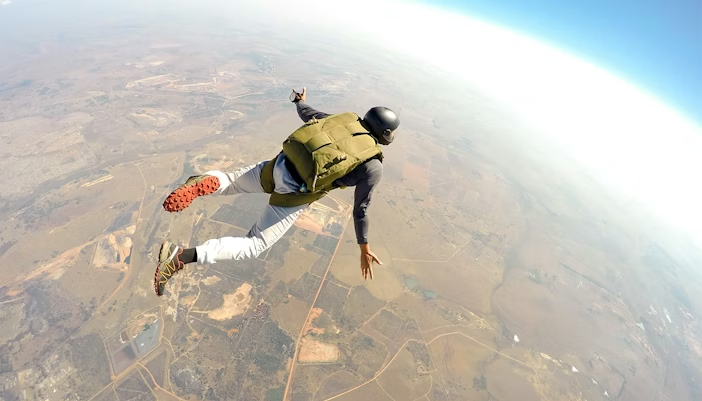
Understanding how many people die each year from skydiving reveals that proper equipment dramatically influences outcomes. Modern skydiving safety relies on multiple redundant systems.
The Complete Skydiving Equipment System
1. The Container/Harness System
Your parachute container holds both main and reserve parachutes plus the AAD. Leading manufacturers:
- Vector 3 by UPT: Industry standard, used by professionals worldwide ($2,500-$3,500)
- Javelin Odyssey by Sun Path: Excellent reserve container design ($2,200-$3,200)
- Infinity by Velocity Sports: Comfortable, reliable system ($2,000-$3,000)
Containers must fit properly—too large or small increases malfunction risk. Professional rigging lofts like ChutingGround Rigging provide fitting services ensuring optimal configuration.
2. Main Parachute
Your primary parachute deploys first. Choosing the right main depends on experience:
Student/Beginner Canopies (First 50 jumps):
- Navigator 260-280 by Aerodyne: Forgiving, stable, excellent for learning ($2,200-$2,600)
- Sabre3 230-260 by Performance Designs: Slightly more responsive, good progression canopy ($2,800-$3,200)
Intermediate Canopies (50-200 jumps):
- Pulse 190-210 by Aerodyne: Performance increase without excessive risks ($2,400-$2,800)
- Sabre3 190-210 by Performance Designs: Versatile all-arounder ($2,800-$3,200)
Advanced Canopies (200+ jumps):
- Katana 150-170 by Performance Designs: High-performance swooping ($3,000-$3,500)
- Velocity 96-120 by Performance Designs: Expert-only, extremely aggressive ($3,200-$3,800)
Critical Warning: Downsizing (choosing smaller parachutes) too quickly causes numerous deaths annually. Follow conservative progression guidelines—smaller isn’t better if it exceeds your skill level.
Wing Loading Guide:
- Beginners: 0.8-1.0 lbs per square foot
- Intermediate: 1.0-1.3 lbs per square foot
- Advanced: 1.3-1.7 lbs per square foot
- Expert: 1.7-2.5+ lbs per square foot
Calculate wing loading: Body weight ÷ Canopy size = Wing loading
Example: 180 lb jumper ÷ 210 sq ft canopy = 0.86 wing loading (appropriate for beginners)
3. Reserve Parachute
Your backup system, packed by certified riggers and inspected every 180 days. Reserve parachutes use more conservative designs optimized for reliability over performance.
Popular reserves:
- PD Optimum Reserve: Proven reliability ($2,000-$2,400)
- Icarus Reserve: Excellent opening characteristics ($1,800-$2,200)
Never skip reserve repacks. The $80-$120 fee every 180 days represents critical safety maintenance.
4. Automatic Activation Device (AAD)
The single most important safety innovation. AADs save 80-100 lives annually in the US alone.
Cypres 2 – $1,395-$1,595
- Industry standard since 1991
- Over 4,800 documented lives saved
- Models: Student/Tandem, Expert, Speed (for swooping)
- 15.5-year lifespan, then requires replacement
- Battery lasts 1,000 jumps or 2 years
Vigil II Cuatro – $1,295-$1,495
- Strong alternative to Cypres
- User-replaceable battery (cost savings)
- Multiple mode settings
- 20-year lifespan
- Slightly less market penetration but excellent performance
M2 by Mars – $995-$1,195
- Budget-friendly option
- Simpler interface
- Good performance record
- Less common, fewer service centers
How AADs Work: AADs measure altitude and descent rate. If you’re below ~750 feet while falling faster than ~78 mph, the AAD fires a cutter that severs the reserve container closing loop, allowing the reserve to deploy automatically.
They activate when you’re unconscious, incapacitated, or experiencing altitude awareness failure. They don’t replace proper procedure but provide backup for catastrophic failures.
Maintenance: AADs require manufacturer servicing every 4 years (Cypres) or battery changes every 2 years. Never skip this maintenance—expired AADs may fail when needed most.
5. Altimeter (Visual)
Wrist or chest-mounted devices showing current altitude.
Alti-2 Atlas – $249
- Large, clear display
- Logbook function stores jump data
- Bluetooth connectivity
- Popular student/rental choice
L&B Viso II+ – $295
- Versatile mixed-use (skydiving/BASE jumping)
- Complex feature set
- Highly accurate
- Requires learning curve
Alti-2 Galaxy – $379
- Premium analog altimeter
- No batteries required (mechanical)
- Simple, reliable, traditional
- Preferred by purists
Altimeters require regular accuracy checks against known elevations. Most drop zones maintain calibration stations for this purpose.
6. Audible Altimeter
Mounted inside helmet, audible altimeters beep at preset altitudes—typically 5,500, 4,500, and 3,000 feet.
Optima II by Parasport – $129
- Beginner-friendly
- Clear, loud beeping
- Simple programming
- Reliable workhorse
Quattro by L&B – $155
- Four programmable altitude warnings
- Adjustable volume
- Small, lightweight
- Popular choice
Audible altimeters provide awareness without looking at visual altimeters—critical when practicing skills or distracted during jump.
7. Helmet
Protects your head during aircraft exit, freefall, and potential landing complications.
Cookie G4 Helmet – $379-$499
- Industry standard for camera flying
- Excellent protection and comfort
- Multiple camera mount options
- Full-face or open-face configurations
Bonehead Aero – $199-$279
- Budget-friendly
- Good basic protection
- Lighter weight
- Popular student choice
Tonfly TFX – $320-$420
- Aerodynamic design
- Comfortable fit
- Good ventilation
- European favorite
Full-face helmets provide maximum protection but can trap heat. Open-face helmets offer better cooling but less jaw protection. Choose based on jumping style and climate.
8. Goggles
Protect eyes during 120+ mph freefall.
Bonehead Killer Goggles – $45
- Industry standard
- Comfortable foam seal
- Anti-fog coating
- Affordable replacement
Clear or lightly tinted lenses work for most conditions. Dark lenses create visibility problems during sunset jumps or under canopy.
Equipment Budget Summary
Complete First-Time Equipment Package:
- Container/harness: $2,500
- Main parachute: $2,500
- Reserve parachute: $2,000
- AAD: $1,400
- Altimeter (visual): $300
- Altimeter (audible): $140
- Helmet: $300
- Goggles: $45
- Jumpsuit: $150
- Miscellaneous (logbook, gear bag): $100
Total: $9,435
Smart Shopping Strategy:
- Buy new AAD – Don’t compromise on this item
- Buy new reserve – Or verify reserve is recently manufactured with documentation
- Consider used main parachute – Inspect with rigger, save $800-1,200
- Consider used container – Inspect thoroughly, save $500-1,000
- Buy new altimeters and helmet – Reliability crucial, prices reasonable
Buying used equipment from Para Gear or ChutingGround with professional inspection can reduce costs to $6,500-$7,500 while maintaining safety.
Rental Alternative: Most drop zones rent complete gear packages for $40-$60 per jump. Across your first 150 jumps, rental costs $6,000-$9,000—comparable to ownership without maintenance responsibilities or fitting concerns.
Age, Health, and Individual Risk Factors
How many people die each year from skydiving statistics represent population averages. Individual risk varies based on personal factors.
Age Considerations
Minimum Age Requirements:
- USPA: 18 years old (no exceptions for tandem)
- Some drop zones: 16 with parental consent (varies by state law)
Maximum Age: No upper age limit exists. People in their 80s and 90s skydive successfully. However, age-related considerations include:
Ages 60-70: Generally proceed without special requirements if health is good. Some operators request medical clearance, but it’s not universal. Risk profile remains similar to younger adults.
Ages 70-80: Most operators require physician clearance. Focus areas: cardiovascular health, bone density, joint mobility. Falls during landing pose greater injury risk due to reduced bone strength.
Ages 80+: Requires careful evaluation. While chronological age isn’t disqualifying, overall health status matters significantly. Successful octogenarian skydivers share characteristics: excellent cardiovascular health, good mobility, reasonable weight, and realistic expectations.
Oldest Tandem Skydivers on Record:
- 103 years old (multiple claims at this age)
- Requires perfect health and physician approval
- Good publicity for drop zones encourages accommodation
Youth Considerations (Ages 18-25): Young adults demonstrate higher risk-taking behaviors statistically. Drop zones closely supervise young jumpers, particularly males 18-25, who represent disproportionate incident rates relative to population.
Weight Considerations
Weight limits reflect engineering constraints, not discrimination. Parachutes generate lift based on surface area relative to total weight.
Tandem Weight Limits:
- Standard limit: 200-220 lbs (varies by operator)
- Some operators: up to 240 lbs with restrictions
- Limits account for tandem instructor weight plus passenger
Exceeding weight limits increases:
- Descent speed (harder landings)
- Required parachute performance
- Stress on equipment systems
- Risk during equipment malfunctions
Solo Jumping Weight Considerations: Solo jumpers face fewer absolute limits but must match parachute size to body weight. Heavier jumpers require larger parachutes:
- 130-170 lbs: 190-230 sq ft parachutes
- 170-210 lbs: 210-260 sq ft parachutes
- 210-250 lbs: 230-280 sq ft parachutes
- 250+ lbs: 260-300+ sq ft parachutes
Larger parachutes cost more and offer fewer high-performance options, but properly sized equipment maintains safety margins.
Medical Conditions and Disqualifications
Automatic Disqualifications:
- Pregnancy: No exceptions at any stage
- Uncontrolled epilepsy: Seizure risk during jump
- Severe heart conditions: Stress test equivalence
- Recent major surgeries: Minimum 6-month recovery typically
- Current bone fractures or severe injuries
- Substance intoxication: Zero tolerance policies
Conditions Requiring Medical Clearance:
- Controlled epilepsy (seizure-free 5+ years)
- Past heart conditions (bypass, valve replacement, heart attack)
- Diabetes (type 1 or 2)
- Severe arthritis or joint problems
- Previous shoulder dislocations
- Back or neck injuries/surgeries
- Respiratory conditions (asthma, COPD)
- Mental health conditions being treated
Medication Considerations: Most medications don’t disqualify you, but inform operators about:
- Blood thinners (increased injury severity risk)
- Blood pressure medications
- Insulin or diabetes medications
- Anxiety or psychiatric medications
- Pain medications affecting coordination
Psychological Readiness
Physical health is only one component. Mental preparedness significantly influences outcomes.
Good Candidates:
- Can follow instructions under stress
- Accept calculated risks based on data
- Trust qualified professionals
- Manage fear without panic
- Make decisions under pressure
Poor Candidates:
- Severe anxiety disorders
- Inability to follow instructions
- Alcohol/drug dependencies
- Recklessness masked as bravery
- External pressure (jumping to please others)
Mental Health Considerations: Skydiving creates intense stress responses. People with severe anxiety, panic disorders, or PTSD should carefully evaluate whether skydiving aligns with mental health needs. Paradoxically, many people report skydiving helps manage anxiety long-term by providing perspective and accomplishment.
However, acute mental health crises (recent suicide ideation, severe depression episodes, dissociation) contraindicate skydiving until stabilized.
Special Populations
Military Veterans: Many drop zones offer discounts and special accommodation for veterans. Veteran-specific considerations:
- PTSD triggers (aircraft noise, parachute deployment)
- Service-related injuries
- Prosthetics (generally acceptable with adaptations)
Adaptive Skydiving: Programs exist for people with disabilities. Organizations like United Parachute Technologies Adaptive Equipment develop specialized equipment for jumpers with:
- Paraplegia
- Amputations
- Visual impairments
- Other physical challenges
Adaptive skydiving requires specialized training and equipment but opens the sport to significantly more people.
Risk Mitigation Through Personal Choices
Regardless of age or health status, certain behaviors reduce risk:
- Choose tandem over solo initially
- Book with USPA Group Member drop zones
- Jump during optimal weather (avoid margins)
- Disclose ALL medical conditions honestly
- Avoid alcohol 24 hours before jumping
- Get adequate sleep before jump day
- Follow ALL instructor guidance without deviation
- Ask questions when confused
- Postpone if you feel unwell
- Refuse to jump if conditions seem unsafe
Your safety is ultimately your responsibility. Professional operators provide the framework, but personal judgment matters.
Insurance and Legal Considerations
Understanding how many people die each year from skydiving includes recognizing legal and financial implications.
Liability Waivers: What You’re Signing
Every skydiver signs comprehensive liability waivers before jumping. These documents:
What Waivers Cover:
- Acknowledge inherent risks of skydiving
- Release operators from liability for injuries/death
- Waive rights to sue in most circumstances
- Confirm voluntary participation
- Accept personal responsibility for outcomes
What Waivers DON’T Cover:
- Gross negligence by operators
- Equipment defects from manufacturing
- Violation of safety regulations
- Intentional misconduct
- False advertising or fraud
Waivers are enforceable in most US states, though standards vary. Courts generally uphold skydiving waivers when properly drafted and signed, meaning lawsuits after incidents rarely succeed unless proving gross negligence.
Reading Your Waiver: Actually read the waiver you’re signing. Key sections to note:
- Specific risks acknowledged
- Medical condition disclosure requirements
- Photography/video release terms
- Dispute resolution procedures
- Applicable state law
Insurance Considerations
Operator Insurance: Legitimate drop zones carry substantial insurance:
- General liability: $5-10 million typical
- Aircraft liability: Separate aviation coverage
- Employee coverage: Workers’ compensation
- Equipment liability: Manufacturer coverage
Verify operators carry insurance by asking directly. Uninsured operators present financial risk if incidents occur—you’ll have no recovery path for medical expenses or damages.
Personal Health Insurance: Most health insurance policies cover skydiving injuries, though some consider it “hazardous activity” with exclusions. Check your policy or contact your insurer before jumping.
Life Insurance: Standard life insurance policies generally cover skydiving deaths, especially tandem jumping. However:
- Some policies exclude “aviation activities”
- Others require premium adjustments for regular jumping
- A few policies outright exclude skydiving
If you’re planning regular skydiving (10+ jumps annually), inform your life insurance carrier. Failure to disclose could void coverage.
Specialized Skydiving Insurance: For regular jumpers, specialized policies exist:
Affinity Insurance Services:
- Skydiving-specific coverage
- Equipment insurance
- Injury coverage
- Life insurance for skydivers
- Premiums: $200-$800 annually depending on jump frequency
Participant Accident Insurance:
- Medical expense coverage
- Accidental death & dismemberment
- Lost wages coverage
- Premiums: $150-$500 annually
Legal Consequences and Responsibilities
Personal Responsibility: Skydivers accept legal responsibility for their actions:
- Following instructions and regulations
- Maintaining equipment properly (solo jumpers)
- Jumping within skill level
- Respecting airspace and property rights
Litigation Reality: Despite waivers, lawsuits do occur after skydiving deaths. Outcomes typically depend on:
Plaintiff Success Factors:
- Documented equipment maintenance failures
- Instructor credential falsification
- Violations of FAA regulations
- Ignoring weather minimums
- Inadequate training documentation
Defendant Success Factors (Operators):
- Proper documentation of training provided
- Equipment maintenance logs
- Valid instructor credentials
- Adherence to USPA Basic Safety Requirements
- Properly signed waivers
Settlements occur more frequently than trials, with amounts varying dramatically based on circumstances.
Notable Case Example: A 2022 tandem incident resulted in a $4.2 million settlement when investigation revealed the operator used non-certified equipment and employed an instructor whose credentials had lapsed. The waiver didn’t protect the operator because conduct constituted gross negligence.
Conversely, a 2023 case involving an experienced jumper (850 jumps) who died during a high-performance landing attempt was dismissed based on the waiver. Court found the jumper voluntarily accepted known risks within his skill level.
Financial Considerations Beyond Insurance
Medical Expense Reality: Skydiving injuries requiring hospitalization can generate substantial bills:
- Emergency room: $1,500-$5,000
- Surgery for fractures: $15,000-$35,000
- Spinal injuries: $100,000-$500,000+
- Long-term rehabilitation: Highly variable
Even with insurance, out-of-pocket maximums ($5,000-$8,000 for most policies) represent significant expense.
Income Loss: Recovery from serious skydiving injuries may prevent work for weeks or months. Short-term disability insurance rarely covers “hazardous activities,” leaving income gaps.
Legal Costs: Attempting to litigate despite waivers costs $50,000-$200,000+ in attorney fees with uncertain outcomes.
Estate Planning for Regular Skydivers
If you plan regular jumping:
- Update life insurance with hazardous activity disclosure
- Ensure will is current
- Consider medical power of attorney
- Inform family of participation
- Document wishes regarding life support
These steps seem morbid but demonstrate responsible risk acceptance.
Frequently Asked Questions
Q: How many people die each year from skydiving in the United States?
A: Based on the most recent complete data, 15 people died from skydiving in the United States in 2024 out of approximately 3.65 million jumps. This represents a fatality rate of 0.41 per 100,000 jumps, or approximately one death per 243,000 jumps. The five-year average (2020-2024) is 14.4 deaths annually. Tandem skydiving is significantly safer, with approximately one death per 500,000 tandem jumps. These statistics represent the safest period in skydiving history, with rates 88% lower than the 1980s despite dramatically increased participation.
Q: Is skydiving more dangerous than driving?
A: No, statistically skydiving is safer than driving equivalent distances. A single skydive carries the same risk as driving approximately 230 miles based on micromort analysis. The National Highway Traffic Safety Administration (NHTSA) reports 1.34 deaths per 100 million vehicle miles, while skydiving fatality rates are 0.41 per 100,000 jumps. However, Americans drive daily and accumulate exposure, while most people skydive infrequently. Annual risk from regular driving far exceeds annual risk from occasional skydiving. The perceived danger of skydiving versus actual statistical risk demonstrates human psychology’s poor intuitive risk assessment.
Q: What causes most skydiving deaths?
A: Human error causes approximately 96% of skydiving deaths, while equipment failure accounts for only 4%. The leading causes are canopy collisions (26%), low pull/no pull incidents where jumpers fail to deploy parachutes in time (20%), high-performance landing maneuvers gone wrong (18%), and improper responses to equipment malfunctions (15%). Modern skydiving equipment is extraordinarily reliable—deaths overwhelmingly result from judgment errors, risk-taking behavior, or failure to follow established procedures. The intermediate experience level (50-500 jumps) demonstrates highest risk due to overconfidence combined with developing judgment. Following conservative progression guidelines and maintaining altitude awareness prevents most fatalities.
Q: Has anyone ever survived a skydiving parachute failure?
A: Yes, though extremely rare. Several documented cases exist of skydivers surviving total parachute failures from terminal velocity. The most famous is Vesna Vulović, a flight attendant who survived a 33,000-foot fall after an aircraft explosion in 1972 (not recreational skydiving, but demonstrates survivability). In skydiving specifically, a British skydiver survived a 15,000-foot fall when both parachutes failed in 2018, landing in a blackberry bush that cushioned impact. A US Army sergeant survived a 12,000-foot freefall in 1963 when parachute tangled. Survival typically requires: landing on something that cushions impact (snow, trees, bushes), hitting at an angle rather than straight down, and exceptional luck. However, complete parachute failures are extraordinarily rare due to reserve parachutes and AADs—equipment malfunctions with proper response are highly survivable.
Q: What is the death rate for tandem vs. solo skydiving?
A: Tandem skydiving has approximately half the fatality rate of solo skydiving. Tandem death rates are approximately 0.20 per 100,000 jumps (one death per 500,000 jumps), while solo jumping averages 0.45-0.50 per 100,000 jumps. In 2024, only one tandem fatality occurred in the United States compared to 14 solo jumping deaths. The enhanced safety of tandem jumping stems from experienced instructor control, larger more conservative parachutes, redundant safety systems, stricter equipment maintenance schedules, and standardized procedures. First-time jumpers should absolutely choose tandem over attempting solo progression if only planning one or two lifetime jumps—it provides maximum safety while delivering the full skydiving experience.
Q: At what point in a jump are you most likely to die?
A: The canopy flight phase (after parachute deployment until landing) accounts for approximately 50-55% of fatalities, making it the most dangerous phase despite being the slowest and most controlled portion of jumping. Freefall accounts for approximately 30-35% of deaths (primarily from failure to deploy parachutes in time), aircraft operations account for 8-10%, and landing itself accounts for 5-8%. Canopy phase dangers include collisions with other parachutes, terrain hazards, power lines, and aggressive landing maneuvers. This statistical distribution surprises most people who assume freefall is most dangerous. In reality, the complexity of navigating parachute traffic, performing landing approaches, and managing final descent creates more opportunities for fatal errors than the relatively simple body position maintenance of freefall.
Q: Can you die from fear during a skydive?
A: While theoretically possible for someone with severe cardiovascular disease to experience a cardiac event triggered by extreme fear, there are no documented cases of otherwise healthy individuals dying purely from fear during recreational skydiving. Heart attacks do occasionally occur during skydiving (accounting for approximately 7% of fatalities), but these involve pre-existing cardiac conditions rather than fear-induced events in healthy people. The human body handles acute stress remarkably well in healthy individuals. However, people with serious heart conditions, uncontrolled high blood pressure, or cardiac history should obtain medical clearance before skydiving. The adrenaline surge and stress response are comparable to high-intensity exercise—if you can handle intense workouts, your cardiovascular system can handle skydiving stress.
Q: Is skydiving safer now than 10 years ago?
A: Yes, significantly safer. The fatality rate in 2014 was 0.89 per 100,000 jumps compared to 0.41 in 2024—a 54% improvement in just one decade. This improvement reflects multiple factors: widespread AAD adoption (now standard on virtually all rental and student equipment), improved training protocols through USPA’s Integrated Student Program, cultural shifts emphasizing safety over bravado, advancement in parachute technology providing more forgiving characteristics, and better drop zone safety committees investigating incidents and implementing improvements. The trend has been consistent improvement over 40+ years, with only occasional year-to-year variation. As equipment technology continues advancing and safety culture strengthens, rates will likely continue improving, though diminishing returns suggest substantial further improvement is challenging.
Q: How many jumps does it take to become safe at skydiving?
A: This question reveals a common misconception—risk never reaches zero, and some of the most dangerous periods occur after achieving intermediate experience (50-500 jumps). However, proficiency markers include: 25 jumps earns USPA A-License (solo certification), 50 jumps begins developing solid skills and judgment, 100 jumps establishes consistent proficiency, 200 jumps enables B-License and most experience requirements, 500+ jumps reaches advanced status with strong instincts and judgment, and 1,000+ jumps qualifies as expert level. Paradoxically, jumpers between 50-500 jumps show elevated incident rates due to overconfidence exceeding skills. The safest skydivers are either complete beginners under close supervision or highly experienced jumpers (5,000+ jumps) who’ve deeply internalized safety practices. Continuous learning, conservative progression, and resisting peer pressure to advance faster than skill development supports determine safety more than raw jump numbers.
Q: What percentage of skydivers eventually die from skydiving?
A: The lifetime risk for recreational skydivers is quite low. If you complete 100 lifetime jumps at current safety rates (0.41 per 100,000), your cumulative risk of death from skydiving is approximately 0.041% or roughly 1 in 2,400. For someone making 500 lifetime jumps, cumulative risk increases to approximately 0.2% or 1 in 500. Active skydivers completing 2,000+ lifetime jumps face approximately 0.8% lifetime risk or roughly 1 in 125. However, these calculations assume average risk—conservative, safety-focused jumpers maintain lower personal risk, while aggressive jumpers pursuing high-performance disciplines increase risk substantially. Most recreational skydivers complete 50-200 lifetime jumps, maintaining lifetime risk under 0.1% (1 in 1,000). For perspective, Americans face approximately 1 in 7 lifetime risk of dying in a car accident—skydiving with reasonable participation represents minimal contribution to lifetime mortality risk.
Q: Are there countries with worse skydiving safety records than the United States?
A: Yes, safety standards vary dramatically by country. Nations with lower safety records typically lack equivalent regulatory oversight to USPA, have less stringent instructor certification requirements, use older equipment with deferred maintenance, and operate in regions with less stable aviation infrastructure. Specific data is difficult to obtain as many countries don’t track statistics as comprehensively as the United States, but anecdotal evidence suggests higher incident rates in parts of Southeast Asia, South America, and Africa where regulation is minimal. Conversely, countries with excellent safety records include New Zealand, Australia, Switzerland, and Germany—all maintaining regulatory frameworks comparable to or exceeding US standards. When planning international skydiving, research country-specific safety standards and choose operators affiliated with recognized international organizations. Budget-destination skydiving saves money but may compromise safety margins Americans expect as standard.
Q: Does skydiving get safer the more experienced you become?
A: The relationship between experience and safety follows a U-shaped curve rather than linear improvement. Complete beginners under tandem instruction are very safe (0.20 fatalities per 100,000). Newly certified solo jumpers (25-100 jumps) face elevated risk as they develop skills without instructor presence. The danger zone emerges at 50-500 jumps when overconfidence outpaces judgment development—this group demonstrates the highest incident rates relative to jumps completed. Safety improves substantially beyond 500 jumps as experience builds genuine risk assessment and decision-making skills. The safest skydivers are those with 5,000+ jumps who’ve thoroughly internalized safety practices. However, many highly experienced skydivers pursue aggressive disciplines (swooping, wingsuiting, BASE jumping) that dramatically increase risk. Ultimately, conservative decision-making matters more than experience level—experienced jumpers who push boundaries face higher risk than cautious intermediate jumpers who respect limitations.
Q: Should I get life insurance before skydiving?
A: If you’re planning a single tandem jump or occasional recreational skydiving, standard life insurance policies generally cover skydiving deaths without special provisions or premium adjustments. Most carriers consider occasional tandem skydiving within normal recreational activities like other adventure tourism. However, if you plan regular skydiving (10+ jumps annually), completing solo certification, or pursuing aggressive disciplines, you should: inform your life insurance carrier about skydiving participation, verify your policy doesn’t exclude “aviation activities” or “hazardous recreational pursuits,” and consider whether premium adjustments apply for regular participation. Some carriers exclude skydiving entirely while others adjust premiums by 10-25% for active skydivers. Specialized life insurance for skydivers is available through providers like Affinity Insurance Services at competitive rates. Failing to disclose regular skydiving participation could result in denied claims—transparency with insurers is essential when transforming skydiving from occasional activity to regular hobby.
Q: What should I do if I’m nervous about skydiving?
A: Nervousness before skydiving is completely normal—approximately 95% of first-time jumpers report significant anxiety. Fear doesn’t disqualify you, but you should: research the safety statistics to understand actual versus perceived risk, choose a highly reputable USPA Group Member drop zone, ask operators detailed safety questions, consider starting with indoor skydiving (wind tunnels) to experience freefall simulation, talk through concerns with instructors during ground school, and remember you can withdraw at any point without penalty. However, if anxiety escalates to panic or you experience pressure from friends/family to jump against your judgment, don’t jump. Skydiving should be a personal choice made from enthusiasm and calculated risk acceptance, not external pressure. Many nervous first-timers report transformative experiences that dramatically boost confidence, but others find it simply confirms their preference for ground-based activities—both outcomes are valid. The key is making an informed decision aligned with your genuine desires rather than performing for others or conquering fear for conquest’s sake.
Conclusion: Understanding Risk to Make Informed Decisions
After examining how many people die each year from skydiving, the comprehensive data reveals a reassuring picture: modern recreational skydiving is remarkably safe when approached responsibly. With 15 deaths out of 3.65 million jumps in 2024, the fatality rate of 0.41 per 100,000 jumps represents the safest period in skydiving history—88% safer than the 1980s despite dramatically increased participation.
Key Takeaways:
- Tandem skydiving is exceptionally safe – One death per 500,000 jumps makes it safer than horseback riding, recreational boating, and driving equivalent distances
- Equipment isn’t the problem – Only 4% of fatalities involve equipment failure; 96% result from human judgment errors that are preventable through conservative decision-making
- Choose operators carefully – USPA Group Member drop zones with modern equipment, certified instructors, and transparent safety records minimize your risk substantially
- Progression matters more than experience – The intermediate danger zone (50-500 jumps) presents elevated risk; conservative progression and resisting peer pressure to advance too quickly saves lives
- Statistics are improving – Continued innovation in equipment (particularly AADs), training standardization, and safety culture strengthen means future rates will likely improve further
Making Your Decision
If you’re considering skydiving for the first time, the statistical evidence supports trying it with a reputable tandem operation. Your single-jump risk (0.0004% death chance or 99.9996% survival) is comparable to everyday activities most Americans undertake without hesitation.
For those considering regular skydiving or solo certification, understand that your personal risk profile depends heavily on decision-making and conservatism. Following established progression guidelines, investing in quality equipment including AADs, maintaining proficiency through regular jumping, and resisting pressure to attempt maneuvers beyond your skill level keep you in the statistically safe category.
Taking Action
Ready to experience skydiving?
- Find USPA-certified drop zones near you using USPA’s Drop Zone Locator
- Research operator safety records through reviews and direct questions about equipment, instructor credentials, and incident history
- Invest in proper equipment if pursuing certification – Don’t compromise on AADs like Cypres 2 or Vigil II
- Consider skydiving insurance through Affinity Insurance Services if planning regular jumping
- Start with ground preparation by reading USPA’s Skydiver Information Manual to understand procedures and safety protocols
The statistics prove that while skydiving will never be risk-free, modern safety innovations, rigorous training, and professional operations have transformed it into a calculated adventure accessible to anyone willing to follow established safety protocols. Understanding exactly how many people die each year from skydiving and why empowers you to make informed decisions and, if you choose to jump, to do so with appropriate precautions that minimize your personal risk.
Related Articles : [How to Prepare for Your First Tandem Skydive] | [dubai skydiving accident 2026] | [dubai skydiving accident]