

Yes, in most cases you can skydive with glasses or contact lenses. Tandem skydiving operators commonly provide protective goggles designed to fit over prescription glasses or to protect contact lenses from strong airflow during freefall. However, equipment and policies can vary by dropzone, so you should always confirm the details with the operator before your jump.
If you wear glasses or contacts and are planning your first skydive, there is usually no reason to cancel your plans simply because you need vision correction.
The important questions are:
- Can you wear prescription glasses while skydiving?
- Are contact lenses safe during freefall?
- Will your glasses fall off?
- Do you need special goggles?
- Can you skydive with poor eyesight?
- What if you recently had LASIK?
- Can you wear sunglasses?
- What should you tell your instructor?
This guide answers all of those questions and explains what you should know before arriving at the dropzone.
Can You Skydive With Glasses?
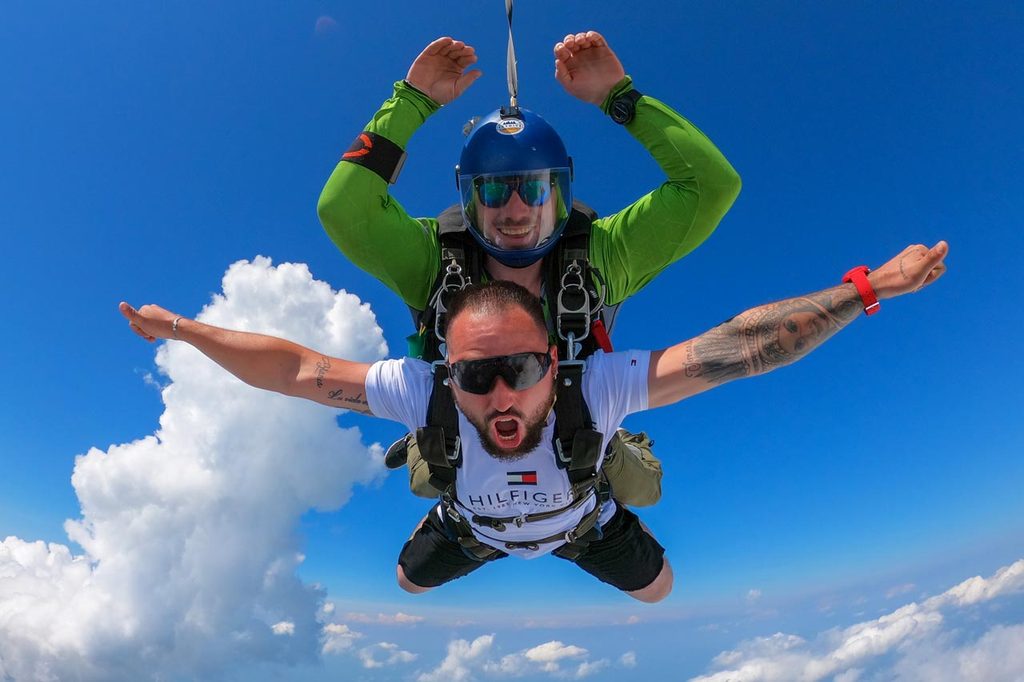
Yes. Most tandem skydiving operations can accommodate prescription glasses.
The main reason is the protective eyewear used during the jump. Many operators provide larger goggles that fit over ordinary glasses, helping protect your eyes from wind and helping keep your eyewear in position. Several current skydiving operators explicitly state that prescription glasses can be worn with their protective goggles.
This is especially important if you have significant vision correction and cannot comfortably see without your glasses.
What happens to your glasses during freefall?
During a tandem skydive, you experience strong airflow during freefall. Ordinary glasses are not designed to remain secure in that environment by themselves.
That’s why your glasses should be worn with the appropriate skydiving goggles supplied or approved by the dropzone.
Your instructor should help you check the fit before the aircraft exits.
A good fit should be:
- Secure without being painfully tight
- Comfortable around your glasses
- Stable when you move your head
- Suitable for the goggles provided by the operator
- Checked before the aircraft door opens
Don’t assume that your everyday glasses will automatically work with every pair of skydiving goggles.
Can You Skydive With Contact Lenses?
Yes, contact lenses can generally be worn while skydiving.
Several skydiving operators specifically state that contact lenses are acceptable and recommend telling the instructor that you are wearing them so the appropriate goggles can be fitted.
Protective goggles are important because freefall exposes your eyes to strong airflow. Without appropriate eye protection, wind can cause discomfort and make it difficult to keep your eyes open.
Are contact lenses better than glasses for skydiving?
There isn’t one universal answer.
Some people prefer contact lenses because there is no physical frame underneath the goggles. Others prefer glasses because they are more comfortable with them and don’t normally wear contacts.
A current skydiving FAQ from Budapest, for example, recommends contacts for comfort but still explains that glasses can be accommodated with larger goggles. That illustrates why the best choice can depend on the operator and the individual jumper.
If you already wear contacts comfortably, they may be a convenient option.
If you don’t normally wear contacts, don’t start using them for the first time on your skydiving day just because you think they are necessary. Use the vision correction you normally tolerate well and ask your dropzone what they recommend.
Can You Wear Glasses and Goggles at the Same Time?
Yes, when the dropzone provides goggles designed to fit over glasses.
These are sometimes called over-the-glasses goggles or simply larger protective goggles.
The exact equipment varies between skydiving centres.
For example, some operators specifically state that their goggles fit over prescription glasses, while others may have different equipment or policies.
Before your jump
Tell the staff:
“I wear prescription glasses and need to wear them during the jump.”
This gives the instructor an opportunity to select the appropriate goggles and check the fit.
Don’t wait until you’re standing at the aircraft door to mention it.
Will My Glasses Fall Off While Skydiving?
They shouldn’t if they are properly secured with suitable protective goggles, but there is no reason to treat ordinary glasses as completely risk-free equipment during a skydive.
Freefall involves substantial airflow, so anything worn on your face needs to be properly secured.
Some operators explicitly note that glasses or lenses can potentially be lost, and policies concerning loss or damage can vary.
How to reduce the risk
Before boarding the aircraft:
- Tell your instructor you wear glasses.
- Put your glasses on normally.
- Allow the instructor to help position the protective goggles.
- Check that the goggles sit securely over the frames.
- Make sure the goggles are comfortable.
- Avoid unnecessarily loose or bulky eyewear.
- Follow the dropzone’s instructions.
If your glasses are particularly large, thick, unusually shaped or fragile, tell the dropzone before booking if possible.
Can You Skydive With Bad Eyesight?
In many cases, yes.
Having poor eyesight by itself does not automatically mean you cannot go tandem skydiving.
The bigger issue is whether your vision can be adequately corrected and whether you meet the operator’s normal participation requirements.
If you rely heavily on prescription glasses, wearing them during the jump may be preferable to removing them because being able to see your instructor, the horizon and the surroundings can make the experience more enjoyable.
However, your specific medical or vision circumstances should be discussed with the skydiving operator and, when appropriate, your eye-care professional.
There is no single universal “maximum prescription” that applies to every skydiving operation worldwide.
Can You Skydive If You Are Nearsighted?
Being nearsighted does not automatically prevent you from tandem skydiving.
If you normally use prescription glasses or contact lenses, tell your instructor before the jump.
Your dropzone can explain which eyewear options it supports and whether its goggles can accommodate your prescription glasses.
The same principle applies to many other common forms of corrected vision: don’t assume you have to jump without your normal vision correction. Ask the operator first.
Can You Skydive With Astigmatism?
Many people with astigmatism use prescription glasses or contact lenses and can participate in tandem skydiving.
The key consideration is whether your vision can be adequately corrected and whether you meet the operator’s requirements.
If you need glasses to see clearly, tell your instructor.
The operator can then determine the best way to accommodate your eyewear.
Can You Skydive With Contact Lenses in Strong Wind?
Contact lenses are commonly worn during skydiving, but the reason protective goggles are important is that freefall creates strong airflow around your face.
Current skydiving operators specifically recommend protective goggles for people wearing contacts.
If you normally experience dry eyes or contact-lens discomfort, consider discussing the situation with your eye-care professional before your jump.
Most importantly, tell your instructor that you are wearing contacts.
Do You Have to Wear Goggles When Skydiving?
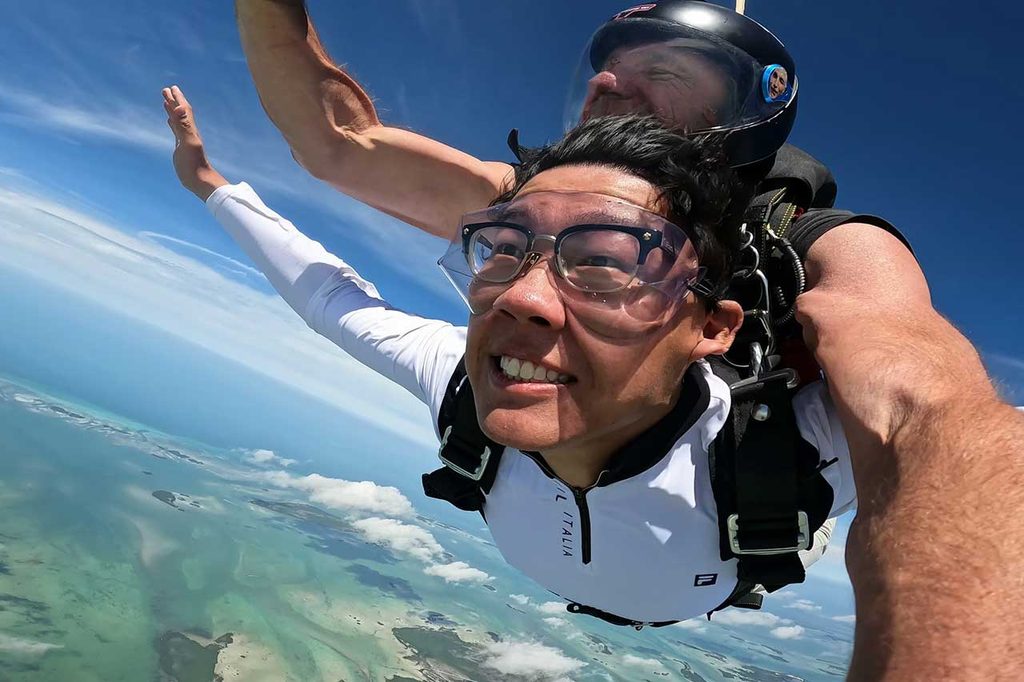
For tandem passengers, protective eye protection is normally part of the standard equipment and procedures used by the operator.
Goggles help protect the eyes from:
- Strong airflow
- Dust
- Small airborne particles
- Cold air
- General environmental exposure during the jump
Several current skydiving operators require or provide goggles for passengers, including for people wearing glasses or contacts.
Your exact equipment will depend on the dropzone.
Why Do Skydivers Wear Goggles?
Skydivers wear goggles primarily to protect their eyes during flight and freefall.
At freefall speeds, keeping your eyes exposed to the airflow can be uncomfortable and can make it difficult to see clearly.
Goggles also help keep contact lenses and prescription eyewear protected.
Think of them as protective eye equipment, not simply an accessory for photographs.
Can You Wear Sunglasses While Skydiving?
This depends on the type of skydive and the operator.
For tandem passengers, ordinary sunglasses may not be appropriate because the dropzone’s protective goggles need to fit properly and the instructor needs to be able to communicate visually with the student.
One established skydiving centre specifically advises against sunglasses for tandem students for these reasons and notes that experienced licensed skydivers may have different equipment options.
Therefore, don’t assume your favourite sunglasses can replace the goggles provided by the dropzone.
Ask before your jump.
Can You Skydive After LASIK?
This question requires more caution than ordinary glasses or contact lenses.
Do not assume that you can skydive immediately after LASIK or another eye procedure.
Your eyes need time to heal, and the appropriate return-to-sport timeline depends on your individual procedure and recovery.
Skydiving operators may have their own requirements. For example, some operators recommend medical clearance or confirmation from a doctor following LASIK rather than giving a universal rule.
The safest approach
If you’ve recently had:
- LASIK
- PRK
- another refractive eye procedure
- eye surgery
- significant eye treatment
ask your eye surgeon or eye-care professional when high-speed outdoor activities are appropriate for you.
Then confirm the skydiving centre’s own requirements before booking.
Don’t use a generic internet article as medical clearance.
Can You Skydive With Prescription Sunglasses?
It depends on the dropzone and the equipment.
Prescription sunglasses can be bulkier than standard prescription glasses and may not fit comfortably under the goggles provided to tandem passengers.
If you need prescription correction, ordinary prescription glasses with suitable over-goggles may be the simpler option at many dropzones.
Always ask the operator before arriving with specialized eyewear.
What If I Can’t See Without My Glasses?
Tell your instructor.
If your vision is significantly impaired without your glasses, don’t simply remove them because you’re worried they might fall off.
Being able to see clearly can be important for following instructions and enjoying the experience.
Many operators have goggles designed to fit over prescription glasses.
The exact solution depends on your glasses and the equipment available at the dropzone.
Can You Wear Glasses During a Tandem Skydive?
Yes, tandem skydiving is one of the most common situations in which people ask this question.
A typical tandem passenger who wears glasses can:
- Arrive at the dropzone wearing their normal glasses.
- Tell the instructor about their prescription eyewear.
- Receive or use suitable protective goggles.
- Check the goggles over the glasses.
- Wear the goggles during the aircraft ride and jump.
- Follow the instructor’s instructions throughout the skydive.
The precise process can vary between operators.
What About AFF Skydiving?
AFF students may also be able to jump with glasses or contact lenses.
However, AFF is different from a tandem skydive because the student is learning to perform skydiving tasks and equipment requirements can vary.
If you’re planning an AFF course, tell the training centre about your eyesight and ask what goggles or helmet arrangements are permitted for students.
Don’t assume that equipment rules for tandem passengers automatically apply to AFF students.
Glasses vs Contact Lenses for Skydiving
| Feature | Prescription Glasses | Contact Lenses |
|---|---|---|
| Can you usually skydive with them? | Yes | Yes |
| Protective goggles needed? | Yes | Yes |
| May require special equipment? | Sometimes | Usually standard goggles |
| Risk of eyewear being lost | Possible | Lower physical-loss risk |
| Comfort | Depends on frames/goggles | Depends on the wearer |
| Best choice | Personal preference + operator policy | Personal preference + operator policy |
There is no universal winner.
The best option is the one that gives you clear vision and feels comfortable while complying with your dropzone’s equipment requirements.
What Should You Tell Your Skydiving Instructor?
You don’t need to give your instructor a complicated medical history for ordinary glasses or contacts.
Simply tell them:
“I wear prescription glasses.”
or:
“I’m wearing contact lenses.”
This lets them know that they may need to adjust or select the appropriate eye protection.
If you have recently undergone eye surgery or have a specific eye condition, mention that before the jump and follow the guidance of both your medical professional and the operator.
What Should You Bring If You Wear Glasses?
Your normal glasses are usually the most important thing.
You may also want to consider:
- A sturdy glasses case
- A spare pair if you have one
- Your normal contact-lens supplies, if applicable
- Cleaning cloth
- Any prescribed eye-care items you normally need
Don’t bring loose items into the aircraft or onto the jump unless the operator specifically permits them.
Skydiving centres have their own rules about personal equipment.
What If My Glasses Are Very Large?
This is something you should discuss with the dropzone before your jump.
Very large, thick or unusual frames may not fit comfortably under every pair of skydiving goggles.
Send the operator a description or photo of your glasses if they ask for one.
The goal is not simply to make the goggles fit.
The goggles need to remain secure and provide appropriate eye protection.
Can You Skydive Without Glasses If You Are Short-Sighted?
Technically, you may be able to participate if the operator permits it, but that doesn’t mean it is the best choice for everyone.
If your eyesight is significantly blurred without correction, removing your glasses could make it harder to see your instructor, the horizon and the scenery.
If you normally depend on glasses, ask your dropzone about over-the-glasses goggles.
Can You Lose a Contact Lens During Skydiving?
It is possible for a contact lens to become displaced or lost, although protective goggles are designed to reduce the effect of airflow around the eyes.
Current operator guidance recommends wearing protective goggles with contact lenses.
If you have a history of contact lenses becoming uncomfortable or displaced during windy outdoor activities, discuss that with your eye-care professional and tell your instructor.
What Is the Best Option for a First-Time Skydiver?
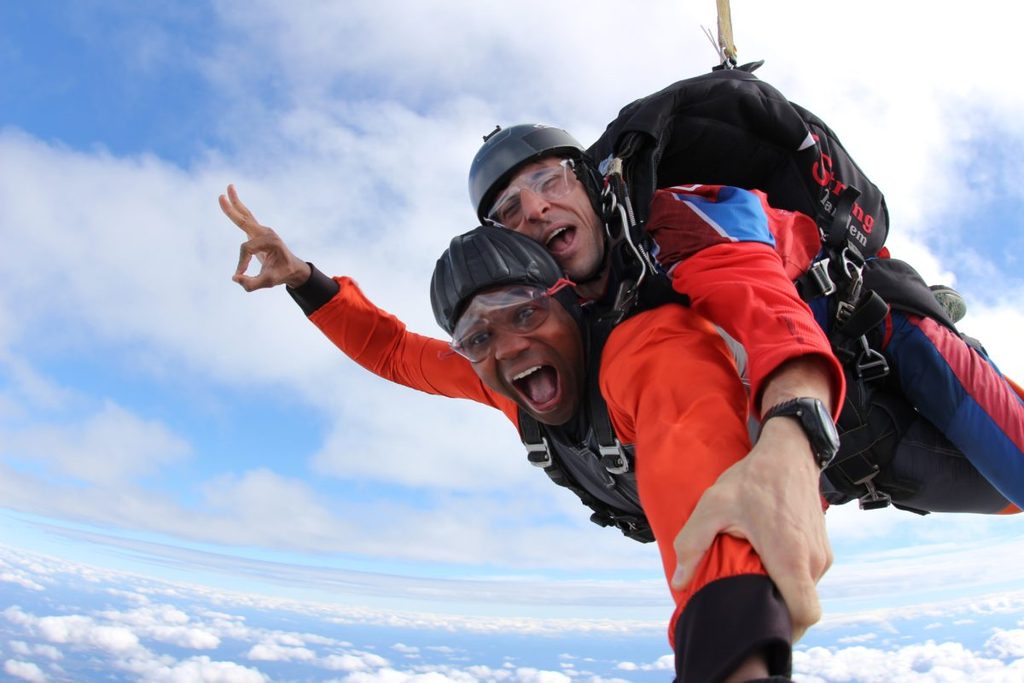
For most first-time jumpers, the simplest approach is:
If you normally wear glasses
Wear your glasses and tell the dropzone.
Ask for goggles that fit over them.
If you normally wear contact lenses
You can generally wear your contacts and use the protective goggles supplied by the operator.
If you recently had eye surgery
Speak with your eye-care professional before booking and confirm the operator’s policy.
If you have poor eyesight
Don’t remove necessary vision correction without discussing the issue with the operator.
Skydiving Glasses Checklist
Before your jump, use this quick checklist:
- Tell the dropzone that you wear glasses or contacts.
- Ask whether their goggles fit over prescription glasses.
- Bring your normal glasses.
- Bring a protective case for your glasses.
- Check the goggles before boarding.
- Tell your instructor about contact lenses.
- Follow the operator’s equipment instructions.
- Ask about any special requirements for unusual frames.
- If you’ve recently had eye surgery, obtain appropriate medical advice before jumping.
Frequently Asked Questions
Can I skydive with glasses?
Yes. Many tandem skydiving operators provide protective goggles that can fit over prescription glasses. Confirm the equipment with your chosen dropzone before your jump.
Can I skydive with contact lenses?
Yes. Contact lenses are commonly permitted, and protective goggles are used to protect the eyes from airflow. Tell your instructor that you are wearing contacts.
Can I wear glasses under skydiving goggles?
Usually, yes, provided the goggles are designed to fit over your frames. Some operators specifically provide over-the-glasses goggles.
Will my glasses fall off during freefall?
Properly fitted protective goggles help keep your glasses secure, but glasses can still potentially be damaged or lost. Check with your dropzone about its equipment and policies.
Can I skydive with bad eyesight?
Often, yes, provided your vision can be adequately corrected and you meet the operator’s requirements. Ask your chosen dropzone about your specific prescription.
Can I skydive after LASIK?
Don’t assume that you can jump immediately after LASIK. Recovery varies, so follow your eye-care professional’s advice and confirm the skydiving operator’s requirements.
Do I need goggles if I wear contacts?
Yes. Contact lenses do not replace protective eye protection. Follow the equipment requirements of your dropzone.
Can I wear sunglasses while skydiving?
Not necessarily. Tandem operators may require specific protective goggles, and sunglasses may not fit correctly underneath them. Ask your dropzone before the jump.
Should I wear contacts instead of glasses?
Not necessarily. If you already wear contacts comfortably, they may be convenient. But if you normally wear glasses, many operators can accommodate them with appropriate goggles.
Final Answer: Can You Skydive With Glasses or Contacts?
Yes, in most cases you can skydive with either prescription glasses or contact lenses.
For glasses, many tandem operators provide goggles that fit over your frames. For contacts, protective goggles help shield your eyes from strong airflow.
The most important thing is to tell your instructor about your eyewear before the jump.
If you’ve recently had LASIK or another eye procedure, don’t rely on a general skydiving rule. Get advice from your eye-care professional and confirm the requirements of your chosen dropzone.
Your eyesight shouldn’t automatically stop you from experiencing a skydive.
With the right preparation and appropriate eye protection, many people who wear glasses or contacts can enjoy the same incredible first-jump experience as everyone else.
Planning Your First Skydive?
If you’re still researching your first jump, continue with our guides on:
- First-Time Skydiving Tips
- What to Wear Skydiving
- How Much Skydiving Costs
- Skydiving Weight Limits
- How Long Skydiving Takes
- Is Skydiving Safe?
- Best Skydiving Locations in the USA
Always confirm current prices, weather requirements, age/weight limits and equipment policies directly with the dropzone before booking, because these details can vary between operators and can change over time.
Last reviewed: August 2026