
Quick answer: There’s no single skydiving weight limit — each drop zone sets its own, within what its equipment is certified to carry. In the US, most tandem operators cap passengers somewhere between 220 and 250 lb (about 100–113 kg), weighed in jump clothes. UK centres usually quote 15 stone (about 95 kg), and Australia and New Zealand typically sit between 100 and 115 kg. Check your chosen drop zone’s posted number before you pay.
If you’ve been quietly wondering whether you’re “too big” to skydive, you’re not alone — it’s one of the most common questions drop zones get. The skydiving weight limit isn’t a judgement about your fitness or your body. It’s mostly arithmetic: a tandem parachute is certified to carry a set total load, and you, your instructor, and the equipment all count toward it.
Once you understand where the number comes from, it gets a lot easier to find a drop zone that fits you — or to know your other options.
Why skydiving has a weight limit at all
The 500-pound math behind most tandem limits
Tandem parachute systems are built and tested to a maximum suspended weight. For example, the technical data sheet for UPT’s Sigma II 370 tandem main canopy lists a recommended weight range of 200–500 lb and a maximum suspended weight of 500 lb (UPT Sigma II 370 data sheet).
That 500 lb has to cover everyone and everything hanging under the canopy. Here’s roughly how it breaks down:
| What’s under the canopy | Approximate weight | Source |
|---|---|---|
| Total certified load | 500 lb | UPT Sigma II 370 data sheet |
| Tandem rig itself | about 60 lb | Skydive Orange |
| Tandem instructor | commonly 160–200 lb | Skydive Midwest |
| What’s left for the passenger | roughly 240–280 lb at the absolute ceiling | Our arithmetic |
Drop zones then leave themselves a margin below that ceiling, which is why the published limit usually lands in the 220–250 lb range rather than right at the edge.
The operator can’t simply decide to ignore this. In the US, FAA rules for tandem jumps (14 CFR 105.45) require the instructor to be trained and certified on the specific tandem system being used and to use the harness position the manufacturer prescribes (14 CFR 105.45). In practice, the manufacturer’s numbers set the outer boundary.
It’s also about the landing, the harness, and the aircraft
The canopy’s rating is only part of the picture:
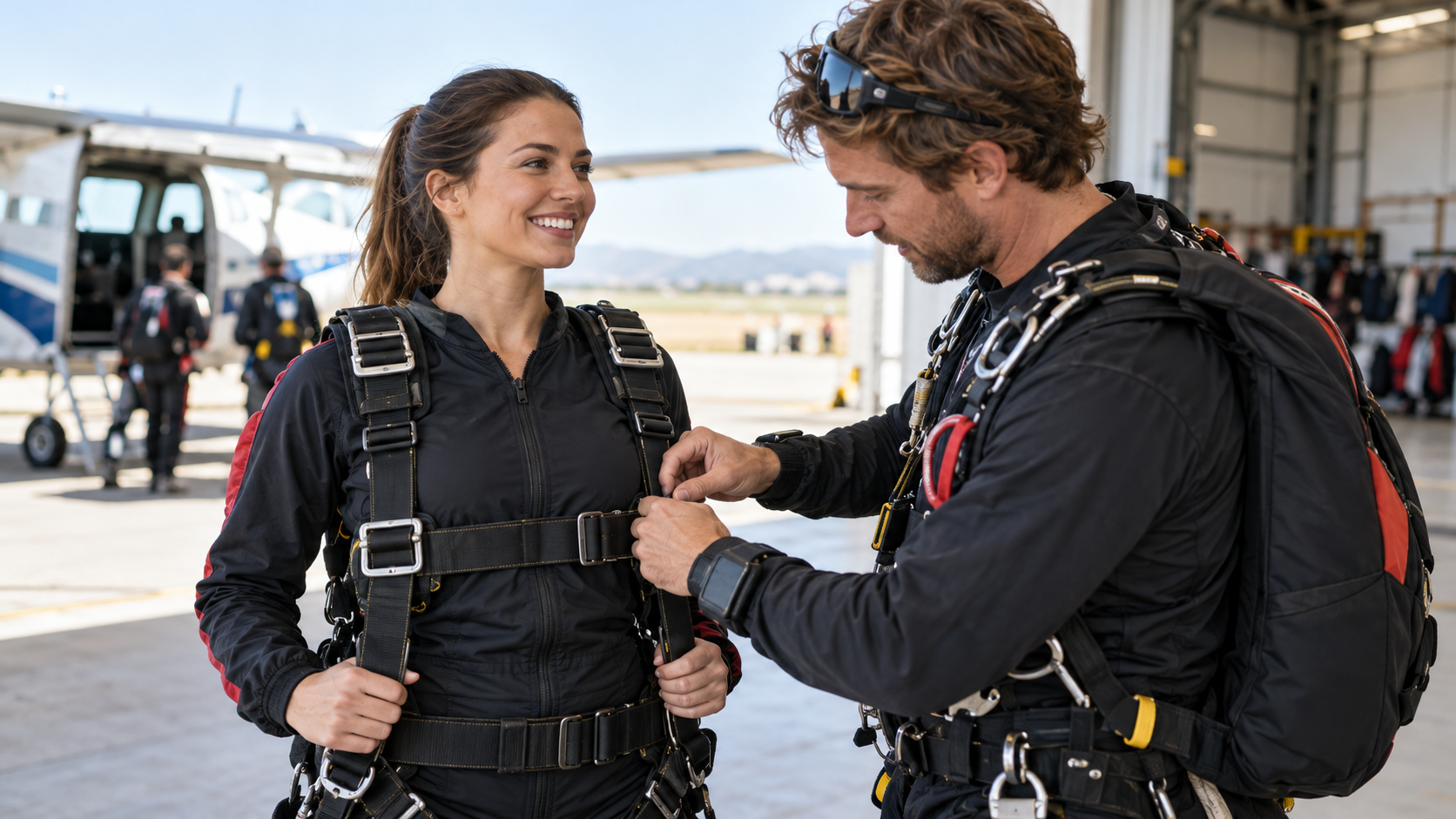
- Harness fit. Before any jump, the harness has to fit you properly and securely. Skydive the Wasatch, for example, says it checks both harness fit and that the combined weight stays inside the manufacturer’s limits (Skydive the Wasatch). Height matters here too, which is why some operators talk about being “height and weight proportionate.”
- The landing. On a tandem, the passenger usually needs to lift their legs so the instructor can land on their own feet. Australian operator Skydive Ramblers points out that landing with a passenger over the limit is riskier for both people (Skydive Ramblers).
- The aircraft. Jump planes have a maximum take-off weight, so operators need accurate weights for everyone on board — the same reason airlines care about baggage (Skydive Jurien Bay).
If you’d like the bigger picture on how tandem jumps work from check-in to landing, our tandem skydiving guide walks through the whole day.
Max weight for tandem skydiving: what US drop zones typically allow
Across published US policies, the max weight for tandem skydiving clusters in the low-to-mid 200s. A few real examples, as published at the time of writing:
- Skydive Orange (Virginia): 220 lb standard, with some people up to 240 lb fully clothed accepted if they’re height-and-weight proportionate and in reasonable shape (source).
- Skydive the Wasatch (Utah): instructors can typically take passengers up to 230 lb (source).
- Skydive Midwest (Wisconsin): 250 lb (source).
Policies change, so treat these as examples of the range — not as current quotes.
Why two drop zones near each other can differ
If one drop zone says 220 lb and another 40 minutes away says 250 lb, neither is necessarily being careless or overcautious. Common reasons for the gap:
- Instructor size. A lighter instructor leaves more of the certified load for the passenger.
- Equipment. Different tandem systems and canopy sizes carry different ratings.
- Conditions on the day. Some operators note that weight cut-offs can vary by day, not just by location, because wind and landing conditions affect what’s safe (Skydive Australia listing via Musement).
- Pricing structure. Skydive Midwest notes that some drop zones set a lower headline limit and then charge extra per pound above it (source). That surcharge is worth factoring into your budget alongside the base price — our guide to how much skydiving costs covers what else to expect.
Skydiving weight requirements by country
These figures are drawn from published operator and association information. They’re a snapshot, not a rulebook — always confirm with the specific drop zone.
| Country / setting | Typical tandem maximum | Where extra checks or fees often start | Example sources |
|---|---|---|---|
| United States | 220–250 lb (100–113 kg) | Varies; some charge per pound above a base weight | Skydive Orange, Skydive the Wasatch, Skydive Midwest |
| United Kingdom | Usually 15 st (about 95 kg / 210 lb) | Must be reasonably fit for your weight | MS Trust (BPA centres), Skydive Northwest |
| Australia | Usually 100–115 kg (220–253 lb) | Around 95 kg: on-site assessment and surcharges at some operators | Skydive Jurien Bay, Sydney tandem listing |
| New Zealand | 100–115 kg (220–253 lb) | Around 95 kg: Tandem Master assessment | NZONE Queenstown listing, Taupo Tandem listing |
| Indoor wind tunnel (iFLY US/Canada) | 300 lb (136 kg) | 260–300 lb evaluated on arrival at some locations | iFLY Canada FAQ |
One pattern worth noticing: in Australia and New Zealand, many operators publish a two-step policy — an assessment band starting around 95 kg, then a hard cut-off. One Sydney operator, for example, lists 110 kg as its maximum, with surcharges that start at 95 kg (source). If you’re in that band, it’s worth emailing ahead rather than finding out at check-in.
Is there a minimum weight?
Sometimes. Many drop zones don’t publish a minimum weight at all — Skydive Jurien Bay states it has none (source). Others do: NZONE in Queenstown lists a minimum of 40 kg and a minimum height of 1.2 m, alongside the requirement that every passenger fits the harness securely (source).
For lighter or shorter people, harness fit is usually the deciding factor rather than the number on the scale. Minimums often overlap with age rules, so check both when you book.
What about solo and AFF weight limits?
If you’re thinking about learning to skydive on your own through AFF (Accelerated Freefall), the question changes slightly. You’ll wear your own student rig, and the canopy has to be sized for your body weight plus your gear. Drop zones match students to canopies from their student equipment, so whether you can start AFF at a higher weight depends on whether they have large enough student canopies and harnesses on hand.
There isn’t a widely published standard figure here, so ask the drop zone directly. Our skydiving for beginners guide explains the different ways to make your first jump.
Overweight skydiving options if you’re above the limit
Being over one drop zone’s limit doesn’t always mean skydiving is off the table. Some practical routes:
- Compare limits, not just prices. Published limits can differ by 20–30 lb between operators in the same region. A short drive may change your answer.
- Ask about the assessment band. If you’re just over a headline number, ask whether they assess case by case, as several Australian and New Zealand operators publish that they do.
- Ask about surcharges up front. Some drop zones accept heavier passengers but charge more. Better to know before you budget.
- Try indoor skydiving. iFLY’s US and Canadian tunnels list a 300 lb upper limit (iFLY Canada), though limits differ by country — iFLY UK lists 117 kg (iFLY UK). It recreates the freefall part of a jump without the canopy ride or landing.
- Raise it when you book, not at check-in. Some operators are blunt about this: one Gold Coast operator states that anyone over its 110 kg limit won’t be allowed to jump and won’t be refunded (source).
One thing we’d gently steer you away from: rounding your weight down on the booking form. The limit exists for the landing and the equipment, not for paperwork — and most drop zones weigh everyone anyway.
Getting weighed: what actually happens on the day
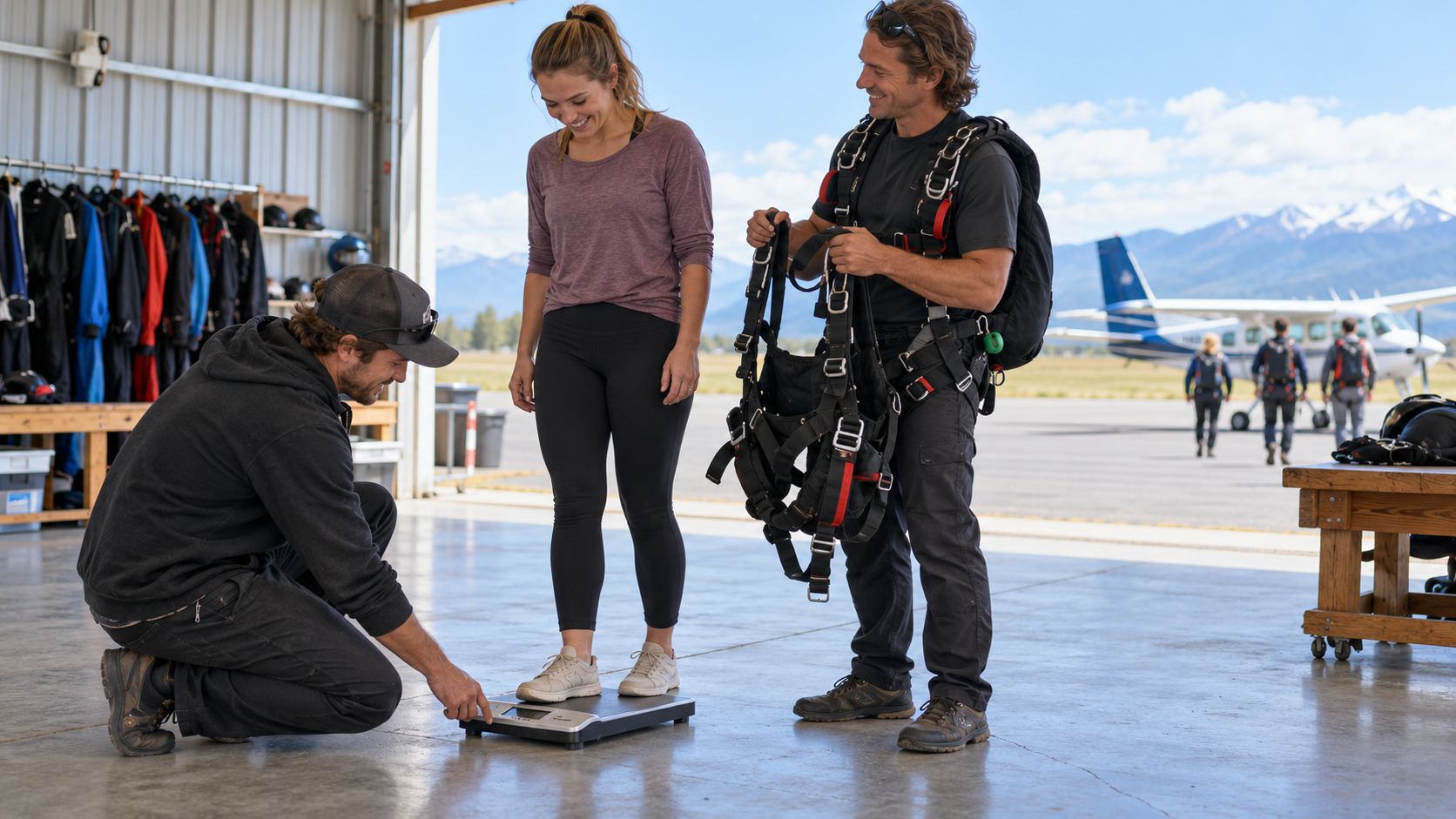
If the weigh-in is the part you’re dreading, here’s the reassuring reality: at most drop zones it’s a routine check-in step that every customer goes through. Staff are recording a number for equipment and aircraft-loading purposes, the same way they would for anyone else on the plane.
A few tips to make it a non-event:
- Weigh yourself at home in your jump clothes and shoes. Most limits are measured clothed.
- Leave yourself a margin. Scales vary a little, and your weight shifts through the day.
- Be upfront when booking. If you’re near the line, a quick message to the drop zone saves you a wasted trip.
- Ask how they handle it. If privacy matters to you, it’s fair to ask how the weigh-in works before you arrive.
Frequently asked questions
What is the weight limit for tandem skydiving?
It depends on the drop zone. In the US, most published limits fall between 220 and 250 lb (about 100–113 kg). UK centres commonly quote 15 stone (about 95 kg), and operators in Australia and New Zealand typically allow 100–115 kg.
Do they actually weigh you before a skydive?
Yes, at most drop zones. Weighing is part of check-in because the operator needs accurate numbers for both the tandem equipment and the aircraft’s loading limits.
Can I skydive if I weigh 250 pounds?
Possibly. A few US drop zones publish a 250 lb limit, and some in Australia and New Zealand accept up to 115 kg (about 253 lb) after an on-site assessment. Many others set their limit lower, so check each operator’s policy directly.
Does height matter as well as weight?
Often, yes. The harness has to fit you securely, so some drop zones ask that heavier passengers be height-and-weight proportionate, and some also set a minimum height.
Will I get a refund if I’m over the weight limit on the day?
Not necessarily. Some operators state clearly that they won’t refund passengers who turn up over the limit, so it’s worth confirming the policy before you pay.
The bottom line
The skydiving weight limit comes from equipment ratings, landing safety, and aircraft loading — not from anyone’s opinion of your body. If you’re close to the line, the best move is simple: find two or three drop zones near you, check their posted limits and surcharge policies, and message them before booking. If you’re weighing up where to jump, our look at skydiving costs is a good next stop.
Written by Alex — lead writer at SkydiveGuides.com, covering skydiving safety, costs, gear, and destinations.
Sources
- UPT Sigma II 370 technical data sheet
- 14 CFR 105.45 — Use of tandem parachute systems
- Skydive Midwest — Tandem skydiving weight limit
- Skydive Orange — Skydiving overweight
- Skydive the Wasatch — Weight limit FAQ
- MS Trust — Parachute jump information (BPA centres)
- Skydive Northwest — Tandem skydive
- Skydive Jurien Bay — Weight limit for skydiving in Australia
- Skydive Ramblers — Why is there a weight limit
- NZONE Skydive Queenstown listing (Bookme)
- Taupo Tandem Skydiving listing (Air New Zealand)
- iFLY Canada — Weight limit FAQ
- iFLY UK — Weight limit FAQ