
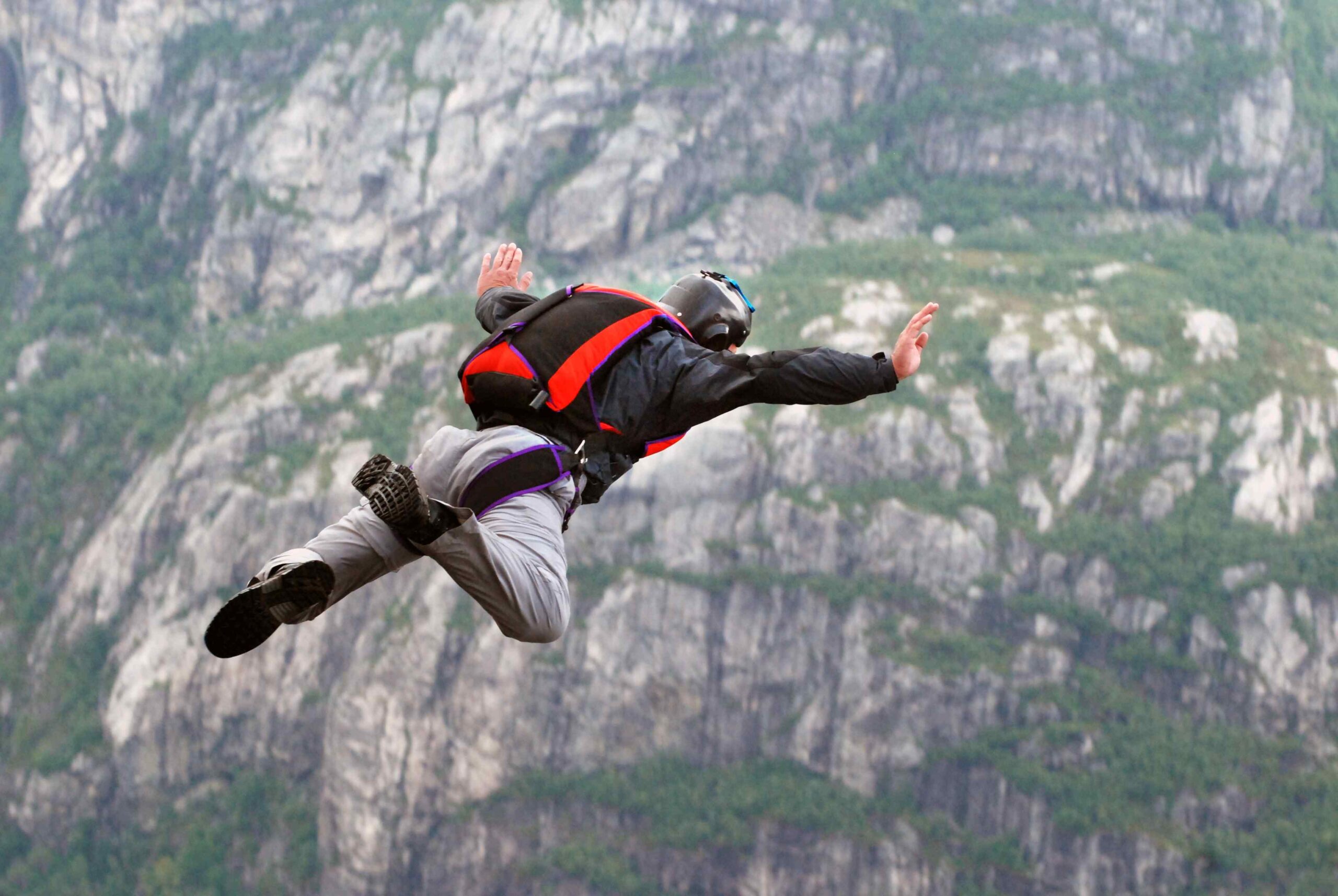
The BASE jumping acronym stands for Buildings, Antennas, Spans, and Earth. These are the four categories of fixed structures that BASE jumpers leap from, each representing a completely different type of exit point with its own unique risks, legal status, and altitude profile.
Understanding what the BASE jumping acronym means is the fastest way to understand the sport itself. Unlike skydiving, which always begins from an aircraft, BASE jumping is defined entirely by what you jump off. The acronym is not just a name. It is a classification system.
B stands for Buildings. Skyscrapers, towers, stadiums, and any other man-made vertical structure qualify under this category. Building jumps are among the most technically difficult because they often involve navigating urban environments, security, and limited landing zones.
A stands for Antennas. Radio masts, TV transmission towers, and communication structures fall into this group. Antennas are often located in remote or rural areas, which can make access easier, but they tend to have guy-wires that create serious hazards during descent.
S stands for Spans. Bridges, arch structures, and any construction that crosses a gap from one point to another are classified as spans. The Perrine Bridge in Twin Falls, Idaho, is the most famous span jump site in the United States and one of the only locations where BASE jumping is legal year-round without a permit.
E stands for Earth. Natural formations including cliffs, mountain faces, and canyon walls make up this category. Earth jumps are what most people picture when they think of BASE jumping, with jumpers launching from places like Kjerag in Norway or El Capitan in Yosemite.
A BASE jumper who has successfully completed at least one jump from all four categories earns a BASE number, a unique identifier in the official BASE registry started by Carl Boenish in 1981. As of today, fewer than 2,000 people in the world hold a registered BASE number.
What Is BASE Jumping? Meaning & Origins
BASE jumping is an extreme sport in which a person jumps from a fixed structure and uses a single parachute to descend to the ground. Unlike skydiving, there is no aircraft, no altitude buffer, and no reserve parachute. Every BASE jump is performed at altitudes far below what skydivers ever experience, which means every second from exit to landing counts in a way that skydiving simply does not replicate.
The term “base dive” or BASE dive is sometimes used interchangeably, particularly by those newer to the sport, though within the BASE jumping community, “jump” is the standard and preferred term.
The sport’s origins trace directly to filmmaker and aerial cinematographer Carl Boenish. Boenish and his team began making parachute jumps from El Capitan in Yosemite as early as 1978. By 1981, Boenish had formally coined the BASE acronym and established the world’s first official BASE number registry, creating a systematic way to categorize jump types and track participants who had completed jumps from all four object categories.
In 1984, Carl Boenish and his wife Jean set a Guinness World Record with a BASE jump from the Trollveggen mountain wall in Norway, the highest cliff BASE jump at that time. Tragically, Carl Boenish died at the same site just two days later, cementing BASE jumping’s reputation as a sport that demands absolute precision with zero margin for error.
Today BASE jumping has grown significantly through social media, GoPro footage, and documentaries. The 2014 documentary Sunshine Superman, directed by Marah Strauch, brought Carl Boenish’s story to mainstream audiences and introduced millions of viewers to the sport’s origins, culture, and genuine danger. BASE jumping also appears prominently in the original Point Break (1991) and its 2015 remake, and has been featured in video games including Just Cause and GTA V.
The sport is legal in some countries and locations, restricted in others, and outright banned in specific areas including most US national parks and many urban environments. Jumpers must research local laws before any jump. In the United States, the Perrine Bridge in Twin Falls, Idaho, remains the only man-made structure where BASE jumping is permitted year-round without a permit.
BASE jumping attracts experienced skydivers who have already mastered parachute handling and want to push into more technical, lower-altitude terrain. Most credible BASE jumping instructors and training programs require a minimum of 200 skydives before a student’s first BASE jump, though many programs strongly recommend 500 or more.
How BASE Jumping Got Its Name: The 1981 Origin Story
The acronym BASE was not invented casually. Carl Boenish, working alongside his wife Jean Boenish, Phil Smith, and Phil Mayfield, deliberately constructed it to give the emerging sport a formal identity that could be categorised, tracked, and recognised as a distinct discipline separate from skydiving.
The four-letter structure was intentional. Boenish wanted the acronym to cover every realistic type of fixed object a jumper would encounter, from the tallest city buildings to the most remote natural cliffs. By creating four clean categories, he also created the basis for the BASE number registry, a system where jumpers who completed one successful jump from each of the four object types would receive a unique lifetime number as formal recognition.
The acronym was written as B.A.S.E. with periods separating each letter in its early years. Over time, the abbreviation shifted to the simplified BASE without periods, which is the version used universally today.
Phil Smith received BASE number 1 and Phil Mayfield received BASE number 2, both earned on the same day in 1981. Carl Boenish himself received BASE number 4. Today the BASE number registry continues, administered by the global BASE jumping community, with fewer than 2,000 numbers issued worldwide since 1981.
BASE vs Skydiving: What’s the Difference?
While both sports involve parachutes, there are key differences:
| Aspect | BASE Jumping | Skydiving |
|---|---|---|
| Jump Point | Fixed structures (Buildings, Antennas, Spans, Earth) | Aircraft |
| Altitude | Much lower (often <1,000 ft) | Typically 10,000–14,000 ft |
| Parachute | Single canopy | Dual (main + reserve) |
| Freefall Time | Shorter (1–5 seconds) | Longer (up to 60 seconds) |
| Risk Level | Extremely high | Relatively controlled |
Fatality Rate Roughly 1 in 2,317 jumps (Kjerag study) Roughly 1 in 150,000 jumps
So, do BASE jumps count as skydives? Technically, no. Skydives are performed from aircraft at altitude. BASE jumps are from stationary fixed structures at much lower heights. However, nearly every BASE jumper starts their journey as a skydiver. The parachute handling skills, body awareness, and emergency decision-making developed through skydiving are considered the minimum foundation for safe BASE jumping.
So, do base jumps count as skydives?
Technically, no. Skydives are from aircraft, while BASE jumps are from stationary structures. However, many BASE jumpers start as skydivers to gain experience with parachute handling and freefall control.
How Many Skydives Before BASE Jumping?
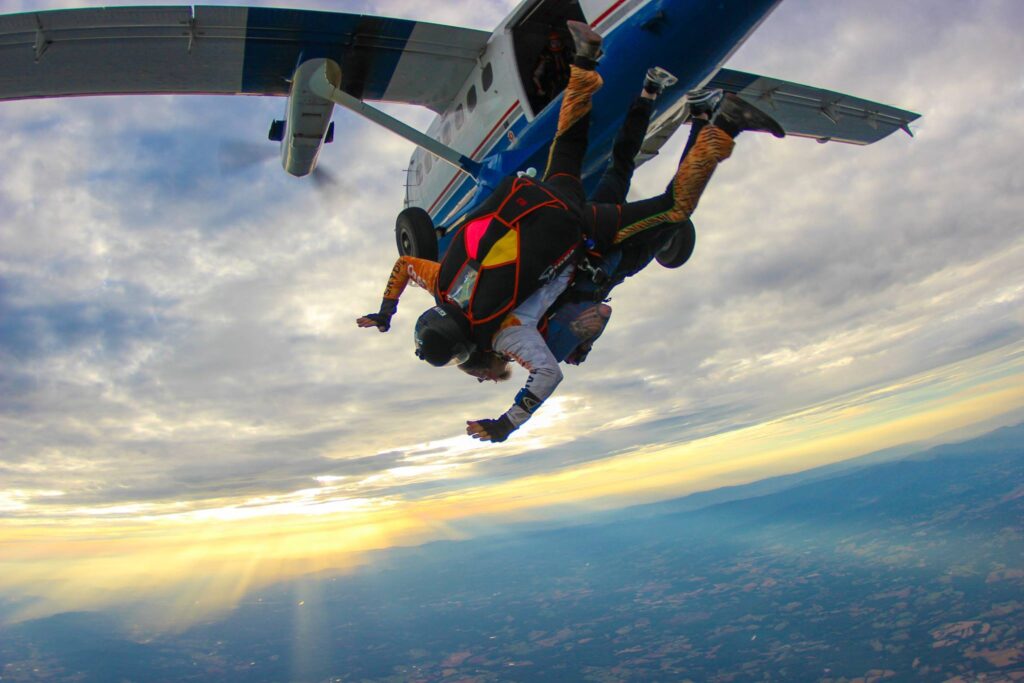
To safely start BASE jumping, experts recommend having at least 200 skydives before attempting your first BASE jump.
This ensures:
- You’re comfortable handling parachutes in varied conditions.
- You understand wind patterns and landing accuracy.
- You’ve mastered emergency procedures.
Many training centers even require proof of experience before allowing a BASE jump course.
If you’re new, start by learning skydiving first — it’s the foundation for every successful BASE jumper.
Most BASE jumping training programs in the US and Europe will review your skydive logbook before accepting you onto a first-jump course. Some programs, particularly those affiliated with professional wingsuit BASE instruction, recommend 500 or more skydives before attempting any fixed-object jumps. The 200-jump minimum is an absolute floor, not a target. Experience matters more than a number.
Risks, Dangers & Death Rates in BASE Jumping
BASE jumping is considered the most dangerous sport in the world. The short freefall distance, lack of backup parachutes, and unpredictable wind conditions make every jump risky.
According to available data, the BASE jumping fatality rate is roughly 1 in every 500–2,500 jumps, far higher than skydiving.
For comparison, skydiving deaths occur in about 1 in every 150,000 jumps.
Learn more about safety comparisons in our related guide:
👉 Skydiving Deaths Per Year
Common causes of BASE jumping accidents include:
- Parachute malfunction or delayed opening
- Jumping in poor weather or windy conditions
- Insufficient training
- Equipment failure
- Impact with objects during descent
BASE Jumping Ground Rules & Safety Measures
If you’re ready to explore the thrill of BASE jumping, safety must come first. Follow these golden rules:
- Train with certified instructors experienced in BASE jumps.
- Always inspect your gear — canopy, pilot chute, harness, and container.
- Check the weather before any jump. Wind speed and direction are crucial.
- Scout your landing zone ahead of time.
- Avoid illegal sites — BASE jumping is restricted or banned in many locations.
- Use a helmet and body protection to reduce injury risk.
Pro Tip: Start with bridge or span jumps, as they often offer better altitude and visibility for beginners.
BASE Jumping in Pop Culture: Films, Documentaries, and Media
BASE jumping has broken into mainstream culture in ways that few extreme sports have matched. For many people, their first exposure to the sport came not from a news story but from a film or a documentary.
The most significant documentary about BASE jumping is Sunshine Superman (2014), directed by Marah Strauch. The film tells the story of Carl Boenish, the man who invented the BASE acronym and built the sport from its earliest jumps at El Capitan in the 1970s. Sunshine Superman was released through Magnolia Pictures and screened at film festivals internationally, receiving strong critical reviews. It is widely considered the definitive film portrait of BASE jumping and its founding figure. If you want to understand the soul of the sport, this is where you start.
In mainstream action cinema, BASE jumping has appeared memorably in the original Point Break (1991), one of the most influential extreme sports films ever made. The 2015 remake updated the BASE jumping sequences with footage shot at real locations worldwide. Both films contributed to the sport’s image as the ultimate expression of defying conventional limits.
Felix Baumgartner, one of the most famous BASE jumpers in the world, became a household name in 2012 with the Red Bull Stratos project. Baumgartner jumped from a helium balloon at the edge of space, breaking the speed of sound in freefall before deploying a parachute and landing safely. While technically not a conventional BASE jump, it was performed by a BASE jumping specialist and used BASE-derived parachute equipment. The jump was watched live by over 8 million people on YouTube, the largest live stream audience in the platform’s history at that time.
BASE jumping also features in video games including the Just Cause series, where wingsuit and parachute mechanics are central to gameplay, and in GTA V, which includes BASE jump missions and challenges. These games have introduced the concept of fixed-object jumping to tens of millions of players who may never have encountered the sport otherwise.
Famous BASE Jumping Locations Around the World
These are the most significant BASE jumping locations in the world, each with a different object category, legal status, and jump profile.
Perrine Bridge, Twin Falls, Idaho, USA (Span) The Perrine Bridge is 486 feet (148 meters) above the Snake River Canyon and is widely considered the most accessible legal BASE jumping site in the world. It is the only man-made structure in the United States where BASE jumping is permitted year-round without a permit. Beginners and experienced jumpers jump here daily. Freefall lasts approximately three seconds before the parachute must be deployed. In July 2006, Captain Daniel Schilling set a Guinness World Record by jumping off the Perrine Bridge 201 times in 21 hours, raising money for charity. As of 2025, eleven BASE jumping fatalities have occurred at this location, underscoring that even the most accessible legal site carries real risk.
Kjerag Massif, Lysefjord, Norway (Earth) Kjerag is the largest and most active BASE jumping drop zone in the world. The cliff face drops 984 meters (3,228 feet) to the fjord below, providing far more freefall time than most sites and making it comparatively more forgiving for experienced jumpers working on canopy skills. BASE jumping at Kjerag is legal and welcomed by local authorities. A study of 20,850 BASE jumps from this site between 1995 and 2005 recorded nine fatalities, a rate of one per 2,317 jumps. Kjerag has recorded over 48,000 registered jumps since the first official jump in 1994.
Kuala Lumpur Tower, Malaysia (Building) The KL Tower hosts the annual Kuala Lumpur Tower International Jump, one of the few legal sanctioned urban building jump events in the world. The open deck sits at approximately 920 feet (280 meters). The event draws jumpers from across the world and is one of the rare occasions where a city high-rise becomes a legitimate, permitted BASE jumping platform.
New River Gorge Bridge, West Virginia, USA (Span) The New River Gorge Bridge stands 876 feet (267 meters) above the river and is one of the longest single-span steel arch bridges in the western hemisphere. BASE jumping from the bridge is permitted only once per year during Bridge Day, held every third Saturday in October. The 2024 Bridge Day event saw 325 BASE jumpers complete 755 jumps with zero injuries.
El Capitan, Yosemite, California, USA (Earth) El Capitan is the birthplace of modern BASE jumping. Carl Boenish and his team made some of the earliest documented parachute exits from this 3,000-foot granite wall beginning in 1978. BASE jumping is currently illegal in Yosemite National Park, as it is in most US national parks, but El Capitan remains a defining site in the sport’s history.
FAQs About base jumping acronym
1. What does BASE stand for in BASE jumping?
BASE stands for Buildings, Antennas, Spans, and Earth, which are the four fixed structures used for jumps.
2. How safe is BASE jumping compared to skydiving?
BASE jumping is significantly more dangerous than skydiving. The fatality rate at Kjerag, the world’s busiest BASE jump site, was recorded at roughly 1 in every 2,317 jumps across an 11-year study. Skydiving fatalities occur at approximately 1 in every 150,000 jumps. The primary reason is altitude. BASE jumpers have seconds, not minutes, to identify and respond to any problem with their equipment.
3. How many skydives should I have before BASE jumping?
At least 200 skydives are recommended to develop proper control, confidence, and understanding of parachute systems.
4. Do base jumps count as skydives?
No, because skydiving involves jumping from an aircraft, while BASE jumping involves fixed objects like cliffs or buildings.
5. Is BASE jumping legal everywhere?
No. Many countries and cities restrict or ban BASE jumping due to safety concerns. Always check local laws before attempting.
6. What is the BASE jumping death rate?
A study of 20,850 jumps at the Kjerag Massif in Norway recorded 9 fatalities over 11 years, a rate of 1 in every 2,317 jumps. This is the most cited and methodologically credible fatality figure in BASE jumping research. More general estimates suggest 1 fatality per 500 to 2,500 jumps depending on the site, experience level, and conditions. For comparison, skydiving fatalities occur at approximately 1 in every 150,000 jumps. Modern safety improvements mean current fatality rates at well-managed sites may be lower than older data suggests.
Final Thoughts
The BASE jumping acronym isn’t just a catchy name — it defines the essence of one of the world’s most daring sports. From leaping off towering buildings to diving from sheer cliffs, BASE jumpers chase an unmatched rush of adrenaline and freedom.
The BASE jumping acronym was designed to organise a sport built on precision, preparation, and an honest reckoning with risk. Every letter represents not just a jump category but a completely different set of challenges, environments, and legal landscapes. Whether you are drawn to the architectural drama of a building exit, the remote access of an antenna mast, the community of a span jump at Perrine Bridge, or the raw geological scale of a cliff face in Norway, the sport demands the same foundation: real skydiving experience, rigorous training, and respect for what a very short freefall actually means.
If BASE jumping is where you want to go, start with skydiving. Build 200 jumps at minimum. Then find a certified first-jump course. The acronym will still be there when you are ready.