
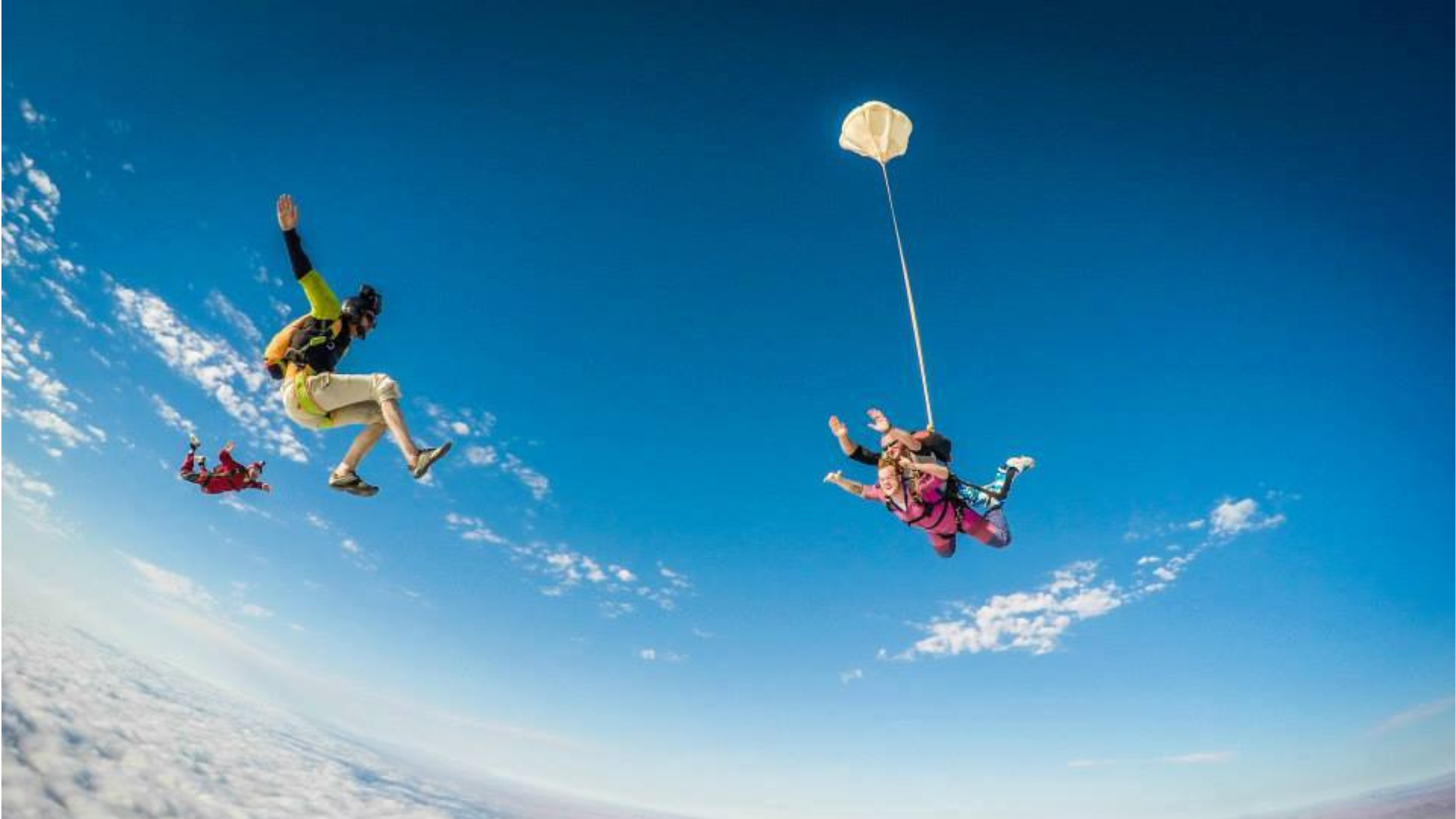
There is a particular kind of traveler this guide is written for. Not the first-timer looking for a quick adrenaline fix, and not the weekend jumper content with their local drop zone. This is written for the traveler who has covered serious ground — who has tracked game across the Serengeti, heliskied in the Bugaboos, and dived the walls of the Coral Sea — and who now wants to add the sky to that list, properly.
Luxury destination skydiving in 2026 is a fundamentally different proposition from what it was even five years ago. The world’s best drop zones have invested heavily in private aircraft fleets, professional media production, five-star ground facilities, and tailored itinerary packages that integrate freefall into a broader high-end travel experience. The result is a category of adventure travel that sits comfortably alongside expedition yachting and private alpine guiding in terms of cost, exclusivity, and the quality of the experience delivered.
This guide ranks the ten best luxury skydiving destinations in the world based on four criteria: the quality and drama of the aerial scenery, the standard of the operator and facilities on the ground, the available altitude and freefall duration, and the ease with which the jump can be integrated into a broader luxury travel itinerary. Every destination on this list has been evaluated against all four. None are here for novelty alone.
One statistic worth noting before we begin: the United States Parachute Association recorded over 3.6 million jumps in the United States in 2025, with scenic and destination skydiving growing by 27 percent compared to pre-pandemic figures. The International Skydiving Commission’s 2025 safety report places the global fatality rate at 0.51 per 100,000 jumps — the lowest in the sport’s recorded history. The infrastructure, safety standards, and operator quality across these destinations reflect that trajectory. The sport has matured. The experience has followed.
Why Serious Travelers Are Choosing Destination Skydiving in 2026
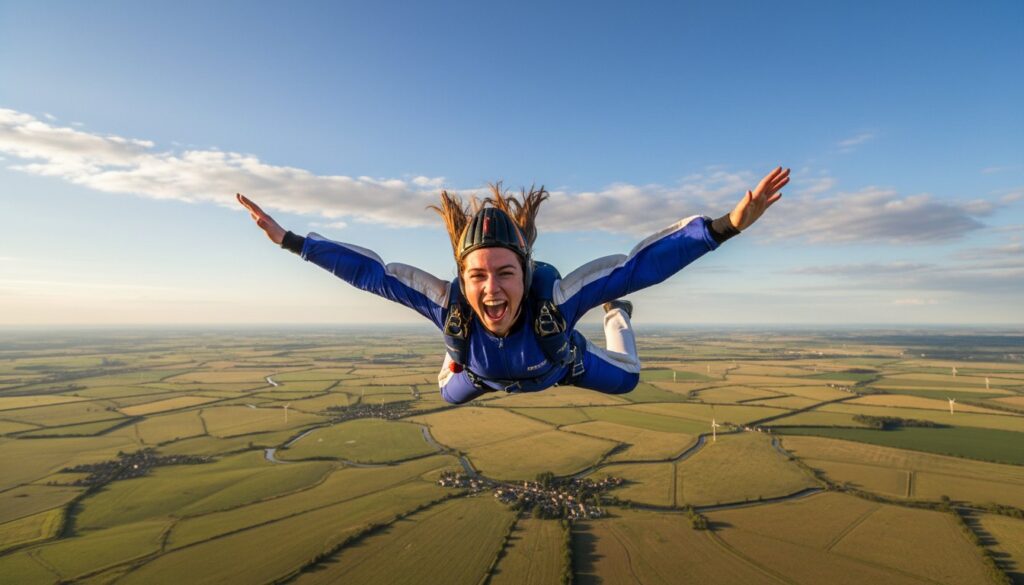
The shift in how experienced travelers approach skydiving has been gradual but now unmistakable. For most of the sport’s commercial history, tandem skydiving was treated as a standalone activity — something you booked for a single afternoon, separate from the broader travel experience. That model has not disappeared, but it has been overtaken by something more considered.
The Adventure Travel Trade Association’s 2025 survey found that 78 percent of skydivers ranked scenery as the most important factor when selecting a destination. That figure has driven meaningful change in how premium operators position themselves. Drop zones in Switzerland, New Zealand, and the UAE no longer compete primarily on price or even on safety record. They compete on the totality of the experience: the view from altitude, the quality of the aircraft, the professionalism of the ground crew, the post-jump facilities, and the ease with which the entire operation can be embedded into a multi-day luxury itinerary.
Three factors are converging in 2026 to make this the strongest year yet for destination skydiving. Safety technology has brought fatality rates to historic lows, removing a barrier that previously deterred many experienced adventure travelers. Post-pandemic appetite for transformative experiences continues to outpace appetite for passive luxury. And a new class of traveler — financially unconstrained, experience-driven, and increasingly resistant to conventional travel — is actively seeking out the kind of perspective that only freefall can provide.
The destinations that follow are the best answers to that demand.
The 10 Best Luxury Skydiving Destinations in 2026
These drop zones are ranked on the full experience they offer — not the jump alone. Each has been selected for the combination of aerial scenery, operator quality, available altitude, and integration with a high-end travel itinerary.
1. Dubai, United Arab Emirates — Freefall Over the Palm
Altitude: 13,000 to 15,000 feet over Palm Jumeirah
Estimated Cost: $600 to $900 USD tandem | Private aircraft from $3,000
Best Season: October through April
Dubai occupies a category of its own in commercial skydiving, not because the scenery is the most dramatic on this list — it is not — but because the operational standard is unmatched anywhere in the world. Skydive Dubai runs with the precision and polish of a private aviation company. The aircraft are modern, the instructors are drawn from an international pool of experienced professionals, and the ground facilities are among the best purpose-built skydiving infrastructure in existence.
The jump itself delivers a view that is genuinely unlike anything else in the sport. Palm Jumeirah from 15,000 feet is one of the most recognizable man-made landmarks on earth, and seeing its full geometry laid out beneath you during freefall produces a disorientation that experienced travelers consistently describe as unexpected. The surrounding Gulf waters, the Dubai Marina skyline, and the desert stretching inland to the horizon complete a panorama that holds up against any natural landscape this list includes.
Luxury package options include private aircraft bookings with exclusive jump windows, dedicated video production crews using professional-grade equipment, VIP ground lounge access, and post-jump hospitality. Several operators offer early morning slots that give small groups a private freefall window before the day’s commercial operations begin. For travelers whose primary requirement is a flawless, high-end operation with no logistical friction, Dubai is the correct answer.
Advance booking of at least three months is recommended for the October through April season. Early morning jumps offer the clearest Gulf visibility and avoid the heat that builds through the day.
2. Interlaken, Switzerland — Above the Bernese Alps
Altitude: 14,000 feet above the Bernese Oberland
Estimated Cost: $450 to $700 USD tandem | Private charter packages available
Best Season: June through September
Interlaken has been a centre of alpine adventure for well over a century, and its position between Lake Thun and Lake Brienz — with the Eiger, Mönch, and Jungfrau rising to the south — makes it one of the most scenically loaded locations for skydiving anywhere in Europe. The freefall panorama here is not simply beautiful. It is structurally complex in a way that rewards attention: the geometry of the two lakes, the graduated elevation of the Bernese Oberland, and the hard profiles of the high peaks combine to create a visual environment that changes significantly at different altitudes during the descent.
Swiss operators maintain European safety standards with meticulous attention to equipment maintenance and instructor certification. Ground crew communication is professional and multilingual. The overall experience on the ground matches what the jump delivers in the air.
Interlaken’s particular advantage for the luxury traveler is its integration into the broader Swiss alpine experience. The jump can be paired with a stay at the Victoria-Jungfrau Grand Hotel — one of the finest mountain properties in Europe — and combined with private alpine guiding, lake sailing, or access to the Jungfraujoch. For those building a multi-activity European adventure itinerary, Interlaken offers the densest concentration of high-quality experiences within a single location.
June through September delivers the most reliable conditions. Late September and early October can produce exceptional autumn light and foliage that transforms the canopy ride into an extended visual experience in its own right. Extended canopy ride upgrades, offering 15 or more minutes under parachute, are available from several operators and are worth requesting.
3. Queenstown, New Zealand — Lake Wakatipu and the Remarkables
Altitude: 9,000 to 15,000 feet over Lake Wakatipu
Estimated Cost: $250 to $400 USD — consistently rated the best value-to-experience ratio in the world
Best Season: December through February
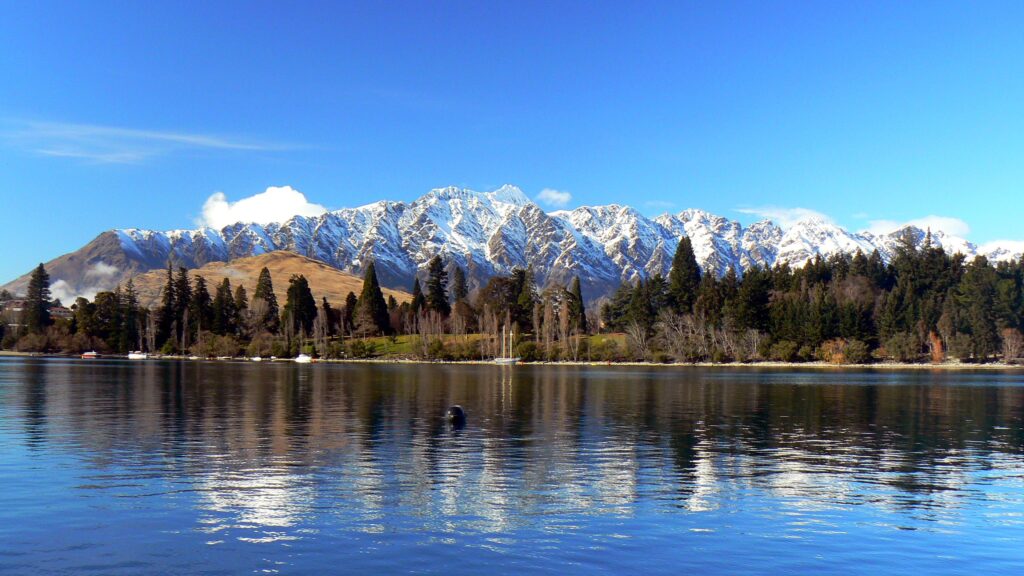
Queenstown’s reputation as the adventure capital of the world is well-earned, and for skydiving specifically, it is difficult to argue against it being the single most scenically compelling drop zone on earth. Lake Wakatipu is 50 miles long and glacially carved. The Remarkables mountain range earns its name from altitude in a way that photographs from the ground cannot prepare you for. The combination of scale, clarity, and compositional contrast — lake, farmland, mountain, sky — produces freefall views that experienced skydivers with hundreds of jumps in multiple countries consistently rank above everything else they have seen.
NZONE Skydive and Skydive Queenstown are the two primary operators, both running professional, well-maintained operations. The 15,000-foot altitude option provides approximately 60 seconds of freefall — enough time to meaningfully take in the landscape rather than simply process the sensation of the jump itself. At lower altitudes the experience is compressed; the 15,000-foot option is the correct choice for anyone making this trip specifically for the scenery.
Queenstown’s position within the South Island’s broader adventure landscape makes it the easiest drop zone on this list to build an extended high-quality itinerary around. Fiordland, the wine regions of Central Otago, helicopter access to remote mountains, and world-class fly-fishing are all within range. The town itself supports a strong hospitality infrastructure at every price point, with several boutique luxury properties that cater specifically to adventure-focused travelers.
December through February is the Southern Hemisphere summer and the primary season for optimal conditions. Fox Glacier, four hours north, offers a secondary jump over an active glacier that pairs naturally with a Queenstown-based itinerary.
4. Moab, Utah, United States — The Colorado Plateau from Above
Altitude: 13,500 feet above Canyonlands and Arches National Park
Estimated Cost: $260 to $350 USD | Private group packages available
Best Season: March through May and September through November
Moab occupies a geographic position that has no equivalent in the world. Canyonlands National Park to the southwest and Arches National Park to the north together constitute one of the most geologically distinctive landscapes on the planet — a layered sandstone terrain of buttes, mesas, canyon systems, and natural arches that reads from altitude as something entirely other than the earth most people know. The Colorado River cuts through the landscape from the northeast, visible from jump altitude as a continuous silver thread through the canyon system.
Skydive Moab is one of the most scenically positioned commercial drop zones in North America. The operation is smaller and more personal than the major international operators on this list, which for many experienced travelers is part of its appeal. The jump experience here is less curated and more raw, reflecting the landscape itself.
Moab’s luxury accommodation infrastructure has developed significantly in recent years. Under Canvas Moab and several high-end glamping properties offer well-appointed options for travelers who want comfort without the anaesthetic effect of a conventional hotel. The surrounding landscape supports mountain biking, canyoneering, and river expeditions that provide a natural framework for a multi-day adventure itinerary with the jump at its centre.
Spring and autumn are the optimal seasons. Summer temperatures in the canyon country regularly exceed 100 degrees Fahrenheit and make jumping uncomfortable. Winter conditions can be exceptional on clear days but require flexibility around weather.
5. Pattaya, Thailand — The Gulf of Thailand at 15,000 Feet
Altitude: 15,000 feet over the Gulf of Thailand
Estimated Cost: $180 to $280 USD — exceptional value relative to experience quality
Best Season: November through February
Pattaya does not carry the brand recognition of Dubai or Queenstown in destination skydiving conversations, which is precisely why experienced frequent jumpers tend to know it well. Thailand Skydiving Club operates a 15,000-foot tandem program over the Gulf of Thailand coastline, and the combination of altitude, tropical coastal scenery, and operating cost makes it one of the most efficient jump experiences available anywhere in the world.
The aerial view encompasses the Gulf’s characteristic turquoise gradient, the palm-fringed coastline stretching in both directions, and on clear days the visible profiles of Gulf islands in the middle distance. Equipment is current, instructors hold international certifications, and the operation runs with the kind of quiet competence that comes from years of experience rather than marketing investment.
Thailand’s pricing structure makes it particularly valuable for travelers who want to log multiple high-altitude jumps within a single trip — an approach that experienced skydivers often prefer for consolidating the learning of the physical and psychological experience before arriving at a higher-cost destination. Pair a Pattaya jump with Bangkok’s five-star hotel infrastructure and you have a luxury adventure trip at a fraction of the cost of equivalent experiences in Europe or the Gulf.
November through February is the dry season and the optimal window for consistent jump conditions.
6. Swakopmund, Namibia — The Namib Desert from Altitude
Altitude: 10,000 to 14,000 feet above the Namib Desert
Estimated Cost: $280 to $450 USD — highly exclusive, limited operator availability
Best Season: June through October
The Namib is one of the oldest deserts on earth and one of the least visited landscapes on this list. Skydiving above it — over the orange dune systems of the central Namib, the salt pans of the coast, and the Atlantic shoreline — produces a freefall environment that experienced travelers consistently describe as unlike anything else they have seen. There is no equivalent. The scale of the dune fields, the chromatic contrast between the desert and the ocean, and the almost complete absence of human infrastructure in the landscape below create a visual context for freefall that no more accessible destination can replicate.
Swakopmund is Namibia’s adventure hub, a small coastal town with a character shaped by its German colonial history and its position between the desert and the South Atlantic. Skydiving operations here are limited — this is not a high-volume commercial operation — and booking well in advance is essential. Private charter jump arrangements are available and worth pursuing for those who want a fully exclusive experience.
The broader Namibia itinerary integrates naturally with the jump. Luxury desert lodges in the Sossusvlei area, private guided wildlife tracking in Etosha, and boat-based encounters with the Skeleton Coast’s marine wildlife provide the framework for one of the most distinctive expedition-style travel itineraries available in Africa. June through October delivers the most reliable conditions and is the peak season for broader Namibia travel.
7. Patagonia, Argentina and Chile — The Southern Andes from Above
Altitude: 10,000 to 12,000 feet above glaciers and granite peaks
Estimated Cost: $400 to $700 USD tandem | Private expedition packages from $2,000
Best Season: November through March
Patagonia presents a different proposition from every other destination on this list. This is not a polished commercial operation with a dedicated ground facility and a consistent daily schedule. Skydiving in Patagonia is expedition-category travel, which means working around variable weather, accepting scheduling uncertainty, and engaging operators whose expertise is shaped by the specific and demanding conditions of the Southern Andes. For the right traveler, these are features rather than limitations.
The visual case for jumping here is straightforward. The Torres del Paine massif, the Perito Moreno Glacier, the Fitz Roy range — from altitude, these are among the most dramatically composed landscapes on the planet. The particular quality of Patagonian light, which at high southern latitudes takes on a clarity and angle that has no parallel elsewhere, transforms the freefall visual experience into something genuinely unlike any other location on this list.
Several operators in the Chilean and Argentine lake districts offer tandem jump programs that can be coordinated with luxury lodge stays inside or adjacent to the national parks. For groups seeking a fully private experience, expedition-package arrangements that include private aircraft access and flexible scheduling based on weather windows are available at significant cost but deliver a level of exclusivity that cannot be purchased at any fixed-schedule drop zone.
November through March is the Southern Hemisphere summer and the primary operational window. Weather flexibility of several days should be built into any Patagonia itinerary regardless of the activities planned.
8. North Shore, Oahu, Hawaii, United States — The Pacific from 14,000 Feet
Altitude: 14,000 feet over the North Shore and Pacific Ocean
Estimated Cost: $250 to $350 USD tandem
Best Season: May through September
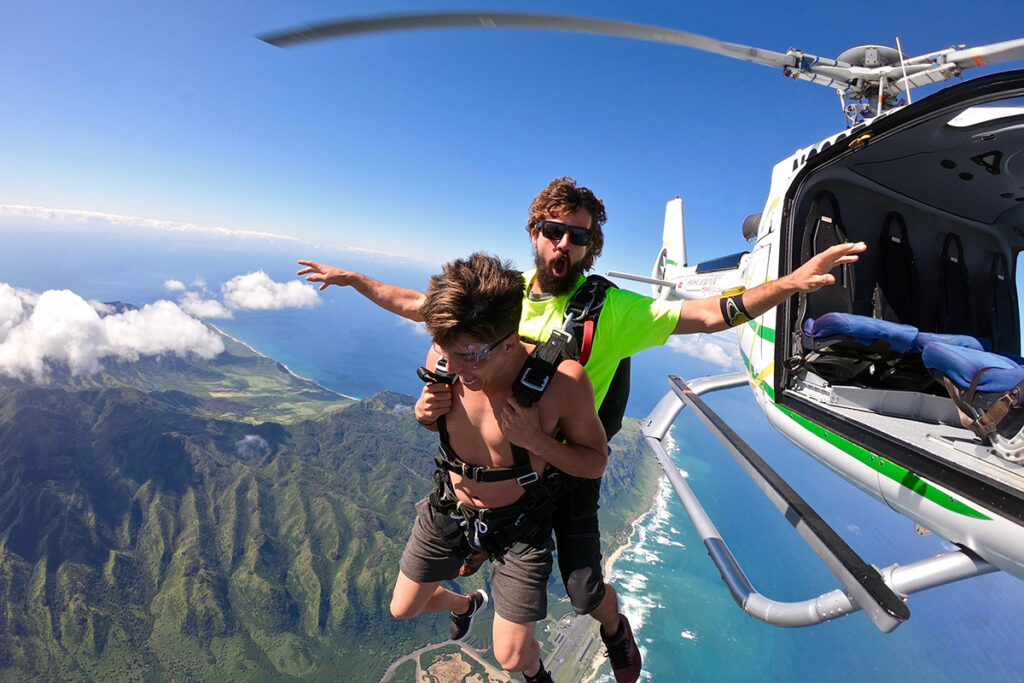
Hawaii skydiving is, in practical terms, among the most accessible luxury jump experiences on this list — accessible in the sense that it requires no special logistics, no extended planning lead time, and no tolerance for operational uncertainty. Skydive Hawaii and Pacific Skydiving both run professional, well-maintained operations on Oahu’s North Shore, and the combination of Pacific Ocean horizon, Ko’olau Mountain ridgeline, and the distinctive green and turquoise color palette of the Hawaiian landscape produces a freefall view of real quality.
The North Shore’s cultural identity as one of the world’s great surfing coastlines adds a context to the jump that makes it distinctively Hawaiian rather than generically tropical. The Banzai Pipeline and Sunset Beach are visible from altitude during the appropriate season, as is the full sweep of the North Shore coastline from the mountains to the reef.
Oahu’s luxury hotel infrastructure — the Four Seasons Resort at Ko Olina, Turtle Bay Resort on the North Shore, and several high-quality boutique properties across the island — makes this one of the easiest destinations on the list to integrate into a broader travel itinerary without any additional logistical planning. May through September is the primary season for consistent jump conditions.
9. Everest Region, Nepal — The Highest Commercial Skydive on Earth
Altitude: 23,000 feet and above — the highest altitude commercial tandem skydive in the world
Estimated Cost: $25,000 to $35,000 USD — full expedition including oxygen, training, and logistics
Best Season: October and May weather windows only
This requires a different category of commitment than any other destination on this list, and it deserves to be understood clearly before inclusion in any itinerary planning. Himalayan Skydive’s operation from above 23,000 feet is not a premium version of a standard tandem jump. It is a multi-day expedition that requires supplemental oxygen, specific physical conditioning, altitude acclimatization protocols, prior skydiving experience, and full medical clearance. The operational window is determined by Himalayan weather patterns and amounts to a handful of viable days in October and another window in May.
What it delivers in return is freefall above the Himalayan range — the Everest massif, Lhotse, Makalu, and the full eastern Nepal panorama — at an altitude that places the jumper above the majority of the world’s mountain peaks. The visual experience of freefall here has no commercial equivalent anywhere on earth. The number of people who have completed this jump is small. The waitlist is long.
This is not a recommendation for most travelers, including most experienced adventure travelers. It is the correct recommendation for a specific type of traveler: one who has the prior skydiving experience, the physical condition, the logistical tolerance for expedition-style uncertainty, and the budget to do it properly. For that traveler, nothing on this list — or likely anywhere in the world of adventure travel — competes with it.
10. Tulum, Mexico — The Yucatan Peninsula from the Air
Altitude: 10,000 to 14,000 feet over the Yucatan Peninsula and Caribbean Sea
Estimated Cost: $200 to $320 USD
Best Season: November through April
Tulum’s emergence as a centre of high-end travel over the past decade has been accompanied by a quiet but meaningful development in the quality of skydiving operations serving the region. Skydive Playa del Carmen, the primary operator for the Tulum and Riviera Maya corridor, runs a professional tandem program from which the aerial view encompasses the Caribbean’s turquoise gradient, the Yucatan jungle canopy, and on clear days the faint profile of Cozumel Island offshore.
The particular appeal of a Tulum-based jump itinerary lies in the combination of experiences available within a small geographic radius. The Yucatan’s cenote system — a network of flooded limestone sinkholes unique to this region — is among the most distinctive natural environments in the Americas. Combining a skydive with private cenote access, Mayan archaeological site visits, and a stay at one of Tulum’s better eco-luxury properties produces a travel experience that covers an unusual range of sensory and intellectual territory within a compact itinerary.
The jump itself is not the most dramatic on this list in terms of raw visual spectacle. But the overall Tulum itinerary represents one of the strongest value-to-experience propositions available for the luxury traveler who wants to combine freefall with a high-quality broader destination experience. November through April is the dry season and the optimal window.
All 10 Destinations Compared
The table below summarises the key practical details for each destination. All cost figures are approximate tandem package prices in USD and will vary by operator, altitude selection, and any additional services booked.

Destination              | Altitude             | Est. Cost (USD)   | Best Season    | Operator Standard
-------------------------|----------------------|-------------------|----------------|-------------------
Dubai, UAE               | 13,000–15,000 ft     | $600–$900         | Oct–Apr        | World-class
Interlaken, Switzerland  | 14,000 ft            | $450–$700         | Jun–Sep        | World-class
Queenstown, New Zealand  | 9,000–15,000 ft      | $250–$400         | Dec–Feb        | World-class
Moab, Utah, USA          | 13,500 ft            | $260–$350         | Mar–May/Sep–Nov| Professional
Pattaya, Thailand        | 15,000 ft            | $180–$280         | Nov–Feb        | Professional
Swakopmund, Namibia      | 10,000–14,000 ft     | $280–$450         | Jun–Oct        | Boutique/Exclusive
Patagonia, S. America    | 10,000–12,000 ft     | $400–$700         | Nov–Mar        | Expedition-grade
North Shore, Hawaii, USA | 14,000 ft            | $250–$350         | May–Sep        | Professional
Everest Region, Nepal    | 23,000+ ft           | $25,000+          | Oct & May      | Expedition-grade
Tulum, Mexico            | 10,000–14,000 ft     | $200–$320         | Nov–Apr        | Professional
Planning a Luxury Skydiving Trip in 2026: What Experienced Travelers Know
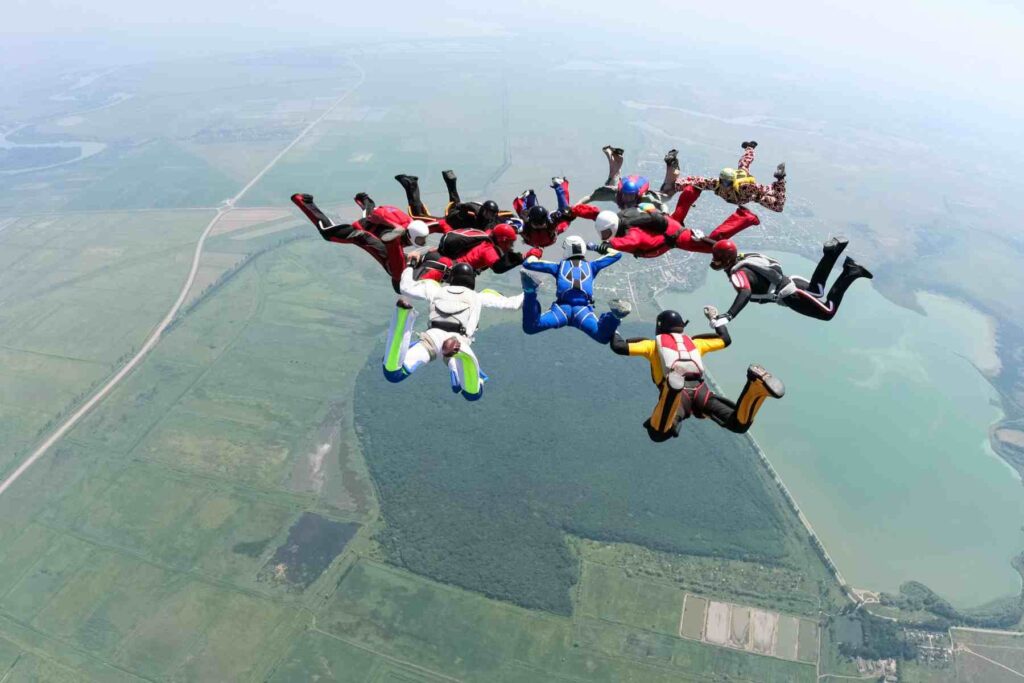
Tandem Is the Right Starting Point Regardless of Travel Experience
Every destination on this list except Nepal offers tandem skydiving, in which the jumper is attached to a certified instructor who manages every technical aspect of the jump from aircraft exit to landing. No prior skydiving experience is required. The pre-jump briefing — typically 20 to 45 minutes — covers body position, breathing, and what to expect at each stage. Everything else is handled by the instructor.
This is worth stating clearly because experienced adventure travelers sometimes assume that their background in other high-risk activities — mountaineering, base jumping, technical diving — translates into some kind of head start in skydiving. It does not translate in any technically meaningful way, though the psychological familiarity with managed risk is genuinely useful. The tandem format is the correct entry point regardless of broader adventure experience, and it delivers the full visual experience that destination skydiving is built around.
Video Documentation Is a Practical Decision, Not an Optional Extra
At every destination on this list, professional video and photography packages are available. Prices typically range from $80 to $200 USD. The case for booking them is straightforward: the freefall lasts between 45 and 60 seconds depending on altitude, and the canopy ride adds several minutes more. The experience passes with a speed and intensity that makes reliable memory encoding difficult. The footage is not a souvenir — it is the only accurate record of what happened.
At iconic locations like Interlaken or Queenstown, the video also captures the aerial landscape in a way that no ground-based photograph of those destinations can replicate. Book it at every jump. The cost is negligible relative to the overall trip investment, and the alternative — no record of a freefall above the Swiss Alps — is not a decision most travelers would make twice.
Weather Flexibility Is Non-Negotiable
Skydiving is a weather-dependent activity, and professional operators will not jump in conditions that fall outside their operational safety parameters. This is not a problem to be solved — it is a structural feature of the activity that requires appropriate trip planning. Every destination skydiving itinerary should include a minimum of one to two buffer days to accommodate rescheduling.
This is particularly important for Patagonia and Nepal, where viable weather windows can be narrow and the logistical complexity of the operation adds additional layers of scheduling uncertainty. It applies in more moderate form to every other destination on this list. Build the flexibility in before departure. Attempting to force a jump into a fixed schedule on the final day of a trip is the most common planning error in destination skydiving, and it fails regularly.
Private Aircraft Bookings Change the Experience Meaningfully
At several destinations on this list — Dubai, Interlaken, and Queenstown in particular — private aircraft bookings are available that give a small group exclusive use of the jump plane, a fully customised altitude selection, and a dedicated jump window without sharing the aircraft or the airspace with other groups.
For groups of four to ten people, the per-person cost of a private aircraft booking is often comparable to a business-class seat upgrade on a long-haul flight. What it provides in return is an experience with a different quality of exclusivity: no waiting, no shared briefings, a personalised pace on the ground, and a jump that belongs entirely to your group. For any group traveling specifically for the skydiving experience, it is worth pricing seriously.
Integrate the Jump Into the Broader Itinerary From the Start
The freefall itself lasts under a minute. The canopy ride adds five to eight minutes. The full experience from arrival at the drop zone to departure after landing typically runs three to five hours. Planning a luxury skydiving trip as though the jump is the entire itinerary misses most of what makes destination skydiving a premium travel proposition.
The best itineraries treat the jump as the centrepiece of a multi-day experience built around the destination. Dubai jumping paired with a desert safari and a Gulf dinner cruise. Queenstown jumping followed by a private Fiordland helicopter access. Interlaken jumping combined with a Jungfraujoch rail excursion and an evening at a Swiss mountain property. The jump creates a relationship with the landscape that ground-level activities then deepen. That combination is what separates destination skydiving from simply booking a jump.
Frequently Asked Questions
Do I need skydiving experience to jump at these destinations?
No prior skydiving experience is required for tandem jumps at any destination on this list except Nepal. In a tandem jump, a certified instructor manages the entire technical process — aircraft exit, freefall body position, parachute deployment, and landing approach. The jumper's role is to follow the briefing instructions regarding body position and to be present for the experience. The instructor handles everything else. Pre-jump briefings typically run 20 to 45 minutes and cover everything required.How safe is skydiving in 2026?
The International Skydiving Commission's 2025 safety report recorded a global fatality rate of 0.51 per 100,000 jumps — the lowest figure in the sport's documented history. For tandem skydiving specifically, the rate is approximately 0.002 per 100,000 jumps. To contextualise that figure: it is lower than the fatality rate for recreational cycling, open-water swimming, and driving on public roads.

Modern equipment — including automatic activation devices that deploy a reserve parachute independently if the primary system fails — has transformed the safety profile of the sport over the past two decades. The operators recommended at the destinations in this guide maintain equipment to international standards and employ instructors with substantial logged jump experience. The residual risk is real but small and is managed by professional operators at every destination on this list.
Which destination is best for a first-time jumper?
Dubai and Queenstown are the two destinations most consistently recommended by experienced skydivers for first-time jumpers who want a premium experience. Both offer operational standards that leave no room for logistical uncertainty, which matters significantly when managing the psychological demands of a first jump. Dubai delivers the superior ground infrastructure and post-jump experience. Queenstown delivers the superior aerial scenery. Both are defensible choices, and the decision between them is essentially one of whether the traveler prioritises urban luxury infrastructure or natural landscape drama.How far in advance should a luxury skydiving trip be booked?
Dubai, Interlaken, and Queenstown during peak seasons require a minimum of two to three months advance booking for standard tandem packages and considerably more for private aircraft arrangements. Namibia and Patagonia should be booked six months ahead given limited operator capacity. The Nepal Everest jump operates on a waitlist that runs one to two years, and inquiries should be made as early as possible regardless of intended travel date.Is skydiving genuinely manageable for people with a fear of heights?
This is one of the most frequently asked questions in the sport, and the honest answer is that a fear of heights and a fear of skydiving are distinct psychological responses that are generated by different stimuli. Fear of heights — acrophobia — is typically triggered by proximity to a visible edge or drop where the body can process the spatial relationship to the ground. At skydiving altitudes, the ground is too distant for that processing to occur in the same way. The freefall sensation itself is dominated by wind resistance and physical sensation, not by a cognitive sense of falling.

This does not mean that everyone with a fear of heights will find skydiving comfortable. But it does mean that the correlation between the two is weaker than most people assume before their first jump. A significant proportion of first-time tandem jumpers who describe themselves as afraid of heights report that the actual experience bears little resemblance to what they anticipated. The pre-jump period — in the aircraft, approaching the door — tends to be the most demanding part. Once exit occurs, the psychological character of the experience changes completely.
Conclusion
Luxury destination skydiving in 2026 is a mature, well-supported category of adventure travel with a stronger safety record, a wider range of high-quality operators, and better integration with broader luxury travel infrastructure than at any point in its history. The ten destinations in this guide represent the best of what the category currently offers — each selected for a different combination of visual drama, operational excellence, and itinerary potential.

What they share is a quality of experience that no other form of travel delivers in quite the same way. The view from 15,000 feet above the Bernese Alps, the Namib Desert, or Lake Wakatipu is not simply a different vantage point. It is a different relationship with a landscape — one that requires the commitment of a jump to access, and that stays with the traveler in a way that more passive forms of luxury travel rarely do.

For the traveler who has been looking for the next significant addition to a serious adventure itinerary, the sky is the correct answer. These ten destinations are the places to find it.

For detailed destination guides, operator recommendations, safety briefings, gear reviews, and cost breakdowns across every level of the sport, visit SkyDiveGuides.com.