
Most people don’t search “how to skydive.”
They search:
“Is skydiving scary?”
“What if I panic?”
“What if I’m afraid of heights?”
Fear is a normal reaction to skydiving — but the reality of the experience is often very different from what beginners imagine.
This guide breaks down skydiving fear vs reality from a gentle, beginner-friendly, safety-aware perspective, so you can understand what actually happens.
The Fear: Movies Make Skydiving Look Chaotic
In movies and viral videos, skydiving is often shown as:
❌ screaming
❌ stomach-drop falling
❌ parachute malfunctions
❌ fast cuts and dramatic music
These scenes are designed for entertainment, not accuracy.
The reality is calmer, more controlled, and professionally managed — especially for first-time tandem skydivers.
The Reality: Skydiving Is Highly Structured & Instructor-Led
A typical tandem jump includes:
✔ safety briefing
✔ gearing up
✔ flight to altitude
✔ instructor-guided exit
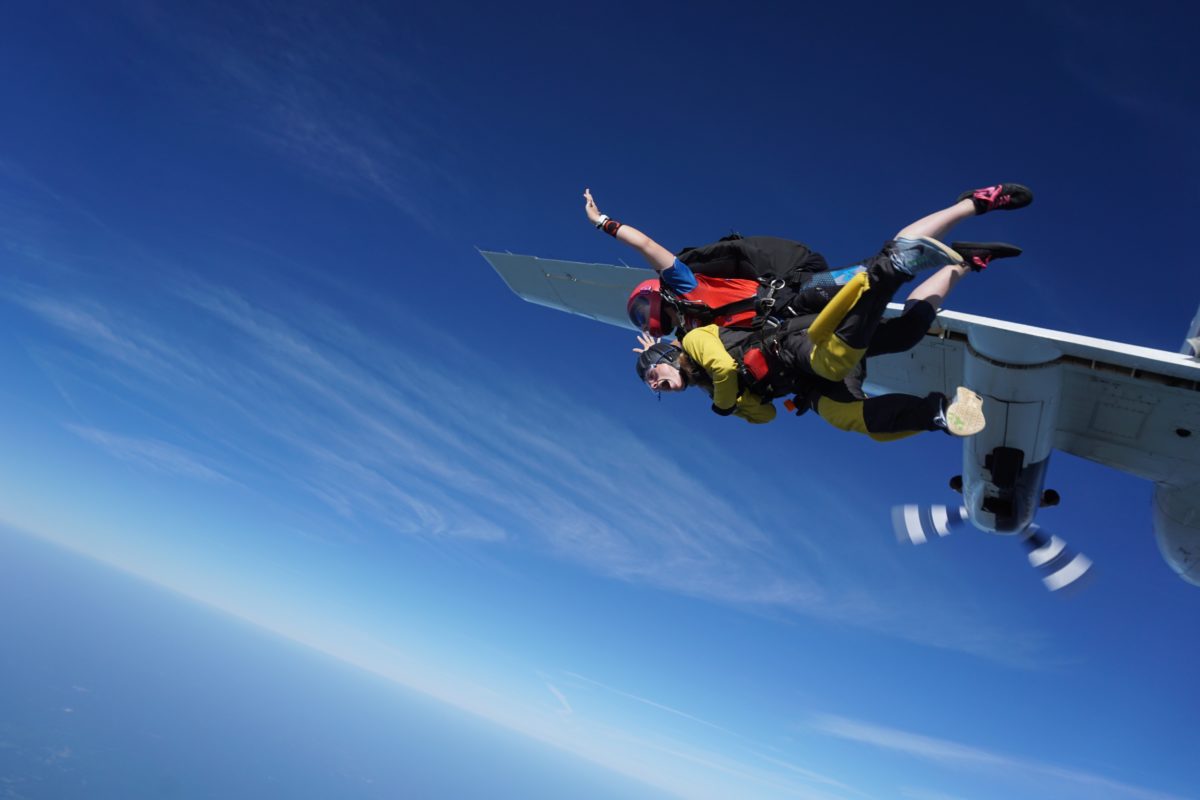
✔ stable freefall
✔ parachute deployment
✔ scenic canopy flight
✔ soft landing
At every stage, the instructor handles the technical and safety responsibilities, while beginners simply follow simple instructions and enjoy the moment.
Fear: “I’ll Feel a Roller Coaster Drop in My Stomach.”
Reality: No Stomach Drop Sensation
Most roller coasters create a stomach drop because they:
- accelerate downward suddenly
- remove support from below
Skydiving doesn’t feel like that because:
✔ airflow creates resistance
✔ you reach terminal velocity smoothly
✔ gravity + drag equalize
Instead of “dropping,” beginners describe it as:
“Floating on a cushion of air.”
The surprise is how stable and supported it feels.
Fear: “I Will Panic Once the Door Opens.”
Reality: Most Panic Happens Before, Not During
The most intense emotional moment is often:
➡ sitting in the plane with the door closed
Once the door opens, many beginners say their brain switches from:
😨 fear → 😳 shock → 😃 excitement
And once they exit, the brain has no time to panic, because the instructor controls body position, stability, and freefall.
Many first-timers report:
✔ less fear during freefall
✔ high focus
✔ adrenaline clarity
✔ surprising calm under canopy
Fear: “What If I’m Afraid of Heights?”
Reality: Skydiving Doesn’t Trigger Typical Height Phobia
Fear of heights usually activates when:
- you are close to the ground
- you can visually judge depth
- you feel like you could fall
Example: rooftop edges, ladders, balconies.
During a skydive:
✔ you are too high for depth perception
✔ the plane exit feels horizontal, not vertical
✔ there is no balcony feeling
✔ horizon is the reference point, not the ground
People afraid of heights often say:
“Weirdly, skydiving didn’t trigger my height fear.”
Fear: “What If the Parachute Doesn’t Open?”
Reality: Modern Equipment Includes Backups & Training
Modern skydiving gear includes:
✔ main parachute
✔ reserve parachute
✔ AAD (automatic activation device)
Tandem instructors also undergo:
✔ emergency procedure training
✔ thousands of jumps
✔ equipment checks
If you’d like to explore real safety data and numbers, check our detailed guide:
👉 skydiving deaths per year worldwide
Data-based awareness is far better than fear-based assumptions.
Fear: “What If I Forget Instructions?”
Reality: The Instructor Controls the Jump
First-timers don’t need to:
❌ deploy parachutes
❌ steer canopies
❌ manage emergency procedures
❌ land solo
The instructor handles:
✔ exit
✔ freefall control
✔ deployment
✔ canopy steering
✔ landing
Beginners simply:
✔ listen to brief instructions
✔ maintain comfortable body posture
✔ lift legs during landing when asked
That’s it.
Fear: “Freefall Will Be Too Intense for Me.”
Reality: Freefall Becomes Enjoyable in Seconds
Freefall feels like:
✔ high-speed wind
✔ forward flying sensation
✔ stable body suspension
✔ loud air noise
✔ no falling drop sensation
After 5–8 seconds, many beginners say:
✔ fear turns into excitement
✔ brain adapts quickly
✔ time feels slower
✔ focus increases
✔ breathing becomes natural
Freefall is only around 40–60 seconds, but the memory lasts for years.
Fear: “Landing Will Hurt.”
Reality: Tandem Landings Are Designed for Comfort
Modern tandem landings are usually:
✔ slide-in landings
✔ or soft stand-up landings
Instructors explain:
✔ when to lift legs
✔ how to brace gently
✔ what to expect on touchdown
Landings are smooth when conditions are good.
Fear: “The Whole Thing Will Be Terrifying.”
Reality: The Emotional Sequence Surprises Most People
A typical first-time emotional sequence looks like:
- Nervous anticipation (plane ride)
- Adrenaline spike (door opens)
- Focus mode (exit + first seconds)
- Excitement & clarity (freefall)
- Peace & joy (under canopy)
- Accomplishment (landing)
- Euphoria (after landing)
Many beginners describe the landing moment as:
“One of the best feelings I’ve ever had.”
Frequently Asked Questions
Is skydiving scary for first-time jumpers?
Yes — before the jump. During the jump, fear often fades quickly.
Does skydiving make you panic?
Most panic happens before exit — freefall feels surprisingly stable and controlled.
Can you skydive if you’re afraid of heights?
Yes — height phobia often doesn’t activate during skydiving due to altitude & perspective.
Does it feel like falling?
Not like roller coasters — it feels like flying on air.
Do you need to be brave to skydive?
You need curiosity, not bravery. Instructors handle the technical parts.
Final Thoughts: Fear Is Normal — Reality Is Different
Skydiving fear lives in the mind.
Skydiving reality lives in the body.
The combination of:
✔ instructor control
✔ layered safety systems
✔ structured procedures
✔ stable freefall sensation
✔ peaceful canopy flight
…makes skydiving far less chaotic and far more enjoyable than most people expect.
If you’re thinking about your first jump, it’s okay to feel afraid — what matters is what happens after the door opens, and that part often surprises beginners in the best possible way.