
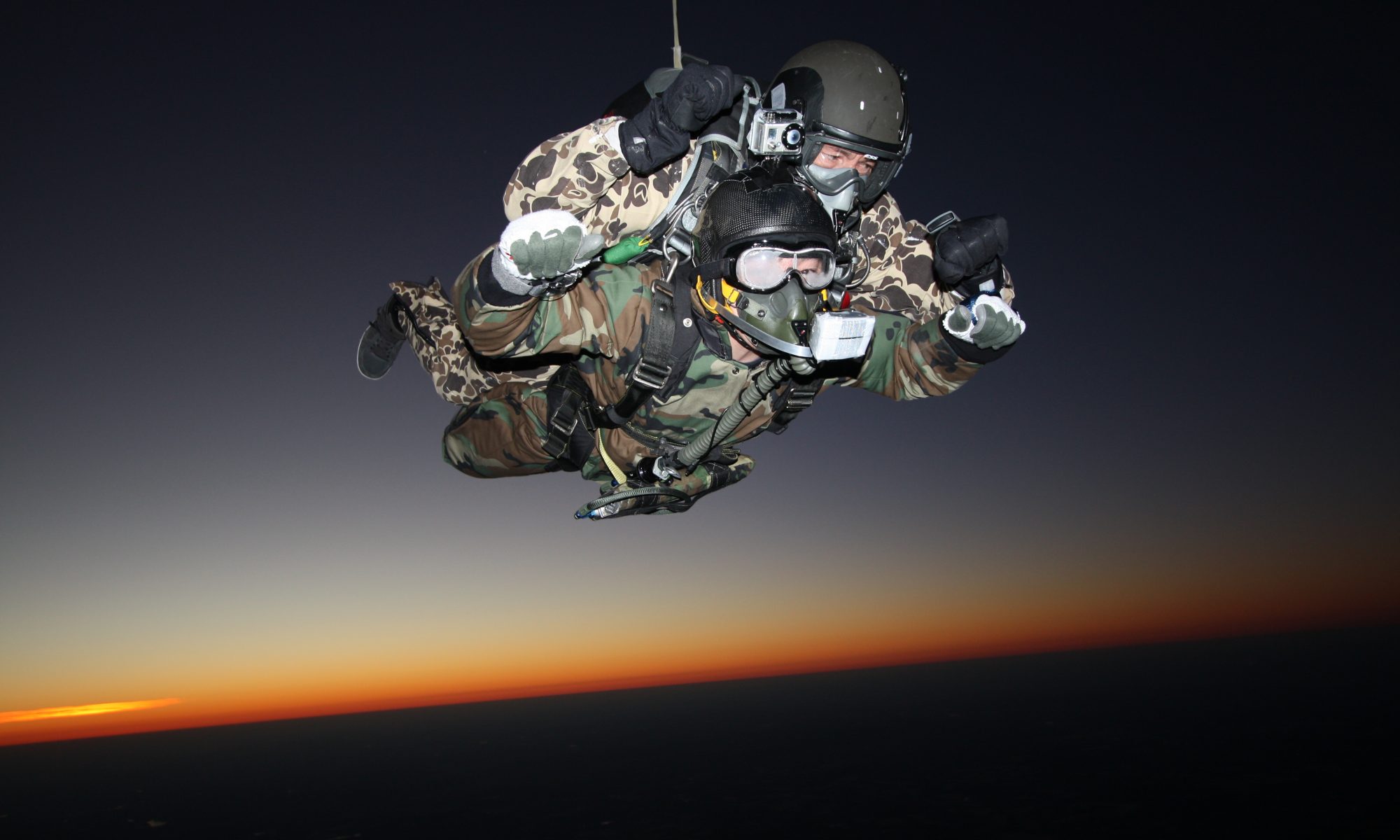
A HALO jump, which stands for High Altitude, Low Opening, is a parachute jump performed from between 15,000 and 35,000 feet, with the parachute deployed below 5,000 feet after a freefall of up to 90 seconds. Originally developed for military special forces to infiltrate enemy territory without radar detection, HALO jumps are now available to trained civilians through specialist skydiving operators.
This guide covers what a halo jump is, how high you jump, what it costs, how civilians can do one, the difference between HALO and HAHO, training requirements, and the world record for the highest jump ever recorded.
What is a HALO Jump?
A HALO jump is a type of parachute jump performed from a high altitude, usually between 15,000–35,000 feet, where the parachutist freefalls for an extended period before deploying the parachute at a low altitude.
- Originally designed for military operations, HALO jumps allow troops to infiltrate enemy territory stealthily.
- Modern adventurers can also experience it under strict safety protocols.
- Compared to regular skydives, HALO jumps offer longer freefall and extreme altitude views.
Key Points:
- Jumping height: 15,000–35,000 feet
- Freefall duration: 60–90 seconds
- Deployment altitude: typically below 5,000 feet
You may also see a halo jump referred to informally as a “helo jump” — a common alternate spelling found in civilian skydiving communities, though it is sometimes confused with helicopter-based jumps specifically.
Can Civilians Do a HALO Jump?
Yes, civilians can experience a halo jump, though it requires specialized training and preparation.
- Many skydiving companies now offer tandem HALO jumps, where an expert instructor guides the jump.
- Civilian jumps often use oxygen systems due to high-altitude conditions.
- Medical clearance is usually required to ensure safety.
Step-by-step path for civilians wanting a solo HALO jump:
- Complete a minimum of 200 logged skydives with a USPA A-licence or international equivalent. No operator will accept an unqualified civilian for a solo HALO jump.
- Obtain medical clearance from a physician confirming fitness for hypoxic conditions above 15,000 feet. Cardiovascular disease, uncontrolled asthma, and unresolved ear or sinus conditions can be disqualifying.
- Complete ground school oxygen training, including correct operation of an on-demand regulator and emergency procedures if oxygen fails during freefall.
- Book through a USPA Group Member Drop Zone with high-altitude operations approval. In the US, fewer than 15 facilities are equipped for civilian HALO jumps above 20,000 feet.
Tandem civilian HALO jumps: A small number of operators offer tandem HALO jumps for complete beginners between 15,000 and 18,000 feet, harnessed to a certified HALO instructor. No prior skydiving experience is required, though medical clearance and an oxygen briefing are still mandatory.
How Scary is a HALO Jump?
For first-time jumpers, a HALO jump can feel intense. Factors influencing fear levels include:
- Altitude anxiety
- Freefall speed of up to 120 mph
- The sensation of jumping from near space
Tips to Overcome Fear:
- Take training seriously.
- Practice breathing exercises.
- Jump tandem with a certified instructor.
Halo Jump Height and Lowest Opening
| Metric | Standard Range | Notes |
|---|---|---|
| Jump Height | 15,000–35,000 feet | Depends on aircraft and location |
| Lowest Opening | 2,000–5,000 feet | Ensures safety and adequate landing time |
| Freefall Duration | 60–90 seconds | Longer than recreational skydives |
Halo Jump Price: How Much Does It Cost?
The cost of a HALO jump varies by altitude, operator, and jump type. Based on US operator pricing as of 2025 to 2026:
Standard solo HALO jump (15,000 to 20,000 ft): $1,500 to $2,500 Tandem HALO jump with oxygen system (up to 18,000 ft): $2,500 to $3,500 High-altitude solo jump above 25,000 ft: $3,500 to $5,000 Ground school and oxygen training for first-timers: $200 to $500 additional
Prices outside the US vary significantly. Australia and New Zealand typically cost 20 to 30 percent more due to stricter regulatory requirements. Always confirm current pricing directly with the operator before booking.
HALO Jump Military vs Civilian
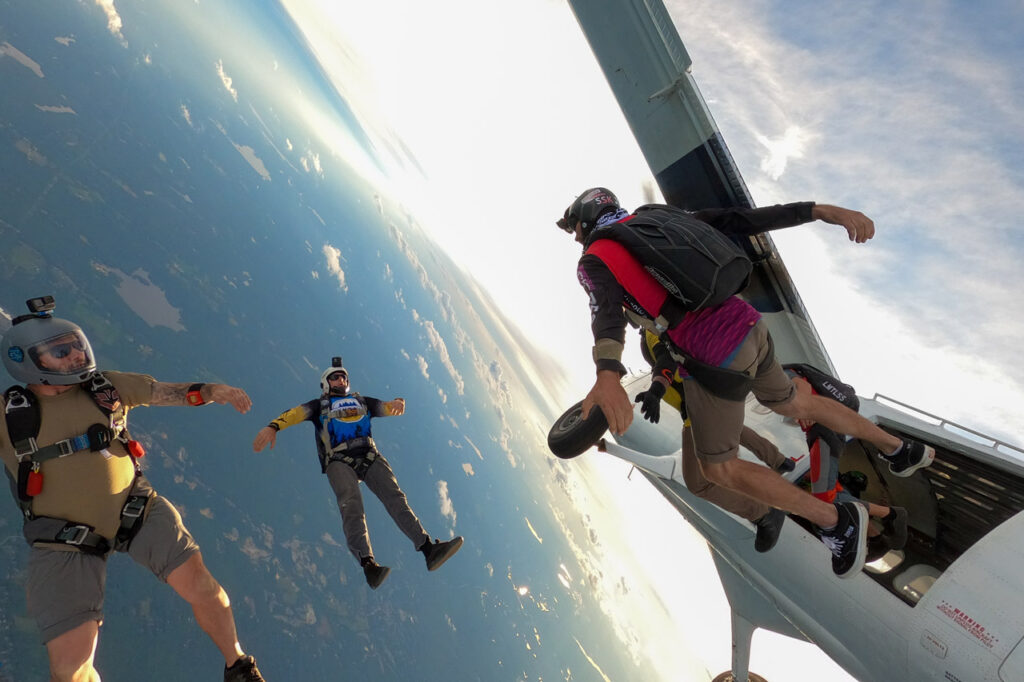
Originally, HALO jumps were exclusive to military operations:
- Military HALO jumps: Stealth infiltration, combat readiness, tactical maneuvers
- Civilian HALO jumps: Adventure experience, recreational thrill, photo/video opportunities
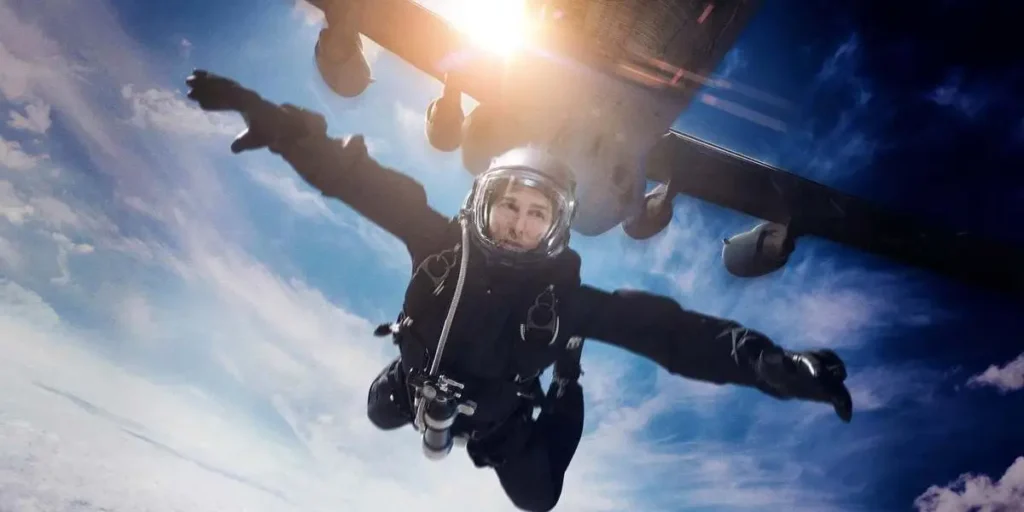
Some adventurers even try to emulate stunts by celebrities like Tom Cruise, who famously performed high-altitude jumps for movie scenes.
HALO Jump Training: What You Need to Learn Before You Jump
HALO jump training covers three areas that standard skydiving courses do not include: oxygen system operation, high-altitude physiology, and equipment familiarisation for extreme cold and low pressure.
- Oxygen system training At altitudes above 15,000 feet, the body cannot sustain full consciousness without supplemental oxygen. HALO jumpers breathe 100 percent oxygen for 30 minutes before exit — called pre-breathing or denitrogenation — to purge nitrogen from the blood. Training covers how to fit and operate an on-demand oxygen regulator, how to recognise hypoxia symptoms (confusion, euphoria, loss of fine motor control), and emergency procedures if oxygen fails during freefall.
- High-altitude physiology ground school Certified HALO instructors require a four to six hour ground school session covering the effects of altitude on the human body, blood oxygen saturation monitoring with a pulse oximeter during ascent, barotrauma risks to ears and sinuses during rapid decompression, and how body position and freefall stability differ at extreme altitudes where air density is significantly lower.
- Equipment familiarisation HALO-specific equipment includes a full-face helmet with an integrated oxygen mask, an automatic activation device calibrated for high-altitude deployment, a GPS unit for navigating under canopy from extreme altitude, and in some operations a pressurised suit for jumps above 25,000 feet.
The full training pathway to solo civilian HALO readiness typically requires two to three days of ground school plus a minimum of three supervised practice jumps at progressively increasing altitudes.
Can You HALO Jump from a Helicopter?
Yes, you can perform a HALO jump from a helicopter, though there are meaningful differences compared to jumping from a fixed-wing aircraft.
Altitude ceiling: Most helicopters have a service ceiling between 10,000 and 16,000 feet. This limits helicopter-based HALO jumps to the lower end of the altitude range. For a jump above 20,000 feet, a pressurised fixed-wing aircraft such as a C-130 Hercules or King Air is required.
When helicopter HALO jumps are used:
- Training exercises, where instructors need repeated low-altitude practice jumps in quick succession
- Film and stunt productions requiring specific camera angles
- Scenic adventure jumps in mountain regions or coastal areas where airport access is limited
- Military exercises in confined terrain where a fixed-wing approach would compromise the operation
Key freefall difference: A helicopter hovers before the jump, removing the forward airspeed a fixed-wing aircraft imparts. This changes body position and freefall dynamics in the first two to three seconds — an adjustment experienced skydivers notice immediately.
HALO Jump vs HAHO: What’s the Difference?
| Feature | HALO Jump | HAHO Jump |
|---|---|---|
| Altitude | High (15,000–35,000 ft) | High (15,000–35,000 ft) |
| Parachute Deployment | Low opening | High opening |
| Purpose | Stealth insertion | Long-distance glide |
| Freefall | Longer freefall | Shorter freefall |
What is the Highest HALO Jump?
- Felix Baumgartner’s Red Bull Stratos jump in October 2012 set the initial record, from 128,100 feet (39,045 metres, approximately 24.2 miles). Alan Eustace then broke that record in October 2014, jumping from 135,890 feet (41,422 metres) — the current world record. Standard civilian HALO jumps reach a maximum of approximately 35,000 feet.
- Regular adventure jumps for civilians range from 15,000–35,000 feet.
- High-altitude jumps require oxygen systems and special pressurized suits.
Tips for a Safe and Thrilling Halo Jump
- Training First: Never skip pre-jump instructions.
- Physical Fitness: Maintain good health to handle extreme altitudes.
- Gear Check: Always use certified equipment.
- Weather Conditions: Avoid jumps during poor visibility or high winds.
- Mental Preparation: Visualization and calm breathing help reduce fear.
FAQ: People Also Ask
Q: What does HALO jump stand for?
HALO stands for High Altitude, Low Opening. It describes a parachute jump where the jumper exits at 15,000 to 35,000 feet and freefalls before deploying the parachute below 5,000 feet. The technique was developed by military forces to allow insertion into a target zone without radar detection.
Q: What is the lowest opening for a HALO jump?
The standard lowest civilian opening altitude is 2,000 feet above ground level. Military HALO operations can deploy as low as 800 feet in emergency scenarios. Most civilian tandem operators set a minimum deployment altitude of 2,500 feet to ensure a safe canopy flight and landing pattern.
Q: How high is a HALO jump?
Civilian tandem HALO jumps range from 15,000 to 18,000 feet. Solo civilian jumps can reach 25,000 to 35,000 feet with oxygen equipment. Military HALO operations use pressurised suits and oxygen systems to operate at the full 35,000-foot ceiling. The higher the altitude, the longer the freefall duration.
Q: Can civilians do a HALO jump?
Yes. Two routes exist: a tandem HALO jump with a certified instructor (no prior skydiving experience needed, medical clearance mandatory), or a solo civilian HALO jump after completing 200 logged skydives and ground school oxygen training with a USPA-approved high-altitude operator.
Q: How scary is a HALO jump?
Most experienced skydivers rate a HALO jump as more intense than a standard skydive due to extended freefall (60 to 90 seconds versus 30 to 45 seconds) and the awareness of extreme altitude. Tandem jumps with a qualified instructor significantly reduce the psychological difficulty for first-time participants.
Q: How much does a HALO jump cost?
As of 2025 to 2026, US civilian HALO jump costs range from $1,500 to $2,500 for a solo jump and $2,500 to $3,500 for a tandem jump with oxygen system. High-altitude solo jumps above 25,000 feet can reach $3,500 to $5,000. Equipment and training add $200 to $500.
Q: What is the difference between HALO and HAHO?
HALO (High Altitude, Low Opening) involves a long freefall before low parachute deployment, used for precision insertion into a small target zone. HAHO (High Altitude, High Opening) deploys the parachute immediately after exit, allowing the jumper to glide up to 40 miles horizontally to land far from the aircraft’s flight path.
Q: What is the highest halo jump ever recorded?
Alan Eustace set the current record in October 2014, jumping from 135,890 feet (41,422 metres) during the StratEx mission. Felix Baumgartner’s 2012 Red Bull Stratos jump from 128,100 feet was the previous record. Standard civilian HALO operations reach a maximum of approximately 35,000 feet.
Q: Can you do a HALO jump from a helicopter?
Yes, though helicopter HALO jumps are limited by service ceilings of 10,000 to 16,000 feet. Fixed-wing aircraft are required for jumps above 18,000 feet. Helicopter-based HALO jumps are used for training, film productions, and scenic adventure jumps in areas without runway access.
Conclusion: Take the Leap of a Lifetime
A halo jump is more than just an extreme sport—it’s an unforgettable adventure for thrill-seekers, travelers, and military enthusiasts alike. By understanding HALO jump heights, prices, safety tips, and preparation, you can experience the ultimate adrenaline rush safely.
Ready to take the plunge? Explore more skydiving adventures here: Best Skydiving in the USA.