

You have watched the videos. You have told your friends you want to do it. You might have even looked up drop zones near you. But every time you get close to actually booking, something stops you — a tight feeling in your chest, a voice in your head saying “what if something goes wrong?” That feeling has a name. It is called fear, and almost every single person who has ever jumped out of a plane felt exactly the same way before their first time.
The good news is that fear of skydiving is completely normal, incredibly common, and something that thousands of people work through every single year. This guide is going to walk you through why that anxiety shows up, what is actually happening in your brain and body when it hits, and the real practical steps that help you move past it so you can finally take that leap you have been thinking about.
Not Sure Where to Start?
Our beginner’s section covers everything from what to wear to what happens on the day — so you can walk in feeling calm and ready.Read the Beginner Guides →
Why Your Brain Is Afraid of Jumping — Even When You Want To

Here is something important to understand before anything else: your brain is not trying to ruin your fun. It is doing exactly what it was built to do. The human brain has a tiny region called the amygdala, and its entire job is to scan for danger and trigger an alarm response when it senses a threat. Standing at the edge of an aircraft door at 12,000 feet is exactly the kind of scenario that sets off every alarm in your nervous system at once.
This response — racing heart, shallow breathing, tight stomach, sweaty palms — is your body preparing you for action. It is often called the fight-or-flight response. The catch is that this system does not distinguish between real danger and perceived danger very well. It reacts to the idea of jumping just as intensely as it would react to an actual threat, even when you are completely safe and surrounded by trained professionals.
Understanding this is the first shift in thinking that makes a real difference. Your fear is not a signal that something is actually going to go wrong. It is your brain doing its job with incomplete information. Your job is to give it better information — which is exactly what the rest of this guide helps you do.
The Truth About How Dangerous Skydiving Actually Is
One of the biggest reasons people stay stuck in anxiety is that their mental picture of the risk is wildly out of proportion to reality. Movies, news stories, and social media tend to highlight the dramatic and the tragic, which gives most people a very skewed sense of how often things go wrong in practice.
The United States Parachute Association regularly publishes safety data on jumps made across the country. The numbers consistently show that the activity is far safer than most people imagine. Trained tandem instructors complete tens of thousands of dives every year, and the vast majority happen without any incident at all. You can read a detailed breakdown of what the actual statistics show in our article on how many people die a year from skydiving — the numbers may genuinely surprise you.
Modern equipment has also come a long way. Parachute systems in use today are engineered with multiple layers of redundancy. Reserve parachutes, automatic activation devices, and rigorous packing protocols all exist specifically to protect jumpers when something unexpected happens. The instructors attached to first-time tandem jumpers are not just confident — they are highly trained, licensed professionals who have each completed hundreds or thousands of jumps before they are ever allowed to take a passenger.
Reality Check: Statistically, you face a higher chance of being injured in a car journey to the drop zone than during the jump itself. That is not meant to make driving seem dangerous — it is meant to illustrate how genuinely safe a properly operated tandem dive is.
The Difference Between Fear and Excitement (It Is Smaller Than You Think)
Here is something that surprised a lot of people when researchers first published it: physiologically, fear and excitement feel almost identical. Your heart rate increases. Your breathing quickens. Your senses sharpen. The physical sensations are nearly the same. What changes is the story your mind tells about what those sensations mean.
When you are afraid, your brain labels those feelings as warning signs — danger is coming, something bad will happen. When you are excited, your brain labels those same feelings as anticipation — something thrilling is approaching, and you cannot wait for it. The feelings themselves are not the problem. The interpretation is.
A useful mental technique that many first-time jumpers swear by is simply reframing the experience in their own heads before the jump. Instead of saying “I am terrified,” try saying out loud or in your head “I am excited.” It sounds almost too simple to work, but a growing body of research into emotional regulation suggests that this kind of verbal reappraisal genuinely changes how your nervous system processes the experience. Give it a try — you might be surprised.
Practical Steps to Prepare Your Mind Before Jump Day
Learn as Much as You Can About the Process
A huge proportion of pre-jump anxiety comes from not knowing what is going to happen. The mind hates uncertainty, and when it does not have reliable information, it fills the gaps with worst-case scenarios. Knowledge is one of the most effective antidotes to this kind of anxiety.
Read about what actually happens from the moment you arrive at the drop zone to the moment your feet touch the ground. Our detailed guide on what to expect on your first skydive walks through the entire experience step by step in plain, easy-to-understand language. When you know what is coming at each stage, the unknown becomes known — and the anxiety loses a lot of its power.
Watch Real First-Timer Videos
There is something uniquely reassuring about watching real people — people who were clearly nervous — go through the experience and land with huge grins on their faces. YouTube is packed with genuine first-jump footage. Search for unfiltered, amateur videos rather than polished promotional content. Seeing someone laugh through their own fear and come out the other side glowing is genuinely helpful for your own mental preparation.
Talk to Someone Who Has Done It
If you know anyone who has jumped before, ask them about it. Not just the exciting parts — ask them if they were scared, how it felt in the moments before the exit, and what they wish they had known going in. Most experienced jumpers love talking about it, and hearing first-hand accounts from real people tends to carry more weight than anything you read online.
Choose a Drop Zone That Prioritises Communication
Not all facilities handle anxious first-timers the same way. A good drop zone will take time to answer your questions patiently, explain every step of the process before you suit up, and pair you with an instructor who is calm, warm, and experienced at managing nervous passengers. Reading reviews before you book — specifically looking for comments about how staff treated anxious beginners — is time well spent.
What Actually Happens to Fear Once You Are in the Air
Here is the thing that most people are not prepared for: once you are actually on the aircraft and climbing to altitude, something shifts. Many first-time jumpers describe the ground training and the walk to the plane as the most anxious part of the whole experience. By the time they are in the air, many people report feeling surprisingly calm — almost resigned to the adventure in a good way.
And then the door opens.
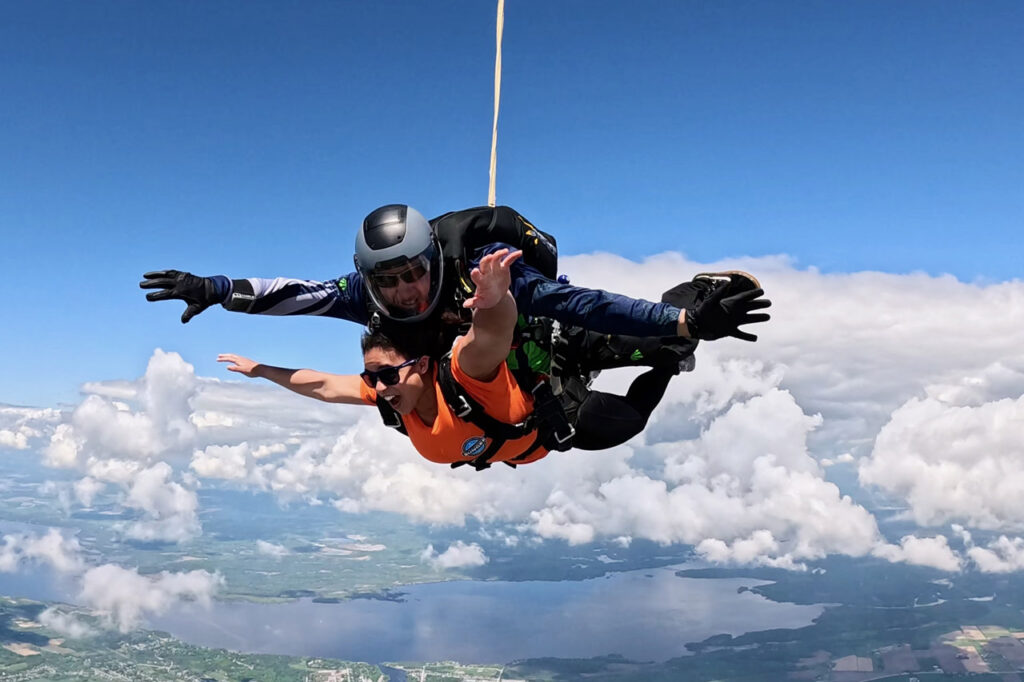
For most people, the moment of the actual exit is the single most intense experience of their lives. Not painful, not horrible — just overwhelmingly intense. And then, within seconds, something genuinely unexpected happens: the body adapts. The wind takes over, the noise fills your ears, the view stretches out beneath you, and a lot of people find that their fear is replaced almost instantly by a state of pure, focused aliveness that they have never felt before.
You can read a first-person account of exactly this kind of experience in our article on what a first jump actually feels like from start to finish. Many people who were convinced they would hate every second of it came back wanting to do it again the same afternoon.
Remember This: The anticipation is almost always worse than the event itself. Every skydiver who has ever lived has felt what you are feeling right now. Most of them went on to jump again. And again. And again.
Breathing Techniques That Help on the Day
Controlled breathing is one of the few tools you have direct control over when anxiety hits hard. When you are anxious, your breathing tends to become shallow and fast, which actually makes the physical symptoms of fear worse by reducing oxygen flow to your brain. Deliberately slowing your breath down breaks that cycle.
A simple technique that works well in high-pressure moments is called box breathing. You breathe in slowly for a count of four, hold for a count of four, breathe out for a count of four, and hold again for a count of four before repeating. This method is used by military personnel, surgeons, and professional athletes to stay calm under pressure. It works in an aircraft doorway just as well as anywhere else.
Practising this technique in the weeks before your jump means it becomes familiar and automatic. When your heart is pounding at altitude, you want this to feel like second nature rather than something you are trying to remember for the first time.
What If Your Fear Is Specifically About Heights?
Interestingly, many people who are afraid of heights find that the jump itself does not trigger their usual height-related fear in the way they expected. This is because at 12,000 feet, the ground is so far below that it does not register visually the same way that standing on a cliff edge or a tall building does. There is no visible edge to lean over, no immediate sense of how far you could fall — just an enormous open sky in every direction.
This does not mean everyone with a fear of heights has an easy time. Some people still feel the anxiety strongly. But it is worth knowing that many acrophobia sufferers report that the jump experience felt completely different from their usual height-related triggers. The sensation of freefall is not like falling from a building — it is more like floating at very high speed, with no reference point for the drop.
Is There Anyone Who Should Not Jump Due to Anxiety?
Most people with ordinary pre-jump nerves are absolutely fine to proceed. Anxiety before a first jump is healthy and completely expected. However, if you have been diagnosed with a significant anxiety disorder, panic disorder, or a heart condition that is worsened by acute stress, it is sensible to speak with your doctor before booking. Most people with mild to moderate anxiety can and do jump safely — but getting clearance from a medical professional gives you both peace of mind and a practical safety check.
You can read about the full set of medical considerations and physical requirements in our guide to health and eligibility rules for first-time jumpers. The requirements are not as restrictive as most people assume, and the article explains each one clearly.
Ready to Take the Next Step?
Find out exactly what happens on jump day — from arrival to landing — so there are no surprises when it matters most.Read: What to Expect on Your First Jump →
One Last Thing to Hold Onto
Every single person who has ever jumped was afraid before their first time. That includes the instructors. That includes the world record holders. That includes people who now jump every single weekend and cannot imagine their life without it. Fear does not mean you are not ready. It means you are human.
The people who end up jumping are not the ones who were never scared. They are the ones who decided the experience was worth more than the discomfort of the fear. And almost without exception, they come back and say that doing it was one of the best decisions of their lives.
You have already done the hard part by researching, reading, and taking this seriously. The next step is the booking. Everything after that takes care of itself.
Frequently Asked Questions
Is it normal to be terrified before a first jump?
Completely normal. Almost every first-time jumper experiences some level of anxiety in the lead-up to their dive. The feeling typically peaks during the approach to the aircraft door and then shifts dramatically once freefall begins. Instructors at good drop zones are used to working with nervous passengers and will support you through every stage of the experience.
Can I back out at the last minute if I am too scared?
Yes. You are never forced to jump. Most reputable drop zones allow you to withdraw at any point before the exit, though refund policies vary depending on how far into the process you are. That said, most people who feel the urge to back out at the door choose to go ahead — and are grateful they did. Talk to your instructor honestly about how you are feeling. They have seen it many times before and know how to help.
Does fear of heights mean I cannot skydive?
Not necessarily. Many people with a fear of heights find that the experience of jumping from 12,000 feet feels very different from standing on a ledge or looking down from a tall building. At that altitude, the visual cues that normally trigger height-related fear are much less intense. It is worth consulting with a drop zone and, if needed, your doctor before deciding.
How long does the nervous feeling last?
For most people, the anxiety is strongest in the 30 to 60 minutes before the jump — during suit-up and the aircraft ascent. Many first-timers report that the moment freefall starts, the anxiety transforms into something closer to exhilaration. After landing, the vast majority of people feel an enormous wave of relief, pride, and happiness. The nervous feeling is temporary. The memory lasts a lifetime.
Should I tell my instructor I am scared?
Absolutely yes. Being honest with your instructor is one of the smartest things you can do. They are trained to manage nervous passengers and will adjust how they communicate with you, what they tell you at each stage, and how they support you through the exit. Hiding your anxiety does not help anyone — sharing it gives your instructor the information they need to make your experience better.
What if I panic during freefall?
True panic during freefall is quite rare, partly because the sensory experience is so overwhelming that the brain does not have much room left for catastrophic thinking. Your instructor remains attached to you at all times during a tandem dive and is in control of the parachute system throughout. If you feel overwhelmed, focus on your breathing and let your body relax into the harness. The canopy will open, the noise will fade, and you will be floating gently before you know it.
More from SkydiveGuides: What Does Skydiving Feel Like? · Gear Safety for Beginners · How to Prepare for Your First Tandem Jump · Skydiving Death Statistics Explained