

Have you ever wondered what the human max falling speed actually is? Whether you are about to book your first tandem skydive or you are just curious about the physics of freefall, this question has a genuinely fascinating answer.
The short answer: most people hit around 120 mph (193 km/h) in a standard belly-to-earth skydiving position. But the real answer goes far deeper than that number. Your body position, your weight, your altitude, your clothing, and even the air pressure around you all change how fast you fall.
And for the record holders? The fastest human freefall ever recorded broke the sound barrier at over 843 mph (1,357 km/h).
In this guide, we break down everything about human max falling speed. You will learn the science behind terminal velocity, how skydivers control their fall rate, what the world records look like, and what your own falling speed will be on a real tandem skydive. Let us get into it.
Table of Contents
1. What Is Human Max Falling Speed?
The human max falling speed is not one single fixed number. It is determined by something called terminal velocity, and terminal velocity is different for every person and every situation.
Terminal velocity is the point at which the downward force of gravity pulling you toward the earth equals the upward force of air resistance pushing back against your body. Once those two forces reach a balance, you stop accelerating. You have reached your maximum falling speed for that particular situation.
For most skydivers falling in a standard belly-to-earth position, that number lands around 120 mph (193 km/h). But in a head-down dive with a tight suit and perfect technique at high altitude, the same human body can reach speeds exceeding 300 mph (480 km/h).
In extreme cases involving near-space altitudes with almost no air resistance at all, a human in freefall has reached 843.9 mph (1,357.6 km/h), which is faster than the speed of sound.
So the honest answer is: the human max falling speed varies enormously based on conditions. Let us walk through every factor that controls it.
2. The Science of Terminal Velocity Explained Simply
To understand human max falling speed, you need to understand terminal velocity. Here is the simple version.
When you jump out of a plane, gravity immediately starts pulling you toward the ground at a rate of 9.8 meters per second squared (32 feet per second squared). In the first moments of freefall, you are accelerating quickly because the air resistance is not yet strong enough to slow you down.
But as your speed increases, air resistance increases too. The faster you move, the more air molecules you push through, and the harder those air molecules push back on you.
Eventually, the air resistance grows large enough to exactly cancel out gravity. At that point, you stop speeding up. You have reached terminal velocity, your maximum falling speed for those conditions.
The key variables that control where your terminal velocity lands are:
Surface area. The more surface area your body presents to the air, the more air resistance you generate and the slower you fall. Spreading your arms and legs wide, belly toward the earth, maximizes your surface area and slows you down.
Body weight. More body mass means more gravitational pull. Heavier people reach a higher terminal velocity because their weight overcomes air resistance more effectively.
Air density. At higher altitudes, the air is thinner and less dense. Thinner air provides less resistance, which means terminal velocity is higher at altitude than at sea level.
Aerodynamics. A streamlined, head-down body shape cuts through air like a missile and generates far less drag. This dramatically raises the speed at which equilibrium is reached.
3. Standard Freefall Speed in Skydiving (Belly-to-Earth)
For the vast majority of skydives, including every tandem skydive you will ever take as a first-time jumper, the standard position is belly-to-earth. It looks exactly like it sounds: you face the ground, arch your back, stretch your arms out, and let your hips be the lowest point of your body.
In this position, the average person reaches a terminal velocity of approximately 110 to 130 mph (177 to 209 km/h). The standard number most instructors cite is 120 mph (193 km/h).
This is the human max falling speed for a typical skydive, and it is where most people spend the majority of their freefall.
Why is this position the standard? Because it is naturally stable. When your center of gravity (your pelvis) sits lower than everything else, you resist the spinning and tumbling that can happen in other positions. It keeps you controlled, safe, and comfortable, which is exactly what you want when you are new to the sport.
4. How Body Position Changes Your Falling Speed
Body position is arguably the most powerful tool a skydiver has for controlling fall rate. Changing your shape in the air can shift your speed by 30, 50, or even 100+ mph without changing a single piece of equipment.
Here is a breakdown of how different positions affect human max falling speed:
Belly-to-Earth (Standard Arch) Speed range: 110 to 135 mph (177 to 217 km/h) This is the default skydiving position. Arms out, legs spread, hips low, back arched. Maximum surface area means slower fall.
Sit Flying (Seated Position) Speed range: 150 to 180 mph (241 to 290 km/h) In sit flying, you are upright like you are sitting in a chair, falling feet first. Your surface area is significantly reduced compared to belly flying, so you fall considerably faster.
Head Down (Vertical) Speed range: 180 to 240 mph (290 to 386 km/h) Head-down freefall, used by experienced skydivers and formation flying teams, points your feet toward the sky and your head toward the ground. Your body becomes a near-vertical column with minimal drag surface, sending speeds into the 200 mph range.
Tracking Speed range: 80 to 120 mph vertical, with significant horizontal travel Tracking is a position where skydivers angle their body to travel across the sky horizontally at speed. It is used to gain separation before opening a parachute. Fall rate drops while horizontal speed increases.
Wingsuit Flying Speed range: 25 to 60 mph vertical fall rate A wingsuit turns the human body into a gliding surface. The nylon material between your arms and legs and between your legs creates enormous lift, dramatically slowing vertical descent while enabling horizontal speeds of 100 mph or more.
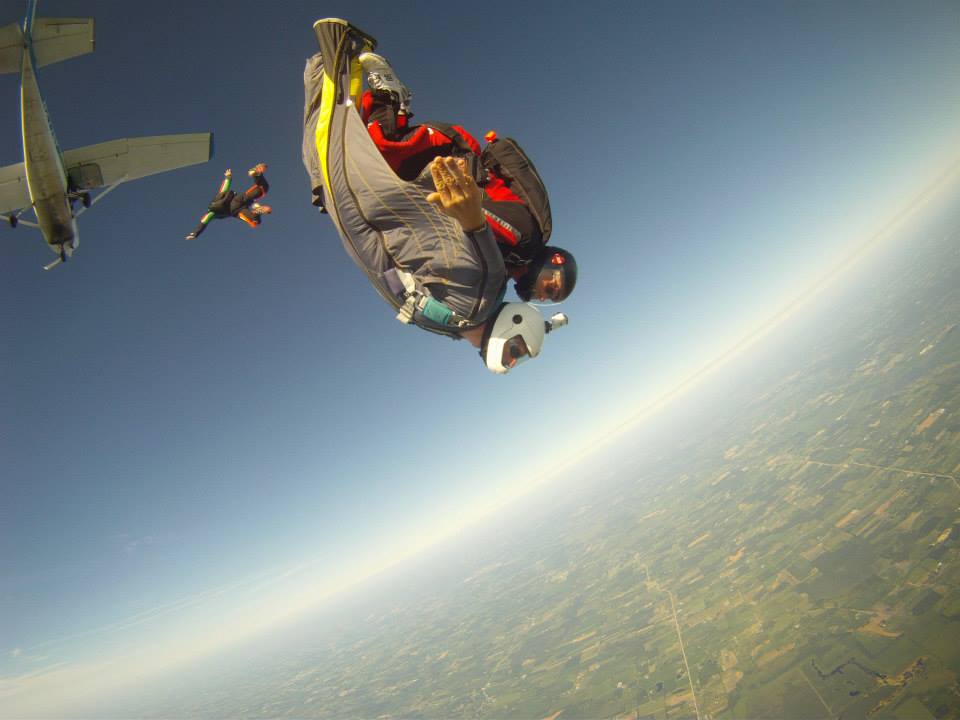
Speed Skydiving (Head Down, Streamlined) Speed range: 250 to 330+ mph (402 to 531+ km/h) This is a dedicated sport discipline. Competitors wear ultra-tight suits and dive in a perfect head-down bullet shape, achieving the highest speeds achievable under normal skydiving conditions.
The takeaway: position is everything. The same human body can fall at 60 mph or 300 mph depending entirely on how it is oriented in the air.
5. How Body Weight Affects Fall Rate
Body weight plays a real role in determining your terminal velocity. Physics does not care about feelings here: a heavier body has more mass being pulled by gravity, and it takes more air resistance to slow that mass down.
This means heavier skydivers naturally fall faster than lighter skydivers in the same position.
In practical terms, this is why dropzones put limits on skydiver weight. It is not just about equipment capacity. A very heavy jumper falls so much faster than a lighter tandem instructor that the jump can become difficult to control. The parachute also has to handle more load, which affects opening forces and canopy behavior.
For group formation jumps, where multiple skydivers fall together in formation, everyone needs to be falling at roughly the same speed. Heavier jumpers can widen their spread (increasing surface area and drag) to slow down. Lighter jumpers can pull their limbs in tighter to speed up. Getting this matching right is a genuine skill and one of the first things taught in advanced skydiving training.
6. How Altitude Affects Human Max Falling Speed
This is one of the most fascinating aspects of human max falling speed, and it is something most people never consider.
Air is not equally dense at all altitudes. Near sea level, the atmosphere is thick and packed with molecules. As you climb higher, the atmosphere becomes progressively thinner. Less air means less resistance, which means terminal velocity gets higher the further up you go.
At a standard skydiving altitude of 10,000 to 15,000 feet, the air is moderately thin but still provides substantial resistance. Terminal velocity in belly-to-earth position lands around 120 mph.
At 30,000 feet (military HALO jump altitude), air density drops significantly. A jumper at this altitude can achieve belly-to-earth speeds of 150 mph or more before air density builds back up during descent.
At near-space altitudes above 100,000 feet, the air is so thin it provides almost no resistance at all. This is where the extreme records are set. A human body in near-vacuum conditions can accelerate to extraordinary speeds before hitting the denser lower atmosphere and being slowed back down.
This altitude effect explains why Felix Baumgartner was able to break the sound barrier during his 2012 Stratos jump from 128,100 feet. The thin air at that altitude allowed him to reach 843.9 mph before the thickening atmosphere slowed him back to normal skydiving speeds.
7. Tandem Skydiving Speed: What to Expect
If you are planning a tandem skydive, here is exactly what to expect in terms of speed.
A tandem pair (you plus your instructor) is heavier than a solo skydiver. Two adult bodies strapped together create a heavier unit that, in theory, would fall faster than a solo jumper.
To manage this, tandem instructors use a device called a drogue parachute. The drogue is a small pilot chute deployed shortly after exit. It acts as a speed limiter, creating just enough extra drag to bring the tandem pair back down to the standard terminal velocity range of around 120 mph.
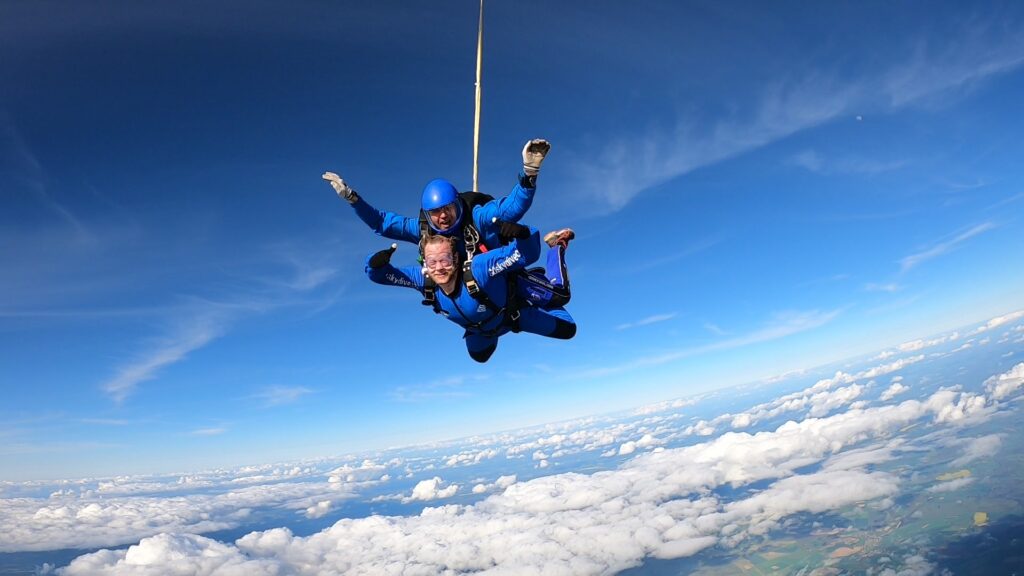
The drogue serves three purposes simultaneously. It controls fall speed so camera operators can fly alongside and capture your jump. It stabilizes the pair during freefall. And it helps reliably deploy the main parachute when the time comes.
Without the drogue, a tandem pair could reach speeds of 150 mph or more in belly-to-earth position, which would make parachute deployment dangerously violent.
So on your tandem jump, expect to hit around 110 to 120 mph during the freefall portion. It feels like standing in an incredibly powerful sustained wind. Most people describe the sensation as less like falling and more like floating on a moving wall of air.
8. Speed Skydiving: The Discipline Built for Going Fast
Speed skydiving is an official competitive skydiving discipline recognized by the Federation Aeronautique Internationale (FAI). The sole goal of the sport is to reach the highest possible vertical speed during a timed measurement window in freefall.
Competitors exit the aircraft at high altitude, typically above 13,000 feet, and immediately transition into an extreme head-down position. They wear specialized, ultra-tight jumpsuits designed to minimize drag. Arms are typically pinned to the sides, legs close together, body shaped into the most aerodynamic form possible.
The speed measurement window begins at 2,700 meters (about 8,858 feet) above the ground and ends at 1,700 meters (about 5,577 feet) above the ground, giving a 1,000 meter measurement zone.
World record speeds in speed skydiving regularly exceed 300 mph (480 km/h). In competition, speeds of 250 mph and above are common among elite athletes.
The current FAI world record for speed skydiving was set in excess of 600 km/h (approximately 373 mph) under standard competition rules. The athletes who compete in this discipline train for years to perfect body position, suit choice, and the technique of slipping through the air with minimum resistance.
This is the highest human max falling speed achievable under standard skydiving equipment and competition conditions.
9. The Fastest Human Freefall Ever Recorded
On October 14, 2012, Austrian skydiver and BASE jumper Felix Baumgartner stepped off a capsule floating at 128,100 feet (39,045 meters) above the New Mexico desert and became the fastest freefalling human in recorded history.
His peak speed during the Red Bull Stratos project: 843.9 mph (1,357.6 km/h), which is Mach 1.25. He broke the sound barrier with his body.
The jump lasted 4 minutes and 20 seconds of freefall before Baumgartner deployed his parachute. He set three world records that day: highest freefall, highest manned balloon flight, and fastest speed in freefall.
What made this possible was the altitude. At 128,100 feet, the atmosphere is nearly a vacuum. There was almost no air resistance in the first portion of his descent. Gravity could accelerate him to extraordinary speeds because nothing was pushing back. Only as he descended into denser lower atmosphere did he begin to slow, eventually reaching a speed at which parachute deployment was safe.
Baumgartner wore a full pressurized suit to survive the near-space environment. Without it, the lack of atmospheric pressure at that altitude would have been instantly fatal.
This jump stands as the definitive answer to the question of what the human max falling speed is under extreme conditions: just over Mach 1, achieved by combining near-vacuum altitude with a perfectly shaped human body and gravity.
10. Felix Baumgartner vs. Alan Eustace: A Speed Comparison
Baumgartner held his records for two years. On October 24, 2014, Google executive Alan Eustace quietly surpassed the altitude record by jumping from 135,890 feet (41,422 meters).
However, Eustace’s peak speed was lower at approximately 822 mph (1,323 km/h), just below the sound barrier. This was partly due to differences in suit design and body position during descent.
Here is a quick side-by-side comparison:
| Record Category | Felix Baumgartner (2012) | Alan Eustace (2014) |
|---|---|---|
| Jump Altitude | 128,100 feet | 135,890 feet |
| Peak Speed | 843.9 mph (Mach 1.25) | 822 mph |
| Freefall Duration | 4 min 20 sec | 4 min 27 sec |
| Sound Barrier | Broken (Yes) | Not broken |
| Distance Traveled | 119,846 feet | 123,334 feet |
Baumgartner still holds the record for fastest human freefall speed. Eustace holds the record for highest altitude jump.
Both jumps are extraordinary achievements and both confirm what the science of terminal velocity predicts: remove air resistance at high altitude, and the human body can reach speeds that would be completely impossible at lower altitudes.
11. What Happens to Your Body at High Falling Speeds?
Understanding the human max falling speed is not just about knowing a number. It is worth understanding what those speeds actually do to your body.
At 120 mph (standard tandem speed)
At this speed, you feel intense wind pressure against your face, body, and exposed skin. It is not painful, but it is powerful. Breathing is possible and comfortable, though most first-time jumpers breathe through slightly parted lips or simply open their mouths to let the air flow. Your cheeks and soft tissue ripple from the wind. Your field of vision narrows slightly from the G-forces involved in reaching this speed, though it normalizes once you stabilize.
At 200 mph (advanced freefall)
The wind pressure at this speed is considerably stronger. Experienced skydivers in head-down positions routinely fly at speeds in this range. The aerodynamic forces require a strong, sustained physical effort to maintain body position. A slight arm or leg shift can cause dramatic changes in trajectory.
At 843 mph (Baumgartner speed)
At the sound barrier and above, the physics changes dramatically. Baumgartner experienced a violent flat spin during his record jump, rotating at up to 60 rotations per second before he was able to arrest it. At those speeds, a spin creates centrifugal forces that can cause loss of consciousness and potentially fatal injuries. The pressurized suit was critical to his survival.
For a standard skydiver, speeds above approximately 350 mph at lower altitudes would be impossible without specialized equipment because the physical forces on the human body become unmanageable with conventional skydiving gear.
12. Human Max Falling Speed vs. Other Falling Objects
To put human freefall speeds in perspective, here is how the human body compares to other falling things:
A baseball falls at around 95 mph terminal velocity due to its small size and high density relative to its surface area.
A golf ball reaches approximately 120 mph terminal velocity, similar to a belly-to-earth skydiver.
A cat (due to their ability to spread their limbs and flatten their body) reaches terminal velocity of around 60 mph, significantly lower than a human. Cats have a lower body weight to surface area ratio that naturally limits their fall speed.
A skydiver in belly position at 120 mph falls faster than a baseball and at the same speed as a golf ball.
A speed skydiver at 300 mph falls three times faster than a pitched baseball.
Felix Baumgartner at 843 mph fell faster than a bullet fired from many handguns, and faster than commercial aircraft cruise.
The range of human max falling speed from 120 mph on a tandem jump to 843 mph in near space is an extraordinary spectrum. It covers everything from “faster than a car on the highway” to “breaking the sound barrier.”
13. Can You Control Your Speed in Freefall?
Yes. Controlling your speed in freefall is actually a fundamental skill in skydiving, and it is one of the first things students learn during Accelerated Freefall (AFF) training.
Here are the primary tools for speed control:
Body position changes. Widening your spread slows you down. Pulling limbs in speeds you up. This is the most immediate and powerful control available.
Arching. A stronger arch while belly-to-earth increases fall rate. A relaxed, flatter arch slows it. This is used constantly in formation skydiving to stay level with other jumpers.
Clothing choice. Looser, baggier clothing increases surface area and slows fall rate. Tight jumpsuits streamline you and speed you up.
Equipment selection. Beyond the drogue on tandem jumps, licensed skydivers choose suit types, weights, and configurations that match their desired fall rate.
Wingsuit deployment. Wingsuits are the most dramatic speed control tool available in civilian skydiving, reducing vertical fall rate by 70 to 80 percent compared to a standard jumpsuit.
Speed control matters because group jumps require everyone to fall at the same rate. If you fall faster than the people you are jumping with, you will drop through the formation. If you fall slower, you will drift above it. Matching fall rates is the foundation of all formation skydiving.
14. Frequently Asked Questions
What is the human max falling speed in skydiving?
In a standard belly-to-earth tandem skydive, the human max falling speed is approximately 120 mph (193 km/h). In a head-down speed skydiving competition, it can exceed 300 mph (480 km/h). In near-space conditions, Felix Baumgartner reached 843.9 mph (1,357.6 km/h) in 2012.
How long does it take to reach terminal velocity in skydiving?
From the moment you exit the aircraft, it takes approximately 10 to 12 seconds to reach your terminal velocity in a belly-to-earth position. During those first seconds, you are actively accelerating toward your max speed.
How fast is a tandem skydive?
A tandem skydive reaches approximately 110 to 120 mph (177 to 193 km/h) during freefall. The tandem instructor deploys a drogue parachute shortly after exit to control the speed and stabilize the pair.
Does body weight affect how fast you fall skydiving?
Yes. Heavier individuals naturally fall faster because their greater mass generates more gravitational force. To compensate in group jumps, heavier jumpers spread out more to increase drag and match the fall rate of lighter jumpers.
Can a human fall faster than the speed of sound?
Yes, but only in conditions close to the edge of space where air resistance is minimal. Felix Baumgartner did exactly this during the Red Bull Stratos jump in 2012, reaching Mach 1.25 (843.9 mph) from an altitude of 128,100 feet.
Is 120 mph the absolute human max falling speed?
No. 120 mph is the standard terminal velocity for a belly-to-earth skydiver at normal jump altitudes. With changes in body position, altitude, and equipment, the human body can fall far faster. The confirmed maximum for any human to date is 843.9 mph.
What does 120 mph feel like during freefall?
Most first-time skydivers describe the sensation not as falling but as floating on a powerful cushion of wind. The wind pressure is intense and sustained, like standing in front of a giant fan, but the experience of falling is not present in the same way you might feel when you trip and fall. Your body acclimates quickly, and within seconds most people are grinning rather than screaming.
How fast do you travel under the parachute?
Once the parachute opens, your speed drops dramatically from around 120 mph in freefall to approximately 10 to 15 mph (16 to 24 km/h) under canopy. Landing speed is typically around 10 mph, similar to a fast jogging pace.
15. Final Thoughts
The question of human max falling speed takes you on a journey from physics class to the edge of space. At the most basic level, a belly-to-earth skydiver reaches around 120 mph, which is already thrilling enough for anyone stepping out of a plane for the first time.
Push the conditions further with an extreme body position and you hit 300 mph. Push further still into near-space with almost no air to resist you, and the human body can break the sound barrier.
What all of these numbers have in common is that they are controlled, understood, and achievable safely with the right training and equipment. Skydiving is not about falling out of control. It is about understanding how your body moves through air and using that knowledge to fly.
If you want to experience your own terminal velocity firsthand, your max falling speed on a tandem jump will be around 120 mph, and the 60 seconds of freefall that produces it will be some of the most electric seconds of your life.
Ready to feel it? Browse our guide to the best skydiving drop zones near you and start planning your jump today.