
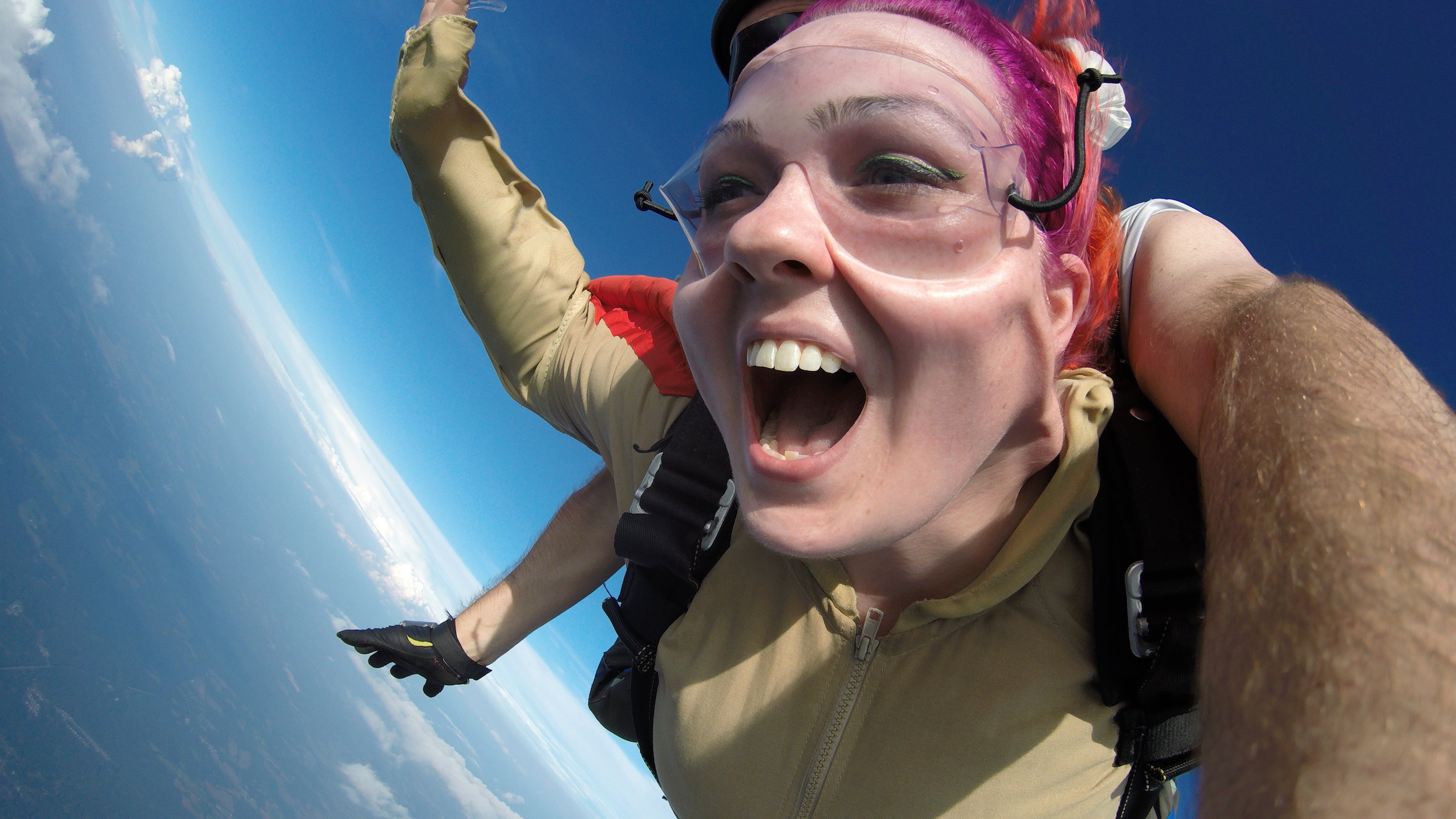
Have you ever watched a skydiving video and noticed how people’s cheeks are flapping in the wind, their mouths wide open, and wondered: can they even breathe up there? This is probably one of the most common questions people ask before their first jump, and honestly, it’s a completely reasonable concern. The idea of falling through the sky at over 100 miles per hour makes most people worry that the wind will be so strong that breathing becomes impossible.
Let me tell you about my friend Sarah. She postponed her first skydive three times because she was convinced she wouldn’t be able to breathe during freefall. She had nightmares about gasping for air while plummeting toward the earth. When she finally worked up the courage to jump, the first thing she told me when she landed was laughing: “I could breathe the entire time! I was so worried about nothing!” Her experience is exactly what millions of first-time skydivers discover every single year.
The truth about breathing during skydiving might surprise you. Not only can you breathe during freefall, but breathing is actually completely natural and easy once you understand what’s really happening up there. Your body doesn’t require any special techniques or superhuman lung capacity. You simply breathe, just like you’re breathing right now while reading this article.
In this comprehensive guide, I’m going to answer every question you have about breathing during skydiving. We’ll explore the science behind why you can breathe at terminal velocity, what it actually feels like, common concerns people have, and tips to make your breathing even easier during your first jump. By the end of this article, you’ll understand exactly why breathing during skydiving is one thing you absolutely don’t need to worry about.
Understanding the Science: Why You Can Breathe During Freefall
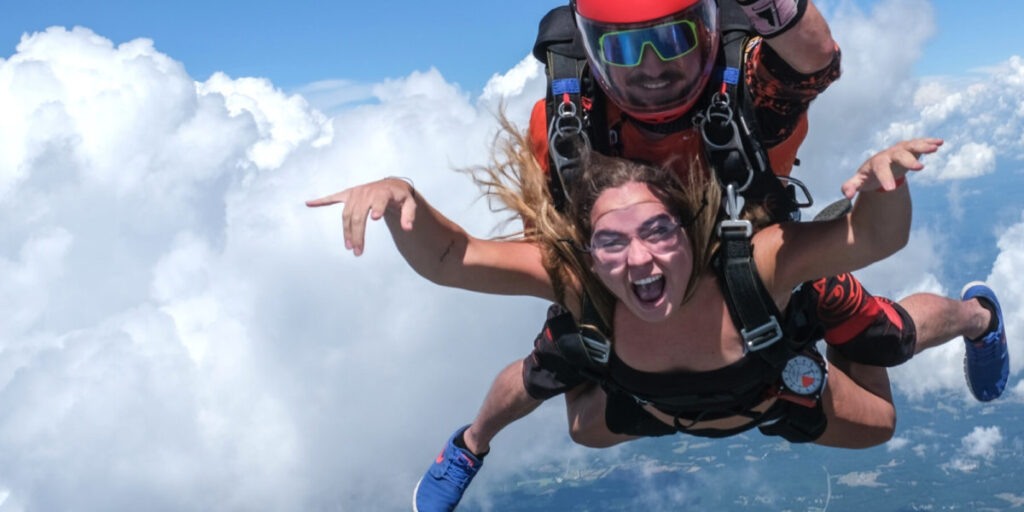
Before we dive into the personal experience of breathing while skydiving, let’s talk about the science that makes it possible. Understanding the physics behind freefall breathing will help eliminate your concerns and replace them with confidence.
When you exit an aircraft at typical skydiving altitude, which is usually between 10,000 and 14,000 feet, you begin accelerating toward the earth due to gravity. However, you don’t just keep getting faster and faster forever. Within the first 10 to 12 seconds of freefall, you reach what’s called terminal velocity. This is the speed at which the air resistance pushing against your body equals the force of gravity pulling you down.
For a skydiver in the standard belly-to-earth position, terminal velocity is approximately 120 miles per hour or about 53 meters per second. This sounds incredibly fast, and it is when compared to everyday experiences. But here’s the critical point that most people don’t understand: at terminal velocity, you’re not accelerating anymore. You’re falling at a constant speed.
This constant speed is what makes breathing possible and actually quite comfortable. Think about riding in a convertible car with the top down on the highway. When you’re cruising at a steady 60 or 70 miles per hour, you can breathe normally even though wind is rushing past your face. The same principle applies during skydiving, just at a higher speed.
The air around you during freefall is not a vacuum. You’re falling through a thick atmosphere that contains plenty of oxygen. At 10,000 to 14,000 feet of altitude, the air is slightly thinner than at sea level, but there’s still more than enough oxygen for your body to function normally. In fact, the oxygen levels at these altitudes are similar to what you’d experience in many mountain cities like Denver, Colorado, where millions of people live and breathe without any difficulty.
Your lungs work on a simple pressure differential system. When you inhale, your diaphragm moves down and your chest expands, creating lower pressure inside your lungs compared to the outside air. Air naturally flows from areas of higher pressure to lower pressure, so atmospheric air rushes into your lungs. During freefall, this process works exactly the same way it does on the ground.
The wind you feel during freefall is called relative wind. It’s the air moving relative to your body as you fall through it. While this wind feels strong and creates that incredible sensation of flying, it doesn’t prevent air from entering your lungs when you inhale. Your nose and mouth create openings that allow air to flow in, just like they do when you’re standing on the ground on a windy day.
Some people worry that the wind will force too much air into their lungs or make breathing difficult. In reality, your body’s natural breathing reflexes handle the situation automatically. You don’t need to think about breathing any more than you do during your normal daily activities. Your brain and body know exactly what to do.
The temperature at altitude is cooler than on the ground, typically around 30 to 40 degrees Fahrenheit colder depending on the season and location. However, this doesn’t affect your ability to breathe. You might feel the cool air entering your lungs, which some people find invigorating and others find initially surprising, but it doesn’t impair your respiratory function in any way.
What Breathing During Skydiving Actually Feels Like
Now that we’ve covered the science, let’s talk about what breathing during a skydive actually feels like based on the experiences of millions of jumpers. Understanding the sensations you’ll encounter helps prepare you mentally and ensures you won’t be caught off guard by unexpected feelings.
The moment you exit the aircraft is the most intense part of the entire experience. Your brain is processing an overwhelming amount of new sensations all at once. The rush of wind hits you immediately, your body accelerates rapidly, and the visual perspective shifts dramatically. In this moment, many first-time jumpers hold their breath without even realizing it.
This breath-holding is a natural stress response. When humans encounter something new and potentially frightening, we instinctively tense up, and that often includes holding our breath. The good news is that this instinct passes quickly, usually within the first few seconds of freefall. Your body quickly realizes it needs oxygen and reminds you to breathe.
Most people describe their first intentional breath during freefall as a moment of revelation. The realization that “oh wow, I can actually breathe normally” often triggers a sense of relief and excitement. Some jumpers even laugh out loud during this moment, which is both breathing and vocalization happening simultaneously at 120 miles per hour.
The air entering your nose and mouth during freefall has a distinctive feeling. It’s forceful and constant, almost like standing in front of a powerful fan, but it’s not uncomfortable or painful. Many skydivers compare it to sticking your head out of a car window on the highway, except more intense and coming from below you rather than straight on.
Your mouth tends to naturally open during freefall due to the force of the wind. This is completely normal and you’ll see it in nearly every skydiving photo or video. Some people feel self-conscious about their faces looking distorted in freefall photos, with cheeks flapping and mouths wide open. But this is simply the wind interacting with your facial muscles, and it happens to everyone, even experienced skydivers with thousands of jumps.
Breathing through your nose is definitely possible during freefall, and some experienced jumpers prefer it because it feels more natural to them. However, most people find breathing through their mouth easier and more comfortable during their first few jumps. The larger opening allows for easier airflow, and you don’t have to think about it as much. As you gain experience, you’ll naturally find the breathing pattern that works best for you.
The sound environment during freefall also affects your perception of breathing. The wind creates a loud rushing noise that fills your ears throughout the experience. This sound is constant and can be quite loud, similar to standing next to a waterfall or next to a highway with heavy traffic. Some people find this noise overwhelming at first, but most adapt to it quickly and even find it exhilarating.
Interestingly, you can talk during freefall, though your tandem instructor or anyone nearby won’t be able to hear you over the wind noise. Some people shout or scream during their first jump as a way to release excitement or nervousness. This vocalization requires breathing, and it happens naturally without any special effort or technique.
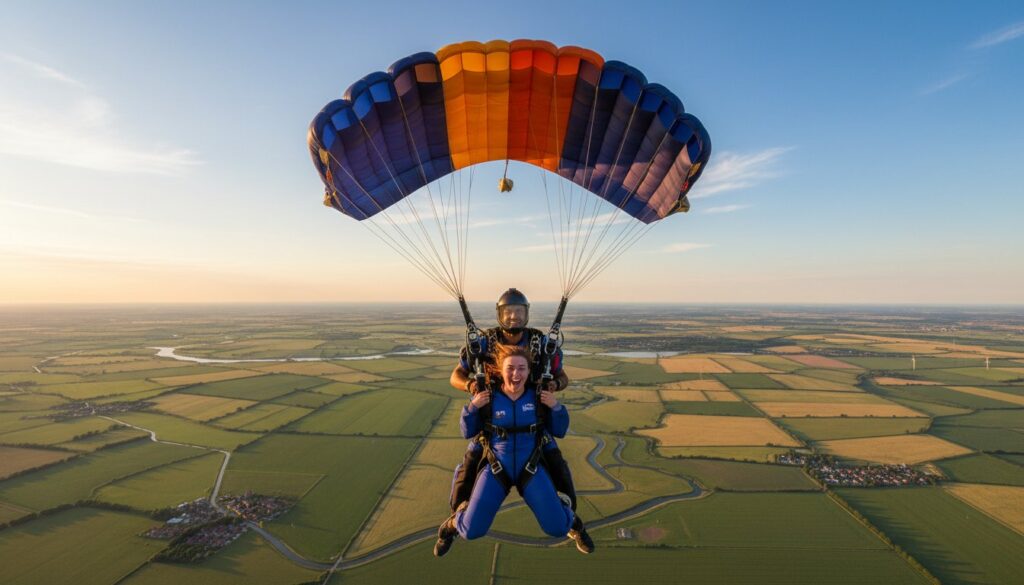
As the parachute deploys and your descent slows dramatically, the sensation of breathing changes completely. The rushing wind stops, everything becomes quiet, and breathing returns to the exact same feeling you have on the ground. This transition is quite dramatic and helps you realize just how much the wind affected your sensory experience during freefall.
Many people report feeling slightly out of breath immediately after the parachute opens, not because they couldn’t breathe during freefall, but because the adrenaline and excitement caused them to breathe more rapidly than normal. This is similar to the breathlessness you might feel after riding a roller coaster or during any exciting activity. It passes quickly, and within a minute or two under the open parachute, your breathing returns to a normal resting rate.
Common Breathing Concerns and Myths Debunked
Over the years, several myths and misconceptions about breathing during skydiving have persisted, causing unnecessary anxiety for people considering their first jump. Let’s address these concerns directly with factual information based on actual skydiving experiences and expert knowledge.
One of the most common myths is that the wind will be so strong that it will force air out of your lungs faster than you can breathe in. This simply isn’t true. While the wind is definitely noticeable and creates a strong sensation, it doesn’t overpower your body’s ability to control breathing. Your diaphragm is a powerful muscle specifically designed to manage airflow in and out of your lungs, and it handles the freefall environment without any problems.
Another misconception is that you’ll hyperventilate during the jump and pass out from too much oxygen. While hyperventilation is theoretically possible if you consciously breathe extremely rapidly and deeply for an extended period, it doesn’t happen naturally during skydiving. The excitement and adrenaline might cause you to breathe faster than your resting rate, but not to the point of hyperventilation. Your body’s natural regulatory systems keep your breathing within normal ranges.
Some people worry that the cold air at altitude will hurt their lungs or make breathing painful. While the air is certainly cooler than ground level, it’s not dangerously cold, and your respiratory system is perfectly capable of warming the air as it enters your body. People ski, snowboard, and participate in winter sports in much colder temperatures without any issues. The brief exposure to cooler air during a skydive poses no risk to your lungs.
There’s also a persistent myth that people with asthma or other respiratory conditions absolutely cannot skydive. While it’s true that certain medical conditions require careful consideration and medical clearance before jumping, many people with well-controlled asthma have successfully completed skydives without breathing difficulties. The key is honest communication with your doctor and the dropzone staff about your specific situation. Never hide a medical condition when booking a skydive, as this information helps instructors keep you safe.
Some first-timers worry that forgetting to breathe during the jump could cause them to pass out. This concern stems from not understanding how breathing works. Breathing is an automatic function controlled by your brainstem, similar to your heartbeat. Even if you’re not consciously thinking about breathing, your body will continue to breathe on its own. The only way to truly stop breathing would be to consciously hold your breath for an extended period, and even then, you’d eventually lose consciousness and your body would resume breathing automatically.
Another common question is whether breathing is harder at the altitude where you exit the aircraft compared to freefall. The answer is that breathing at altitude before you jump might feel slightly different because the air is thinner, but the difference is minimal at typical skydiving altitudes. During the plane ride to jump altitude, you might notice slightly heavier breathing similar to what you’d experience at a high-altitude hiking location. However, this is much less noticeable than the sensation of wind during freefall.
People sometimes ask if the g-forces during skydiving make breathing difficult. Unlike high-performance aerobatic flights or rocket launches, skydiving involves very minimal g-forces. The acceleration phase at the beginning of freefall is brief, and terminal velocity itself involves zero g-forces because you’re moving at constant speed. The parachute deployment creates a brief upward force, but it’s not strong enough to affect breathing. Modern parachute systems are designed to open smoothly, making the transition comfortable.
Tips for Easier Breathing During Your First Skydive
While breathing during skydiving is natural and doesn’t require special training, there are several tips that can help you feel more comfortable and confident during your first jump. These strategies come from experienced instructors who have trained thousands of first-time jumpers.
Before your jump, during the training session that every first-time skydiver receives, pay close attention when your instructor discusses body position and breathing. They’ll typically mention that breathing normally is important and that you should avoid holding your breath. Take this advice seriously and make a mental note to remind yourself to breathe once you’re in freefall.
During the plane ride to altitude, practice calm, steady breathing. The minutes before your jump can be nerve-wracking, and anxiety often leads to rapid, shallow breathing. By consciously maintaining slow, deep breaths during the ascent, you’ll arrive at exit altitude in a calmer state. This makes it easier to continue breathing normally once you jump.
Right before you exit the aircraft, take one deep breath and then let it out slowly. This serves two purposes: it ensures you start freefall with fresh oxygen in your lungs, and it helps calm your nervous system. Many instructors recommend this technique, and it’s similar to the breathing exercises used in meditation and stress management.
As soon as you exit the aircraft, consciously remind yourself to breathe. Make it a mental cue: “exit, arch, breathe.” This simple reminder helps override the natural instinct to hold your breath during the initial shock of freefall. Within a few seconds, breathing will become automatic again, but that initial conscious reminder is helpful.
If you find yourself feeling breathless or like you’re not getting enough air during freefall, open your mouth wider. This might sound too simple to be effective, but it genuinely helps. A larger opening allows more airflow, and it works with the natural force of the wind rather than against it. This is why you see so many skydivers with wide-open mouths in freefall photos.
Try to relax your facial muscles and jaw during freefall. Tension in your face can make breathing feel more difficult than it actually is. Let the wind do its thing with your cheeks and mouth. Fighting against the wind by trying to keep your mouth closed or your face rigid only creates unnecessary muscle tension and can make you feel more breathless.
Focus on the incredible view and experience rather than on your breathing. When you consciously obsess about whether you’re breathing correctly, you can actually make breathing feel more difficult through anxiety. Trust that your body knows how to breathe, and instead direct your attention to the amazing sensation of flight and the spectacular views spreading out below you.
If you’re particularly nervous about breathing, consider scheduling your jump earlier in the day when you’re less likely to have worked yourself into an anxiety spiral. Some people find that overthinking a skydive for hours beforehand increases their nervousness, while jumping relatively soon after arriving at the dropzone gives anxiety less time to build.
Communicate with your tandem instructor before the jump about your concerns regarding breathing. They’ve heard this worry hundreds of times before and can provide reassurance and specific guidance. During freefall, your instructor is right there with you and can help if you seem to be having any difficulties, though in reality, breathing issues during tandem jumps are extremely rare.
After your jump, regardless of how you felt about breathing during the experience, most people find it helpful to reflect on what actually happened versus what they worried might happen. This reflection helps solidify the understanding that breathing is not a real obstacle to enjoying skydiving. If you decide to jump again, you’ll approach the experience with much less anxiety about this particular aspect.
The Physical Reality: Altitude and Air Pressure Explained
To fully understand breathing during skydiving, it helps to know a bit more about how altitude affects air pressure and oxygen availability. This knowledge can eliminate the mystery and replace worry with understanding.
At sea level, atmospheric pressure is approximately 14.7 pounds per square inch. This pressure decreases as you gain altitude because there’s less air above you pressing down. At 10,000 feet, which is a common skydiving exit altitude, the atmospheric pressure is about 10.1 pounds per square inch. At 14,000 feet, it’s around 8.8 pounds per square inch.
This decrease in pressure means the air is less dense at altitude, which in turn means there are fewer oxygen molecules in a given volume of air compared to sea level. However, the decrease is not dramatic enough at skydiving altitudes to cause significant breathing difficulties for healthy individuals. The oxygen concentration in the air remains at about 21 percent regardless of altitude. It’s the density that changes, not the proportion.
Commercial airplane cabins are typically pressurized to the equivalent of about 6,000 to 8,000 feet of altitude. This means that every time you fly commercially, you’re already experiencing reduced air density similar to or even greater than what you’ll encounter during the brief time you’re at altitude before jumping. If you can breathe normally on a commercial flight, you can definitely breathe during the airplane ride to skydiving altitude.
The human body is remarkably adaptable to moderate altitude changes. Healthy individuals can function normally up to about 10,000 feet without any acclimatization period. Some people might notice they breathe slightly more frequently or deeply to compensate for the thinner air, but this adjustment happens automatically without conscious effort.
Mountain climbers who ascend to extreme altitudes like Mount Everest need supplemental oxygen because at those heights, there simply aren’t enough oxygen molecules in each breath to sustain normal body functions. However, Mount Everest’s summit sits at 29,029 feet, more than double the highest altitude you’ll experience during a typical skydive. The altitudes involved in skydiving are nowhere near the danger zone for oxygen deprivation.
During your brief time at altitude in the aircraft before jumping, you might notice some physiological changes. Your ears might pop as they equalize pressure, similar to what happens during an airplane flight. You might feel your breathing rate increase slightly. These are normal adaptations and don’t indicate any problem or danger.
The entire time you spend at altitude during a skydiving experience is quite brief, usually only 15 to 20 minutes from takeoff to jump. This short duration means your body doesn’t need to make significant adaptations to the altitude. You’re not spending hours or days at elevation like mountaineers or residents of high-altitude cities.
Once you exit the aircraft and begin descending during freefall, you’re actually moving back toward thicker air and higher oxygen density with every passing second. Freefall typically lasts 40 to 60 seconds, during which time you fall about 5,000 to 7,000 feet. This means you’re constantly moving into air that’s becoming easier to breathe, though the change is so gradual you won’t notice it during the excitement of freefall.
After the parachute opens, your descent slows dramatically, but you continue moving downward through progressively denser air. By the time you land, you’re back at whatever altitude the landing area sits at, which is often close to sea level. The entire altitude cycle during a skydive involves going up, spending a brief time at altitude, then coming back down, all within a span of about 30 to 40 minutes total.
People who live at high altitude or who have recently spent time at elevation might actually find breathing at skydiving altitudes easier than sea-level residents because their bodies have already adapted to thinner air. However, even sea-level residents experience no significant difficulty during the brief time at altitude during a skydive.
Real Experiences: What First-Time Jumpers Say About Breathing
Hearing from people who have actually completed their first skydive provides valuable perspective and reassurance. The overwhelming consensus among first-time jumpers is that breathing was much easier than they expected and became a complete non-issue within seconds of exiting the aircraft.
One common theme in first-timer accounts is the surprise at how normal breathing felt once they got past the initial shock of exit. Many people report that they were so worried about breathing beforehand, but once they were actually in freefall, they realized they were breathing without even thinking about it. The body’s automatic systems took over, and breathing happened naturally.
Some jumpers describe a moment of panic or confusion during the first few seconds after exit, during which they held their breath without realizing it. This breath-holding typically lasts only a second or two before the body’s need for oxygen takes over and breathing resumes. By the time most people reach terminal velocity, about 10 to 12 seconds into freefall, they’re breathing normally and often don’t even remember that brief moment of held breath.
First-timers frequently mention that their tandem instructor’s presence helped them stay calm about breathing. Knowing that an experienced professional was attached to them and monitoring the situation provided reassurance. Some instructors tap their students’ shoulders or make hand signals during freefall to remind them to keep breathing and stay relaxed, which many first-timers find helpful.
The sensation of wind on their face is something almost every first-time jumper mentions. While they expected the wind to prevent breathing, they discovered it was more of a sensory experience than an actual obstacle. The wind certainly feels strong and creates an intense sensation, but it doesn’t interfere with the mechanical process of breathing. Many people describe it as feeling like they’re floating on a cushion of air rather than fighting against a hostile force.
Interestingly, several first-time jumpers report that they found breathing easier during freefall than they did during the anxious minutes before the jump. The anticipation and nervousness while waiting to jump can cause rapid, shallow breathing that feels uncomfortable. Once in freefall, the concentration required for the experience and the sheer amazement of the sensation often cause breathing to regulate naturally.
Photography and video from first jumps consistently show people with wide-open mouths, sometimes appearing to be screaming or gasping. However, when these same jumpers review their videos afterward, they often don’t remember feeling breathless or struggling for air. The open mouth is simply the natural position faces take in strong wind, not an indication of breathing difficulty.
Parents who have watched their adult children skydive often express surprise at how calm and controlled the descent looks on video, especially regarding breathing. The footage shows people falling smoothly through the sky, clearly able to wave at the camera, give thumbs up, and even smile, all of which require normal breathing and muscle control. This visual evidence helps reassure future jumpers that breathing really isn’t a problem.
Some experienced jumpers who remember their first jumps years ago mention that breathing concerns didn’t even occur to them until after the jump was over. They were so overwhelmed by the entire experience, so focused on following their instructor’s guidance and taking in the incredible views, that breathing just happened automatically in the background without requiring any conscious thought.
For those who struggled with severe anxiety before their first jump, many report that the breathing reality was the first major relief during the experience. Within seconds of realizing “I can breathe normally!” a significant portion of their fear evaporated, allowing them to actually enjoy the rest of the freefall. This moment of realization often transforms the experience from terrifying to exhilarating.
Athletes and people who participate in other extreme sports sometimes compare skydiving breathing to their other activities. Surfers note it’s easier to breathe during freefall than when getting pummeled by waves. Runners mention that breathing during a skydive feels effortless compared to breathing during a challenging sprint. These comparisons help put the breathing aspect of skydiving into perspective.
Medical Considerations and When to Seek Advice
While the vast majority of people can breathe normally during skydiving without any issues, certain medical conditions warrant special consideration. Being informed about these conditions and communicating openly with medical professionals and dropzone staff ensures everyone’s safety.
If you have a diagnosed respiratory condition such as asthma, chronic obstructive pulmonary disease, emphysema, or any other lung disease, you should consult your doctor before booking a skydive. Many people with well-controlled asthma have successfully completed tandem jumps without incident, but your specific situation needs professional evaluation. Your doctor can assess whether your condition is stable enough and whether the altitude and physical exertion involved in skydiving present any risks for you specifically.
Cardiovascular conditions also deserve attention because skydiving is physically and emotionally demanding. The excitement and adrenaline can cause your heart rate and blood pressure to spike temporarily. If you have heart disease, high blood pressure, or a history of heart problems, medical clearance is essential before attempting a skydive. Your cardiologist can determine whether your heart can handle the stress of the experience.
Recent surgeries, particularly those involving the chest, lungs, or abdomen, may temporarily disqualify you from skydiving. Surgical sites need adequate time to heal, and the physical forces involved in skydiving could potentially compromise healing tissue. Always discuss recent surgeries with both your surgeon and the dropzone staff. They can advise on appropriate waiting periods before it’s safe to jump.
Certain medications can affect your ability to safely skydive. Medications that cause drowsiness, affect balance, or impair judgment might make skydiving unsafe. If you take any prescription medications, disclose this information to the dropzone when booking your jump. They can advise whether your specific medications present any concerns, or they might request medical clearance from your doctor.
Pregnancy is an absolute contraindication for skydiving at all reputable dropzones. The forces involved during parachute deployment and landing, while not extreme, could potentially pose risks to a developing fetus. If there’s any possibility you might be pregnant, postpone your skydive until after delivery and after your doctor clears you to resume normal physical activities.
Ear and sinus conditions can make the pressure changes during ascent and descent uncomfortable or even painful. If you have a current sinus infection, ear infection, or any condition affecting your ability to equalize pressure in your ears, postpone your jump until the condition has resolved. Attempting to skydive with congested sinuses or blocked ears can result in severe pain and potential injury to your eardrums.
Age itself isn’t necessarily a disqualifying factor, but certain age-related conditions might be. Older adults considering skydiving should discuss the activity with their doctors, particularly if they have any chronic conditions or take multiple medications. Many people in their 70s, 80s, and even 90s have successfully completed tandem skydives, so age alone doesn’t prevent participation, but medical fitness does matter.
Mental health conditions deserve consideration as well. The intense stress and fear associated with skydiving could potentially trigger panic attacks or exacerbate certain anxiety disorders. If you have a diagnosed anxiety disorder, PTSD, or other mental health condition, think carefully about whether skydiving is right for you. Some people find that conquering the fear of skydiving actually helps with their anxiety, while others find it overwhelming. Consider your own mental health history and discuss concerns with your therapist if you have one.
Neurological conditions that affect muscle control, balance, or consciousness require careful evaluation. Conditions like epilepsy could potentially cause seizures during the stress of skydiving, which would be extremely dangerous at altitude. Discuss any neurological conditions with your doctor before considering a skydive.
The most important thing is honesty. Never hide medical conditions from dropzone staff, even if you’re worried they might prevent you from jumping. The waiver forms you sign before skydiving ask detailed questions about medical history for good reason. Dropzones need accurate information to keep everyone safe. In many cases, conditions that seem like they might disqualify you actually don’t, but staff need to know about them to make informed decisions.
If medical clearance is required, your doctor will typically provide a letter stating that you’re fit to participate in skydiving. This letter should be dated close to your jump date and should specifically mention skydiving, not just “physical activity.” Bring this documentation with you to the dropzone on jump day.
Remember that dropzone staff err on the side of caution with medical concerns. If they seem overly cautious or ask many questions about your health, it’s because they genuinely care about your safety. Their goal is not to prevent you from jumping but to ensure that everyone who does jump does so safely. Understanding the safety statistics and what actually happens during skydiving, which you can learn more about in our guide about skydiving deaths per year worldwide, can help put these safety measures in proper perspective.
Comparing Breathing During Skydiving to Other Activities
Sometimes the best way to understand what breathing during skydiving feels like is to compare it to other activities you might already be familiar with. These comparisons can help contextualize the experience and make it feel less foreign and frightening.
The most common comparison people make is to sticking your head out of a car window while driving on the highway. If you’ve ever done this, you know that the wind hits your face forcefully and creates a rushing sensation, but you can still breathe normally. Skydiving is similar, just more intense. The wind is stronger, coming from more directions, but the fundamental ability to breathe remains the same.
Riding a motorcycle at highway speeds without a full-face helmet provides another useful comparison. Motorcyclists regularly breathe normally while wind rushes past their faces at 60, 70, or even 80 miles per hour. While skydiving involves higher speeds, the principle is identical. The wind doesn’t prevent your lungs from functioning; it just creates a strong sensory experience around your face.
Swimming, particularly when doing strokes like butterfly or freestyle, requires coordinated breathing in challenging conditions. When your face is in the water or turning to catch a breath, you’re working against resistance and timing your breathing carefully. Many swimmers find that breathing during skydiving is actually easier than breathing during intense swimming because in freefall, air is constantly available and you don’t need to time your breaths around strokes.
Roller coasters, especially those with steep drops, create intense sensations and sometimes cause that stomach-dropping feeling that can temporarily affect breathing. However, even the most intense roller coaster doesn’t prevent breathing for more than a second or two. Skydiving is similar but actually more comfortable for many people because you’re moving at a constant speed after the first few seconds, unlike a roller coaster that’s constantly changing speed and direction.
Hiking at high altitude requires more effort to breathe than skydiving at the same altitude because during hiking, you’re exerting yourself physically. During a tandem skydive, you’re relatively passive, with your instructor controlling the jump while you simply enjoy the ride. The physical demands are minimal, making breathing easier than during many strenuous ground-level activities.
Scuba diving requires controlled breathing through a regulator in an alien environment underwater. Skydivers often note that breathing during freefall is far more natural and easier than breathing underwater because you’re still breathing regular air through your nose and mouth rather than through specialized equipment. The sensation is more familiar even though the overall environment is extraordinary.
Running, particularly sprinting or running at high intensity, demands rapid breathing to supply oxygen to working muscles. During a tandem skydive, you’re not exerting yourself physically the way you do during running, so your oxygen demands are more like resting levels than exercise levels. This makes breathing feel easy despite the dramatic environment.
Public speaking or performing in front of crowds can cause nervous breathing patterns, rapid heartbeat, and the feeling of breathlessness from anxiety. While skydiving certainly triggers nervousness, many people find that once they’re actually in freefall, their breathing regulates more easily than during a stressful public speaking situation because the physical act of breathing isn’t impaired, just the emotional state affecting it.
Snorkeling near the water’s surface requires breathing through a tube, which adds slight resistance and requires conscious awareness. Skydiving requires no equipment in your mouth or nose, no special breathing techniques, and no conscious effort. You simply breathe normally, making it more natural than many water sports despite appearing more extreme.
Understanding through these comparisons helps demystify skydiving breathing. It’s not about learning a special skill or developing unusual lung capacity. It’s simply about breathing in an unusual environment, and your body is perfectly capable of handling the task. Many people who enjoy adventure sports find that once they understand the reality, concerns about breathing drop dramatically on their list of worries. If you’re still curious about the overall safety of skydiving, our comprehensive article on car vs skydiving death statistics risk comparison provides detailed information that might further ease your concerns.
Frequently Asked Questions About Can you breathe during skydiving
Can you really breathe normally during freefall?
Yes, you can breathe completely normally during freefall. Once you reach terminal velocity, which happens within the first 10 to 12 seconds after exiting the aircraft, the airflow around your body stabilizes and breathing becomes natural and effortless. Your lungs function the same way they do on the ground, and there’s plenty of oxygen available in the air around you. Millions of people skydive every year, and breathing is not an issue for the vast majority of them.
Will I hyperventilate or run out of air during skydiving?
No, hyperventilation during skydiving is extremely rare. While excitement and adrenaline might cause you to breathe faster than your normal resting rate, your body’s natural regulatory systems prevent true hyperventilation. You won’t run out of air because you’re falling through the atmosphere, which contains abundant oxygen. The air at skydiving altitudes has slightly lower density than sea level, but there’s more than enough oxygen for normal breathing throughout the entire experience.
What if I forget to breathe during the jump?
Breathing is an automatic function controlled by your brainstem, so even if you’re not consciously thinking about it, your body will continue breathing on its own. Many people do hold their breath for a second or two immediately after exiting the aircraft due to the shock and excitement, but your body’s need for oxygen quickly takes over and breathing resumes automatically. You cannot forget to breathe for long enough to cause any problems.
Does the wind force air into your lungs?
The wind doesn’t force air into your lungs against your will. Your diaphragm controls breathing by creating pressure differentials that draw air in when you inhale and push air out when you exhale. The wind you feel during freefall creates a strong sensation on your face and body, but it doesn’t override your body’s natural breathing control. You breathe the same way you do on a windy day at ground level, just with stronger wind.
Is breathing harder at the altitude before you jump?
At typical skydiving altitudes of 10,000 to 14,000 feet, the air is slightly thinner than at sea level, which means it contains fewer oxygen molecules per breath. However, this difference is minimal and similar to the air pressure in commercial airplane cabins or mountain cities like Denver. Most healthy people don’t notice any significant difference in breathing at these altitudes, and any minor increase in breathing rate happens automatically without conscious effort.
Can people with asthma go skydiving?
Many people with well-controlled asthma have successfully completed tandem skydives. However, anyone with asthma should consult their doctor before booking a jump to ensure their condition is stable and that skydiving won’t pose specific risks in their case. Factors like medication effectiveness, recent attacks, and overall asthma severity all play a role in determining whether skydiving is safe for someone with this condition. Always be honest with both your doctor and the dropzone about respiratory conditions.
Will the cold air at altitude hurt my lungs?
No, the cold air at altitude won’t hurt your lungs. While the air is definitely cooler than ground level, typically 30 to 40 degrees Fahrenheit colder, your respiratory system naturally warms the air as it enters your body. People participate in winter sports and outdoor activities in much colder temperatures without lung damage. The brief exposure to cooler air during a skydive poses no risk to your respiratory system.
Do you breathe differently under the parachute than during freefall?
Yes, breathing feels completely different once the parachute deploys compared to during freefall. During freefall, you feel the constant rush of wind, whereas under the open parachute, everything becomes quiet and calm. Breathing under the canopy feels exactly like breathing on the ground because you’re descending slowly and there’s no significant wind resistance. Many jumpers find the transition from freefall to canopy flight to be dramatic, and the change in breathing sensation is part of that transition.
Taking the Leap With Confidence
Now you know the truth about breathing during skydiving. It’s not the obstacle you might have feared. Your body is perfectly designed to breathe at terminal velocity, and millions of people before you have discovered that breathing during freefall is natural, easy, and completely manageable.
The concern about breathing is understandable. When you’re contemplating jumping out of a perfectly good airplane, your brain searches for every possible reason to back out, and breathing seems like a logical concern. But now you’re armed with facts, scientific explanations, real experiences, and comparisons that all point to the same conclusion: breathing during skydiving is a complete non-issue.
Think about Sarah, the friend I mentioned at the beginning of this article. She postponed her jump three times because of breathing worries that turned out to be unfounded. Don’t let the same fear rob you of an incredible experience. The moment you realize you can breathe normally during freefall is often the moment when fear transforms into pure exhilaration.
The instructors who will guide you through your first jump have trained thousands of people, many of whom had the exact same concerns you have right now. They know how to help you stay calm and focused. They’re experts at recognizing when someone is holding their breath and can provide reminders and reassurance. You won’t be alone up there, and you won’t be the first nervous person they’ve worked with.
Your body already knows how to breathe. It’s been doing it successfully every moment of your life without conscious thought. Skydiving doesn’t change this fundamental biological function. Trust your body to do what it was designed to do, and focus your mental energy on enjoying the incredible experience of human flight.
The views from 13,000 feet are spectacular. The sensation of freefall is unlike anything else you’ll ever experience. The feeling of accomplishment when you land safely is profound and lasting. These are the things you should be thinking about as you prepare for your jump, not worrying about a breathing difficulty that simply doesn’t exist.
Thousands of people will make their first skydive today, and tomorrow, and every day after. The vast majority of them will land safely with huge smiles on their faces, already talking about when they can jump again. Very few of them will mention breathing as anything other than a non-issue that turned out to be much easier than expected.
If you’re ready to experience the thrill of skydiving, start by finding a reputable dropzone near you. Look for facilities that are members of the United States Parachute Association, employ experienced instructors, and have strong safety records. Ask questions, voice your concerns including any about breathing, and trust that they’ll provide honest, helpful answers.
Book that jump. Face that fear. Discover that breathing during skydiving is easy, natural, and nothing to worry about. The sky is calling, and an adventure unlike any other is waiting for you. Your only regret will be not doing it sooner.
Visit our complete guide at Skydive Guides for more information about preparing for your first jump, understanding safety procedures, and discovering the best locations to experience the thrill of skydiving. The journey from nervous first-timer to confident skydiver starts with taking that first step, and now you know that breathing won’t stand in your way.